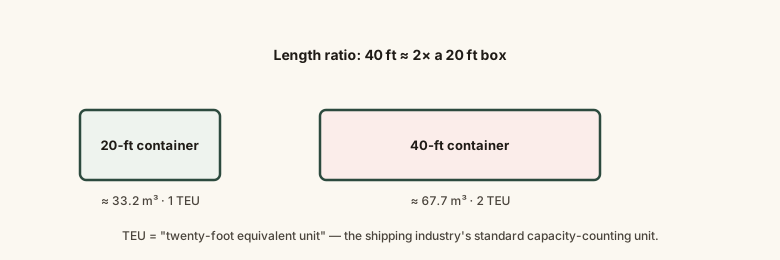
The global shipping industry standardizes cargo volume around the ISO container, counted in TEUs (twenty-foot equivalent units) — a 20-foot container holds about 33.2 cubic meters and counts as 1 TEU, while a 40-foot container holds about 67.7 cubic meters and counts as 2 TEU, letting ports and ships measure capacity in one consistent unit regardless of what's actually inside each box.
Reading time
— 4 min
Updated
— Aug 21, 2026
Fact-reviewed
— Aug 21, 2026
Key Takeaways
Key Takeaways
1Global shipping is built around one standardized box, the ISO container, so that ports, ships, trucks, and cranes anywhere in the world can handle any container the same way.
2Container capacity is counted in TEUs (twenty-foot equivalent units) — a standard 20-foot container is 1 TEU (≈33.2 m³ internal volume), and a 40-foot container is 2 TEU (≈67.7 m³).
3Finding a rectangular volume — a container's internal capacity, or how many boxes fit inside it — is the same length × width × height formula used for any rectangular prism, just applied at industrial scale.
The concept
Nearly all ocean freight moves in one standardized steel box, the ISO container, built to fixed dimensions so it stacks and locks the same way on any ship, truck chassis, or rail car anywhere on Earth. The industry measures how much cargo capacity a ship, port, or shipment represents using a single unit, the TEU, based on the volume of the smaller standard container size.
Once you know the standard box's own volume, most practical container-loading questions reduce to the same length × width × height arithmetic used for any rectangular space.
Quick check
A shipping line reports a vessel's capacity as '20,000 TEU.' What does that actually tell you?
Worked examples
Example 1: Calculating a 20-foot container's internal volume (baseline case)
Using standard internal dimensions of roughly 5.9 m × 2.35 m × 2.39 m: 5.9 × 2.35 × 2.39 ≈ 33.14 cubic meters — matching the commonly cited "≈33.2 m³" figure for 1 TEU, with small rounding differences depending on the exact manufacturer's internal wall thickness.
Example 2: Why a 40-foot container isn't exactly double the 20-foot container's volume (edge case / variation)
A 40-foot container's internal dimensions are roughly 12.03 m × 2.35 m × 2.39 m, giving 12.03 × 2.35 × 2.39 ≈ 67.6 cubic meters. Doubling the 20-foot figure would suggest 33.14 × 2 ≈ 66.28 m³ — close, but not identical, because the 40-foot container's length isn't exactly double the 20-foot container's length once internal wall structure is accounted for (39' 5.75" vs. 19' 4.25" internal length, not a clean 2:1 external-to-internal ratio). The industry still treats it as 2 TEU by convention for capacity counting, even though the true internal volumes aren't in a perfectly exact 2:1 ratio.
Quick check
Is a 40-foot shipping container's actual internal volume exactly double a 20-foot container's internal volume?
Example 3: Estimating how many standard boxes fit inside a 40-foot container (real-world / applied case)
A shipper is loading boxes measuring 1 m × 1 m × 1 m (1 cubic meter each) into a 40-foot container (≈67.6 m³ internal volume). A naive volume-only estimate suggests up to 67 boxes. In practice, real loading always falls short of the pure volume estimate because boxes are rectangular and the container's usable space isn't perfectly filled at every stacking layer (pallets, air gaps, and pack patterns leave real space unused) — professional logistics planning uses a realistic packing efficiency factor, often around 70-85% of raw volume, rather than the naive 100% figure, which is why real container load plans consistently fit noticeably fewer boxes than the raw division suggests.
How it works (visual)
20-foot container (1 TEU) vs 40-foot container (2 TEU), drawn to relative scale
The near-2:1 length ratio in the diagram is deliberate — it's what makes the TEU counting convention a genuinely useful shorthand rather than an arbitrary industry number.
Common mistakes
Common Mistakes
✕
Treating a ship's TEU rating as a literal count of physical containers.
→ Remember TEU is a volume-equivalent unit — a 40-foot container alone counts as 2 TEU, so the physical box count can be well below the TEU figure.
✕
Estimating how many boxes fit in a container using raw volume division with no packing efficiency factor.
→ Apply a realistic packing efficiency (commonly 70-85% of raw volume) rather than assuming a container fills perfectly.
✕
Assuming a 40-foot container is exactly double a 20-foot container's internal volume.
→ Use the actual published internal dimensions — the ratio is very close to 2:1 but not perfectly exact.
Common misconception
“TEU is just a fancy industry name for 'one shipping container' — a 10,000 TEU ship carries 10,000 boxes.”
TEU (twenty-foot equivalent unit) is a capacity-counting unit based on volume-equivalence, not a count of physical boxes. Since a standard 40-foot container counts as 2 TEU, a ship rated for 10,000 TEU could be carrying anywhere from 5,000 (if all containers are 40-foot) up to nearly 10,000 physical boxes (if all are 20-foot), depending on the actual mix loaded.
Quick check
A logistics report says a port handled '2 million TEU' last year. What can you conclude about the number of physical containers handled?
Try it yourself
Calculate a rectangular container's internal volume
Internal volume (m³)33.14
What to do next
What to do next
Remember TEU counts volume-equivalent capacity, not literal boxes — a 40-foot container is 2 TEU.
Use length × width × height for any rectangular container or packaging volume estimate.
When estimating how many items fit in a container, apply a realistic packing efficiency factor rather than raw volume division.
Use the calculator above with a container or box's actual internal dimensions for a real volume estimate.
FAQ
FAQ
Related terms
Related terms
TEU
Twenty-foot equivalent unit — the standard unit for counting cargo container capacity, based on the volume of a 20-foot ISO shipping container (about 33.2 cubic meters).
ISO container
A standardized steel shipping container built to International Organization for Standardization dimensions, most commonly in 20-foot and 40-foot lengths, designed to stack and interlock identically on any compliant ship, truck, or rail car worldwide.
This entry was researched from public sources and drafted with AI-assisted tools, then edited — errors are still possible. Spot one, or want a topic covered? Read our disclaimer.
 KnowThis