 KnowThis
Key Takeaways
Key Takeaways
- 1Celsius-to-Fahrenheit conversion is not a pure multiplication — it's °F = (°C × 9/5) + 32, combining a scaling factor with a fixed offset.
- 2The 9/5 factor exists because a Fahrenheit degree is a smaller temperature interval than a Celsius degree — it takes 180 Fahrenheit degrees to span the same range as 100 Celsius degrees.
- 3The +32 offset exists because the two scales don't share a zero point: 0°C (water's freezing point) is 32°F, not 0°F.
The concept
Once the formula is internalized, applying it to real numbers — room temperature, oven settings, a weather forecast — is where it actually becomes useful.
A recipe calls for baking at 180°C, but your oven only shows Fahrenheit. Which calculation gets you the right dial setting?
Worked examples
Example 1: Converting room temperature (baseline case)
Example 2: Converting a sub-zero temperature (edge case / variation)
Example 3: Converting Fahrenheit back to Celsius (real-world / applied case)
Why does converting Fahrenheit to Celsius require subtracting 32 first, rather than multiplying by 5/9 first?
How it works (visual)
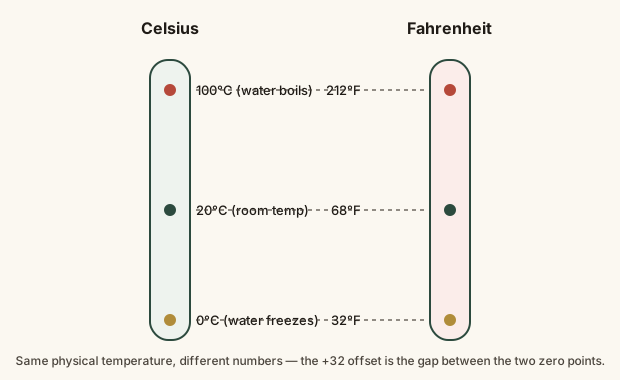
The dashed connecting lines are the whole point of this diagram: 0°C and 32°F sit at the same height because they represent the identical physical temperature, just labeled differently. The gap between the two scales' zero marks is exactly the +32 offset baked into the conversion formula.
Common mistakes
Common Mistakes
Multiplying by 1.8 but forgetting to add 32 (or vice versa when converting back).
→ Remember it's a two-step formula, not one: scale first, then shift. Sanity-check with 20°C = 68°F — if your answer isn't close to that pattern, you likely dropped a step.
Using 5/9 when converting Celsius to Fahrenheit, or 9/5 when converting Fahrenheit to Celsius (mixing up the direction).
→ Celsius-to-Fahrenheit multiplies by 9/5 (since Fahrenheit degrees are smaller, you need more of them); Fahrenheit-to-Celsius multiplies by 5/9 (the reciprocal) after subtracting 32 first.
Treating this like a standard multiply-by-a-factor conversion (as with length or weight).
→ Temperature is a genuine exception among common conversions — it needs an added or subtracted offset because the two scales' zero points don't match, unlike length, weight, or volume units.
Common misconception
“Celsius and Fahrenheit measure different things, which is why the conversion is more complicated than other unit conversions.”
Both scales measure the exact same physical quantity — temperature. The conversion is more complex only because the two scales assign different numbers to the same zero point and divide the same range into different-sized degree intervals, not because they're measuring anything different.
Which of these is the correct reason Celsius-to-Fahrenheit conversion needs both a multiplication and an addition?
Try it yourself
What to do next
What to do next
- Memorize one reference point — 20°C ≈ 68°F — and use it to sanity-check any conversion you calculate.
- Write out both steps every time (multiply, then add) rather than trying to do it in one mental leap, especially with negative temperatures.
- Use the calculator above to build intuition for how the two scales relate before relying on it for anything important.
- When converting Fahrenheit back to Celsius, remember the steps reverse in both operation and order: subtract 32 first, then multiply by 5/9.