 KnowThis
Key Takeaways
Key Takeaways
- 1Kelvin is anchored to absolute zero (0 K = −273.15°C), the coldest temperature physically possible, rather than an arbitrary reference point like water's freezing point.
- 2Converting Celsius to Kelvin is pure addition — K = °C + 273.15 — with no scaling factor needed, because a Kelvin and a Celsius degree are exactly the same size.
- 3Kelvin values are never written with a degree symbol (°) and are never negative, both direct consequences of the scale starting at an actual physical floor.
The concept
Kelvin shows up constantly in science contexts even though it rarely appears in everyday weather reports — understanding why helps make sense of both.
Why can a Kelvin temperature never be negative, while Celsius and Fahrenheit both can be?
Worked examples
Example 1: Converting room temperature to Kelvin (baseline case)
Example 2: Converting absolute zero itself (edge case / variation)
Example 3: Why scientific formulas require Kelvin, not Celsius (real-world / applied case)
A chemistry formula requires you to double the absolute temperature of a gas sample currently at 300 K. What temperature, in Celsius, does that correspond to?
How it works (visual)
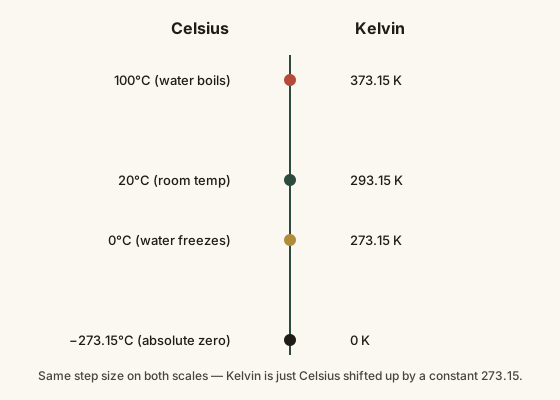
Because the two scales rise in lockstep — one Kelvin step equals one Celsius step — the diagram's tick marks line up perfectly across both columns, just shifted by a constant 273.15. That constant shift, with no rescaling, is the entire Celsius-to-Kelvin conversion.
Common mistakes
Common Mistakes
Writing Kelvin temperatures with a degree symbol (°K).
→ Kelvin values are written as plain numbers followed by "K" — e.g. 293 K, not 293°K. The unit itself already implies an absolute scale, so the degree symbol is dropped.
Treating a Celsius-to-Kelvin conversion like the Celsius-to-Fahrenheit one, and trying to apply a scaling factor.
→ Kelvin-Celsius conversion is addition only (K = °C + 273.15) — there's no multiplication step, since the two scales use identically sized degree intervals.
Doubling or halving a Celsius or Fahrenheit value and assuming that reflects a real doubling/halving of temperature.
→ Only Kelvin (or another absolute scale) supports meaningful ratio comparisons, because only it has a true zero. Convert to Kelvin first before doing any doubling/halving math.
Common misconception
“Kelvin is just Celsius with a different name, useful only for scientists showing off.”
Kelvin and Celsius use identically sized degree steps, but Kelvin's zero point is physically meaningful — the actual coldest possible temperature — while Celsius's zero is an arbitrary reference (water's freezing point). That difference is exactly why Kelvin, not Celsius, is required for any calculation involving a genuine ratio or ratio-based formula in physics and chemistry.
Which statement correctly distinguishes Kelvin from Celsius?
Try it yourself
What to do next
What to do next
- Memorize the conversion as pure addition: K = °C + 273.15, no multiplication involved.
- Remember Kelvin values are always positive (or zero) in classical physics — a negative Kelvin reading signals an error, not a valid cold temperature.
- When a formula involves doubling, halving, or any ratio of temperatures, convert to Kelvin first — doing that math directly in Celsius or Fahrenheit gives a wrong answer.
- Drop the degree symbol when writing Kelvin values — it's "293 K", not "293°K".