 KnowThis
Key Takeaways
Key Takeaways
- 1A watt is a unit of power — a rate — describing how fast electricity is used at a given moment, not a total amount of energy.
- 2A kilowatt-hour (kWh) is a unit of energy — power multiplied by time — and it's the actual quantity electric utilities bill for, not watts or kilowatts directly.
- 3To estimate an appliance's cost, convert its wattage to kilowatts, multiply by hours used, then multiply by your utility's price per kilowatt-hour.
The concept
Once the power-versus-energy distinction is clear, estimating what any single appliance actually costs to run becomes a straightforward three-step calculation.
A 2,000-watt appliance and a 200-watt appliance both run for exactly 1 hour. Which statement is correct?
Worked examples
Example 1: Estimating the cost of running a space heater (baseline case)
Example 2: Comparing a low-power device left on constantly (edge case / variation)
Example 3: Reading a real appliance label and estimating annual cost (real-world / applied case)
Why might a refrigerator's energy label report annual kilowatt-hours rather than just its wattage rating?
How it works (visual)
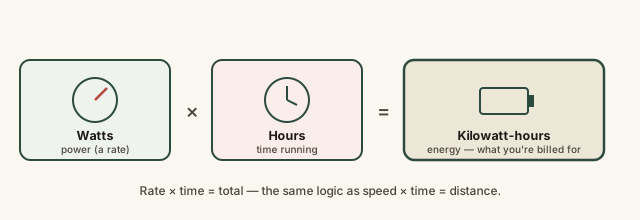
The speedometer-and-clock framing is deliberate: watts describe how fast energy is being used at any instant (like speed), while kilowatt-hours describe the total accumulated over time (like distance) — multiplying the rate by the duration is what turns one into the other.
Common mistakes
Common Mistakes
Thinking a higher-wattage appliance always costs more to run than a lower-wattage one.
→ Total cost depends on both wattage and how long the appliance runs — a low-wattage device left on for a very long time can use more total energy than a high-wattage device used briefly.
Forgetting to convert watts to kilowatts (divide by 1,000) before multiplying by hours to estimate kWh.
→ Electricity is billed in kilowatt-hours, not watt-hours — always divide the wattage by 1,000 first, or use kilowatts directly if the appliance label already provides them.
Estimating a cyclical appliance's (fridge, AC) energy cost from its peak wattage rating alone.
→ Use the appliance's labeled estimated annual kWh figure when available — it accounts for on/off cycling that a single wattage number can't capture.
Common misconception
“Watts and kilowatt-hours are basically the same thing, just at different scales, like grams and kilograms.”
Watts and kilowatt-hours measure fundamentally different kinds of quantities — watts measure power (a rate, energy per unit time), while kilowatt-hours measure energy (a total amount). Converting between them requires knowing how long something ran, not just a scale factor — this is a categorically different relationship than something like grams to kilograms, which are both the same kind of quantity (mass) at different scales.
Is it possible to convert a wattage rating directly into kilowatt-hours without any additional information?
Try it yourself
What to do next
What to do next
- Remember watts measure a rate (power) and kilowatt-hours measure a total (energy) — the two aren't interchangeable without factoring in time.
- Check your appliance's wattage label, then use the calculator above with your actual electricity rate to estimate real running costs.
- For appliances that cycle on and off (fridges, AC units), trust a labeled annual kWh estimate over a single wattage number.
- Look at both wattage and expected usage duration when comparing appliances for energy efficiency, not wattage alone.