 KnowThis
This entry covers unit literacy — reading and converting a thermometer reading — not personalized medical advice. For fever management or any health concern, consult a licensed healthcare provider.
Key Takeaways
Key Takeaways
- 1The commonly cited '98.6°F normal' figure is a rounded average from an 1868 German study of roughly 25,000 people — real average body temperature varies by individual, measurement site, and time of day, and modern studies suggest the population average may run slightly lower.
- 2A commonly cited general fever threshold is approximately 38°C (100.4°F), though exact clinical definitions vary slightly by measurement method and health authority.
- 3Body temperature naturally fluctuates by about 0.5°C (roughly 1°F) over the course of a day, typically lowest in early morning and highest in late afternoon or evening.
The concept
With the historical and unit background established, converting a specific reading between scales is the practical skill worth having on hand.
Why might a modern study report a slightly lower average body temperature than the traditional 98.6°F figure?
Worked examples
Example 1: Converting the traditional "normal" reading (baseline case)
Example 2: Converting a commonly cited fever threshold (edge case / variation)
Example 3: Reading a digital thermometer that only displays one scale (real-world / applied case)
A thermometer reads 39°C. Approximately what is that in Fahrenheit, and how does it compare to the commonly cited 100.4°F fever threshold?
How it works (visual)
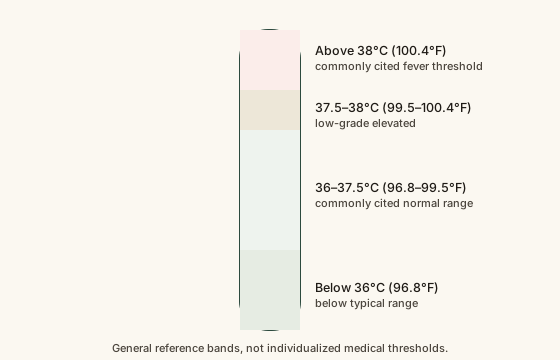
These bands are general reference points, not individualized medical thresholds — a specific person's normal baseline can sit meaningfully above or below the commonly cited range, which is exactly why tracking your own typical baseline is more informative than comparing a single reading against a population average alone.
Common mistakes
Common Mistakes
Treating 98.6°F (37°C) as an exact, universal normal temperature for every individual.
→ Understand it as a rounded historical population average — individual baseline body temperature commonly varies by several tenths of a degree from person to person.
Comparing a Fahrenheit thermometer reading directly against a Celsius-based reference chart (or vice versa) without converting first.
→ Always convert to a shared scale before comparing — the standard formula (°F = °C × 9/5 + 32) applies to body temperature exactly as it does to any other Celsius-Fahrenheit conversion.
Assuming all thermometer types (oral, ear, forehead, underarm) read identically for the same underlying body temperature.
→ Different measurement sites read somewhat differently relative to core body temperature — use the reference range appropriate to your specific thermometer type, generally provided in its instructions.
Common misconception
“98.6°F is a precise, fixed normal temperature, and any deviation from it signals illness.”
98.6°F is a rounded average from a 19th-century population study, not an exact individual threshold. Normal body temperature varies by person, time of day, and measurement method — modern research suggests the true population average may run somewhat lower, and a single reading a few tenths of a degree away from 98.6°F is not inherently abnormal on its own.
Why does body temperature naturally vary throughout a single day for the same healthy individual?
Try it yourself
What to do next
What to do next
- Know which scale your household thermometer displays, and keep the conversion formula (or this page) handy if you need to compare against a chart in the other scale.
- Treat 98.6°F / 37°C as a rough historical reference point, not a precise personal baseline — your own normal may sit a bit above or below it.
- Take temperature readings at a consistent time of day and with a consistent method when tracking changes, since normal daily fluctuation can otherwise look like a meaningful change.
- For any actual health concern or fever management decision, consult a licensed healthcare provider rather than relying on general reference numbers alone.