 KnowThis
Key Takeaways
Key Takeaways
- 1Wind chill and heat index are both calculated 'feels like' values, not what a thermometer actually reads — they estimate how the body perceives temperature under wind or humidity.
- 2Wind chill only applies meaningfully below about 10°C (50°F) with wind above roughly 4.8 km/h — it isn't calculated for warm, calm conditions because the underlying physics doesn't apply.
- 3Heat index is the humid-weather counterpart to wind chill — instead of wind stripping heat away, high humidity slows sweat evaporation, making hot air feel hotter than the thermometer shows.
The concept
Because both values are calculated rather than measured directly, understanding when each applies — and when neither does — matters as much as the arithmetic itself.
Why doesn't the US National Weather Service calculate a wind chill value for a 25°C day, even if it's windy?
Worked examples
Example 1: Calculating wind chill on a cold, windy day (baseline case)
Example 2: Wind chill approaching the calm-air threshold (edge case / variation)
Example 3: Comparing heat index across two humidity levels (real-world / applied case)
Two cities both report an air temperature of 32°C, but City A has 20% humidity and City B has 80% humidity. Which city has the higher heat index, and why?
How it works (visual)
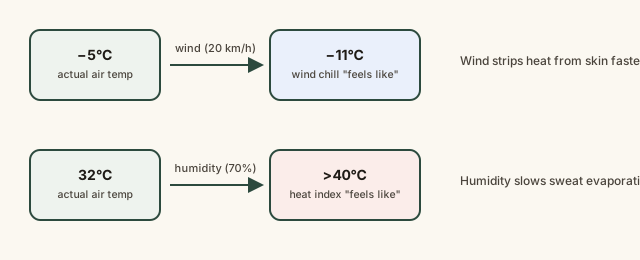
Both arrows start at the same place — the actual thermometer reading — and diverge in opposite directions depending on the cause: wind pulls the cold-weather number colder, while humidity pushes the hot-weather number hotter.
Common mistakes
Common Mistakes
Assuming wind chill or heat index is what a thermometer would read if placed outside.
→ Both are calculated physiological estimates of how conditions feel to human skin, not literal air temperature readings — a thermometer will always show the actual air temperature, not the wind chill or heat index value.
Applying a wind chill calculation to warm weather, or a heat index calculation to cold weather.
→ Wind chill is only meaningful below about 10°C with real wind; heat index is only meaningful in warm-to-hot, humid conditions. Outside those ranges, the raw air temperature is the relevant number.
Assuming heat index and wind chill are calculated the same way, just with different inputs.
→ They model entirely different physical mechanisms — convective heat loss to moving air (wind chill) versus impaired evaporative cooling from humidity (heat index) — so they use different formulas, not a shared one with swapped variables.
Common misconception
“Wind chill can make water freeze faster or make an inanimate object colder than the actual air temperature.”
Wind chill describes how quickly *exposed human skin* loses heat — it's a physiological estimate, not a change in the actual physics of the air. Inanimate objects (a car, a bottle of water) cool down to the actual air temperature regardless of wind chill; wind can speed up how fast they *reach* that temperature, but they won't end up colder than the air itself.
Will a bucket of water left outside on a −5°C day with strong wind chill (feels like −11°C) actually freeze to a lower temperature than a bucket left outside on a calm −5°C day?
Try it yourself
What to do next
What to do next
- Check both the actual temperature and the wind chill or heat index when planning cold- or hot-weather outdoor activity — the 'feels like' number is often the more useful safety guide.
- Remember wind chill only applies below roughly 10°C with real wind — don't expect (or calculate) one on a mild, breezy day.
- In humid climates, treat the heat index rather than the raw temperature as your guide for hydration and heat-safety decisions.
- Don't assume wind chill changes how cold an inanimate object gets — it's specific to how fast living skin loses heat, not a change in air physics.