 KnowThis
Key Takeaways
Key Takeaways
- 11 food Calorie (kilocalorie) equals 4.184 kilojoules exactly — a fixed conversion factor, since both units measure the same physical quantity: energy.
- 2The 'Calorie' on a US nutrition label is capitalized deliberately — it's actually a kilocalorie (1,000 small calories), not the small calorie used in older chemistry contexts.
- 3Nutrition labels differ by country not because the food itself changes, but because different national standards require different energy units — Calories (US), kilojoules (Australia), or both (much of Europe).
The concept
With the base conversion factor established, applying it to real nutrition labels and daily energy totals is where the number actually becomes useful.
A protein bar's US label lists 250 Calories. Roughly how many kilojoules would appear on an Australian label for the same bar?
Worked examples
Example 1: Converting a single food item's label (baseline case)
Example 2: Converting a daily energy target (edge case / variation)
Example 3: Reading a European label showing both units (real-world / applied case)
A food label shows both 500 kJ and 100 kcal for the same serving. Are these numbers consistent with each other?
How it works (visual)
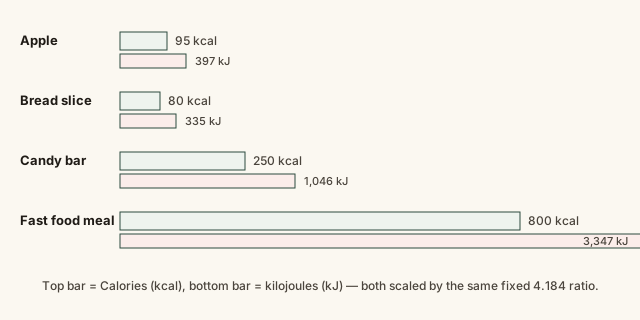
Because the two axes are scaled proportionally by the fixed 4.184 factor, every bar lines up at the same relative position on both scales — the physical energy content never changes, only which number is used to describe it.
Common mistakes
Common Mistakes
Confusing the food 'Calorie' (kilocalorie) with the small calorie used in chemistry, which is 1,000 times smaller.
→ Nutrition labels always use the capitalized food Calorie (kilocalorie) — when doing conversions with the 4.184 factor for food energy, you're already working in the correct unit.
Assuming a country's official daily energy reference value (like 8,700 kJ in Australia) is just a direct unit conversion of another country's reference value (like 2,000 Calories in the US).
→ Reference values are set independently by each country's dietary guidelines and may not match a pure unit conversion exactly — check the actual conversion (2,000 × 4.184 = 8,368 kJ) separately from any country's published reference number.
Rounding the conversion factor too aggressively (e.g. using 4 instead of 4.184) for a large total.
→ For single food items the rounding error is small, but for daily or weekly totals, use the full 4.184 factor to avoid compounding a noticeable discrepancy.
Common misconception
“Foods labeled in kilojoules are measured or produced differently from foods labeled in Calories — they're not really comparable.”
The unit on the label has nothing to do with how the food itself was measured, produced, or how much energy it actually provides — kilojoules and Calories are simply two different, exactly convertible units for describing the same physical quantity, energy. A food labeled in kilojoules and an identical food labeled in Calories provide the exact same nourishment; only the printed unit differs.
Why can you directly and precisely convert between Calories and kilojoules, but not between Celsius and Fahrenheit with a simple multiplication?
Try it yourself
What to do next
What to do next
- Memorize the factor: 1 Calorie = 4.184 kilojoules, for quick mental conversion when reading a label in an unfamiliar unit.
- When a label shows both units, use the pair as a built-in check — multiplying the Calorie figure by 4.184 should closely match the printed kilojoule figure.
- Don't assume a country's official daily reference intake is a pure unit conversion of another country's — check the actual math if it matters for your purpose.
- Use full precision (4.184, not a rounded 4) when converting daily or weekly energy totals, where rounding error compounds.