 KnowThis
Key Takeaways
Key Takeaways
- 1A BTU is defined as the heat needed to raise one pound of water by one degree Fahrenheit — a small, precise unit of energy, related to the metric world's kilowatt-hour by a fixed factor.
- 21 BTU equals approximately 0.000293071 kilowatt-hours, so appliance ratings often use thousands of BTUs (or BTU/h as a rate) rather than the raw unit.
- 3An air conditioner's BTU rating describes its cooling *rate* (BTU per hour), not a total energy amount — it's a capacity spec, similar to how horsepower rates an engine's power output rather than its total energy use.
The concept
With the base unit and rate distinction clear, applying it to a real appliance label is where the concept becomes practically useful.
An air conditioner is rated 10,000 BTU/h. What does the '/h' in that rating actually tell you?
Worked examples
Example 1: Converting a small heater's rating to kilowatt-hours (baseline case)
Example 2: Sizing an air conditioner for a room (edge case / variation)
Example 3: Comparing a central AC's "ton" rating to BTU/h (real-world / applied case)
A central AC system is rated at 2.5 tons. How many BTU/h is that, and why does converting to a common unit matter here?
How it works (visual)
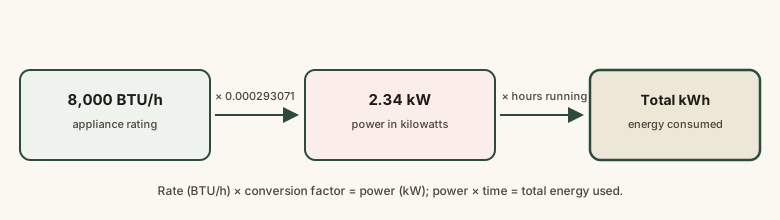
The chain mirrors any rate-to-total conversion: a BTU/h rating is a rate (like wattage), so multiplying by the conversion factor gets kilowatts, and multiplying that by hours of runtime gets the actual total energy consumed — the same two-step logic used for any power-to-energy calculation.
Common mistakes
Common Mistakes
Treating a BTU/h rating as a fixed total energy amount rather than a rate.
→ Remember the '/h' — it's a rate, like wattage. Multiply by the number of hours running to get a total energy figure in BTUs (or convert to kWh first, then multiply).
Assuming a bigger BTU rating is always better when choosing an air conditioner.
→ An oversized unit for the room cools too quickly and cycles on/off excessively, reducing both comfort and efficiency — match the rating to the room's actual size using a standard sizing guideline, don't just maximize it.
Confusing 'tons' of cooling capacity with a literal weight measurement.
→ In HVAC contexts, a 'ton' is a historical energy-rate unit (12,000 BTU/h) unrelated to weight — treat it purely as a cooling-capacity unit.
Common misconception
“BTUs and kilowatt-hours measure fundamentally different things, since one is used for heating/cooling and the other for electricity.”
Both units measure the same physical quantity — energy — and convert to each other with a simple fixed factor (1 BTU ≈ 0.000293071 kWh), just like Calories and kilojoules. The reason BTUs show up specifically for heating and cooling appliances is historical convention in the US HVAC industry, not because a different physical quantity is being measured.
Why does a central air conditioning system's capacity get rated in 'tons' historically, rather than directly in BTU/h?
Try it yourself
What to do next
What to do next
- When comparing appliances, note whether a spec is a rate (BTU/h, watts) or a total (BTU, kWh) before comparing numbers directly.
- Use a standard room-size sizing guideline (roughly 20 BTU/h per square foot as a starting estimate) rather than assuming a higher BTU rating is automatically better.
- Convert 'ton' ratings on central AC systems to BTU/h (× 12,000) when comparing against window units or other equipment rated directly in BTU/h.
- Convert BTU/h to kilowatts when you want to estimate an appliance's likely impact on your electric bill, which is billed in kilowatt-hours.