 KnowThis
Key Takeaways
Key Takeaways
- 1Rooftop solar panels generate electricity directly from sunlight via the photovoltaic effect — there's no combustion and no storage step required for the panel itself to produce current.
- 2Net metering lets a home export surplus solar power to the grid for bill credit, which is why most home solar systems work without a battery at all — the grid effectively acts as free storage.
- 3A solar system's real-world output depends on panel efficiency, local sun-hours, roof orientation, and shading — the same-rated system produces meaningfully different annual electricity in different locations.
The concept
Because output depends directly on sunlight, the same solar system installed in two different locations, or even on two differently-angled roofs at the same address, produces different amounts of electricity over a year — sizing a system correctly means starting from a home's real usage and local sun conditions, not just a generic panel count.
A homeowner assumes their solar panels must include a battery, since otherwise the electricity they generate during the day would be wasted while they're at work. Is this assumption correct for a typical grid-connected system?
Worked examples
Example 1: Why solar output varies by roof orientation (baseline case)
Example 2: Net metering across a full day (edge case / variation)
If a home's solar panels generate most of their electricity around midday but the household uses most of its electricity in the evening, what mechanism reconciles that mismatch without requiring a home battery?
Example 3: Comparing a solar investment against a grid-mix baseline (real-world / applied case)
How it works (visual)
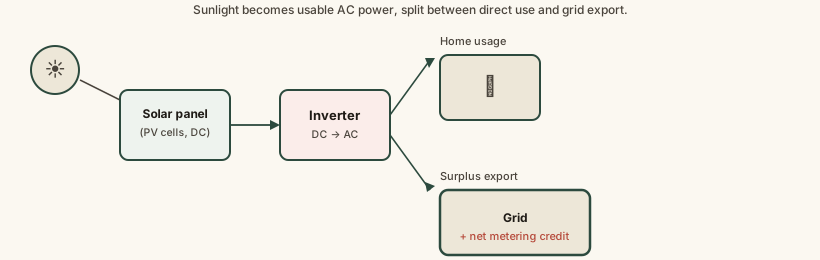
The inverter is the hinge point of the whole system — everything to its left is DC current generated directly from light, and everything to its right is standard AC electricity that behaves exactly like grid power once it crosses that conversion step, which is why solar-generated electricity can seamlessly power ordinary household appliances or flow back out to the grid.
Common mistakes
Common Mistakes
Assuming solar panels store energy internally like a battery.
→ Remember panels only generate current while lit — storage (if present at all) is a completely separate battery component, and most grid-connected systems rely on net metering instead of a battery.
Comparing two solar quotes by panel count alone, ignoring orientation, shading, and panel efficiency rating.
→ Compare quotes by projected annual kWh output for your specific roof, not just number of panels or total wattage rating.
Assuming 100% of a home's electricity becomes 'green' the moment solar panels are installed.
→ Recognize that at night or during low-sun periods the home still draws standard grid electricity — solar typically offsets a portion of annual usage, not all of it, unless paired with substantial battery storage.
Common misconception
“Home solar only makes sense in sunny climates like the desert Southwest — it's not worth it anywhere with regular clouds or cold winters.”
Solar panel output depends on sunlight intensity and hours, not ambient temperature — panels can actually lose a small amount of efficiency in extreme heat. Many regions with moderate cloud cover and cold winters, including much of Northern Europe and the US Midwest and Northeast, have substantial installed residential solar capacity, because even diffuse daylight still generates usable current, and net metering evens out day-to-day generation variance over a billing cycle.
Does extreme summer heat improve solar panel output, since heat and sunlight are often correlated?
What to do next
What to do next
- Check whether your utility offers net metering and at what credit rate before assuming a solar payback estimate is accurate.
- Ask any solar installer for a projected annual kWh output specific to your roof's orientation and shading, not just a generic panel-count quote.
- Look up your utility's published fuel mix disclosure to understand what grid electricity your home solar would actually be displacing.
- Decide whether you need battery backup (for outage protection) separately from the core economics of a grid-connected, net-metered system.