Renewable vs. Non-Renewable Resources: What Actually Makes the Difference
Renewable resources like sunlight, wind, and flowing water replenish naturally within a human lifetime, while non-renewable resources like fossil fuels form over millions of years, far slower than they're consumed.
Reading time
— 5 min
Updated
— Aug 16, 2026
Fact-reviewed
— Aug 16, 2026
Key Takeaways
Key Takeaways
1The distinction between renewable and non-renewable is about replenishment speed relative to human consumption, not about being 'clean' or 'green' — sunlight and wind replenish continuously, while fossil fuels form over millions of years, far slower than we use them.
2Coal forms mainly from ancient swamp plant matter, and oil and natural gas form mainly from ancient marine microorganisms — not from dinosaurs, despite the popular myth; dinosaurs contributed negligibly, if at all, to fossil fuel deposits.
3Burning fossil fuels releases carbon that had been locked underground for millions of years back into the atmosphere far faster than the natural carbon cycle can reabsorb it, which is the well-documented mechanism behind rising atmospheric CO2 and global temperature, per NASA and NOAA data.
The concept
A renewable resource — sunlight, wind, flowing water, geothermal heat — naturally replenishes fast enough that using it doesn't meaningfully run it down over a human lifetime. A non-renewable resource — coal, oil, natural gas, uranium — exists in a fixed, limited supply that took millions of years to form and isn't being replaced anywhere near the rate it's being used. The sun will keep shining and wind will keep blowing regardless of how much energy we capture from them; every barrel of oil pumped out of the ground, by contrast, is one that took millions of years to form and won't be replaced within any timeframe that matters to us.
That's the core distinction: replenishment speed relative to consumption. Working through where fossil fuels actually come from — and how "years remaining" gets calculated for a finite resource — makes the difference concrete.
Quick check
What actually determines whether a resource is classified as renewable or non-renewable?
Worked examples
Example 1: Calculating years remaining with a reserve-to-production ratio (baseline case)
A country has 1,000 million barrels of proven oil reserves and currently produces (and consumes at a comparable rate) 50 million barrels per year. Using reserve-to-production ratio = reserves ÷ annual consumption rate: 1,000 ÷ 50 = 20 years of supply remaining at the current rate. This is the exact methodology energy agencies like the EIA use to estimate a resource's remaining lifespan — and it's explicitly a snapshot, not a fixed prediction, since it changes whenever new reserves are discovered, extraction technology improves, or consumption rates shift.
Example 2: Why biomass can behave like a non-renewable resource (edge case / variation)
Wood is biologically renewable — trees regrow. But renewability in practice depends on the harvest rate staying at or below the regrowth rate. If a forest is cut down faster than it can regenerate, the wood supply effectively behaves like a non-renewable resource during that period, despite being made of an inherently regrowable material. This is a genuine, well-recognized edge case in resource management: the renewable/non-renewable label isn't purely a fixed physical property of the material itself, it also depends on how the resource is actually being used relative to its natural replenishment rate — which is why sustainable forestry practices specifically track harvest rate against regrowth rate rather than assuming "renewable" automatically means "unlimited."
Quick check
A forest is being logged faster than new trees can grow to replace them. Is this wood supply still accurately described as 'renewable'?
Example 3: Hydroelectric power as a continuously renewable system (real-world / applied case)
A hydroelectric dam generates electricity by directing flowing river water through turbines — water that arrived at the reservoir through the ongoing water cycle: solar-driven evaporation, condensation, and precipitation feeding the river continuously. As long as precipitation patterns in the watershed remain stable, that flow keeps arriving indefinitely, which is why hydroelectric power is classified as renewable. Compare that to a coal power plant: each ton of coal burned is drawn from a fixed underground reserve that isn't being replenished on any relevant timescale, so every year of operation permanently reduces the remaining supply available for the future. Same basic goal — generating electricity — but one draws on a continuously replenished resource and the other draws down a finite one, which is the entire practical distinction the renewable/non-renewable classification is built to capture.
How it works (visual)
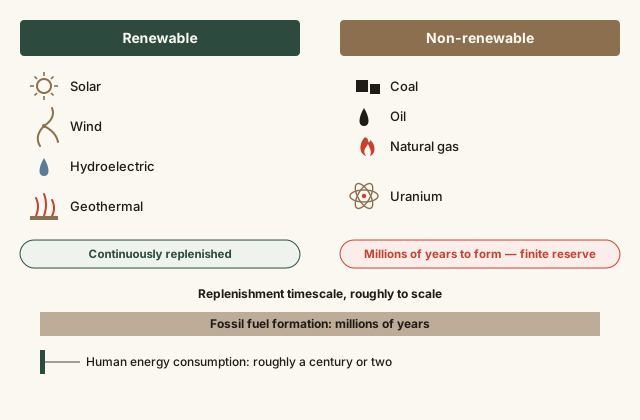
Renewable vs. non-renewable energy sources and their replenishment timescales
The scale bar at the bottom is the entire point of the diagram: human energy consumption happens on a timescale of years, while the non-renewable resources on the right formed on a timescale of millions of years — a mismatch of roughly six orders of magnitude. The renewable resources on the left don't face that mismatch at all, since their replenishment (solar radiation, wind, the water cycle, geothermal heat from Earth's interior) is effectively continuous rather than a one-time, ancient deposit being drawn down.
Common mistakes
Common Mistakes
✕
Believing fossil fuels come from dinosaur remains.
→ Coal forms mainly from ancient swamp plant matter, and oil and natural gas form mainly from ancient marine microorganisms like plankton and algae — dinosaurs contributed negligibly, if at all, to fossil fuel deposits.
✕
Assuming 'renewable' automatically means 'unlimited, regardless of how it's used.'
→ Renewable resources like biomass can still be depleted in practice if harvested faster than their natural replenishment rate — renewability depends on usage rate relative to regrowth rate, not just the material's inherent properties.
✕
Classifying nuclear energy as renewable because it produces very little carbon during operation.
→ Nuclear power's low emissions don't make it renewable — uranium is a finite, mined fuel. Renewable vs. non-renewable is about resource replenishment, not about how much carbon a technology emits when running.
Common misconception
“Coal and oil come from dead dinosaurs.”
Coal forms primarily from ancient swamp and forest plant material, especially from the Carboniferous period roughly 359-299 million years ago, buried and compressed over millions of years into progressively denser carbon-rich rock. Oil and natural gas form mainly from the remains of ancient marine microorganisms, like plankton and algae, that settled in seafloor sediment and were subjected to heat and pressure over millions of years, per the U.S. Department of Energy and USGS. Dinosaurs, as land animals present during only part of this vast timeframe, are not considered a meaningful source of fossil fuel deposits — the popular association is a persistent myth, likely reinforced by dinosaur-branded gas station logos rather than actual geology.
Quick check
Given how fossil fuels actually form, is it accurate to say oil deposits are made of decomposed dinosaurs?
Try it yourself
Estimate years remaining using a reserve-to-production ratio
Years remaining at current consumption rate20.0 years
What to do next
What to do next
Try the calculator above with your own hypothetical numbers to see how sensitive 'years remaining' is to both reserve size and consumption rate.
Next time you see a fossil-fuel-and-dinosaur association (a gas station logo, a cartoon), mentally correct it to the real source: ancient plants for coal, ancient marine microorganisms for oil and gas.
Look up what share of your local electricity grid comes from renewable versus non-renewable sources.
Read the related entry on Rocks, Minerals & Natural Resources to see how fossil fuels fit into the broader picture of resources extracted from Earth's crust.
FAQ
FAQ
Related terms
Related terms
Renewable resource
A resource, like sunlight, wind, or flowing water, that naturally replenishes within a human timescale, making it effectively inexhaustible if not overused.
Non-renewable resource
A resource, like coal, oil, natural gas, or uranium, that exists in a finite quantity and forms or replenishes far more slowly than humans consume it.
Fossil fuel
A non-renewable fuel — coal, oil, or natural gas — formed from the buried, heat- and pressure-transformed remains of ancient organisms over millions of years.
Reserve-to-production ratio
A resource's proven remaining reserves divided by its current annual consumption rate, giving an estimate of years remaining at current usage — a real metric used by energy agencies.
Carbon cycle
The natural movement of carbon between the atmosphere, oceans, land, and living things, which fossil fuel combustion adds extra ancient carbon into far faster than it can be reabsorbed.
This entry was researched from public sources and drafted with AI-assisted tools, then edited — errors are still possible. Spot one, or want a topic covered? Read our disclaimer.
 KnowThis