Global Warming vs Climate Change: What's the Difference
Global warming refers specifically to the long-term rise in Earth's average surface temperature, while climate change is the broader term covering all the resulting shifts — in precipitation, storm intensity, sea level, and regional weather patterns — some of which don't look like simple warming at all.
Reading time
— 4 min
Updated
— Aug 22, 2026
Fact-reviewed
— Aug 22, 2026
Key Takeaways
Key Takeaways
1Global warming is a specific measurement: the rise in Earth's average surface temperature over time. Climate change is the umbrella term for everything that rising average temperature sets in motion.
2A single unusually cold winter in one region is a weather event, not evidence against either global warming or climate change — climate is a decades-long statistical pattern, not a single data point.
3Scientists shifted toward preferring 'climate change' as the broader term partly because some real effects — like certain polar vortex disruptions bringing extreme cold snaps — don't sound like 'warming' locally even though they're consistent with a warming-driven shift in atmospheric circulation.
The concept
Global warming is the rise in Earth's average temperature — about 1.1°C since the late 1800s, per NASA and NOAA records. Climate change is the wider term for everything that warming causes: shifting rainfall patterns, more intense heatwaves and storms in some regions, melting ice, rising seas, and yes, occasionally colder extreme weather in specific places due to disrupted atmospheric circulation. Warming is the driver; climate change is the full set of downstream effects.
The practical test for telling the two terms apart: if a claim is about the specific number (a temperature trend), it's about global warming; if it's about the broader pattern of effects (storms, droughts, sea level, ecosystem shifts), it's about climate change. One thing worth not confusing with either: a natural, recurring ocean pattern like El Niño and La Niña shifts global weather for a year or two at a time, on top of the longer-term climate change trend, not as a substitute explanation for it.
Quick check
A news report says 'a record cold snap hit the Midwest this week, disproving climate change.' What's the actual flaw in this reasoning?
Worked examples
Example 1: Reading a global temperature anomaly chart correctly (baseline case)
NASA's GISS temperature record shows global average temperature roughly 1.1°C above the late-1800s baseline, as a smoothed multi-year trend line with year-to-year noise around it. Some individual years sit below the trend line, some above — 2023 and 2024 both ran notably warmer than the trend due to a strong El Niño pattern layered on top of the underlying warming. The trend line, not any single year, is the "global warming" figure.
Example 2: A region getting wetter, not just hotter (edge case / variation)
Some regions, particularly parts of the northeastern United States and Northern Europe, have seen measurably increased heavy-precipitation events as part of climate change, per NOAA's National Climate Assessment — warmer air holds more moisture (about 7% more per degree Celsius of warming, a well-established physical relationship called the Clausius-Clapeyron relation), so when storms do form, they can dump more rain. This is a genuine climate change effect that isn't captured by the phrase "global warming" alone, since the headline experience locally is "wetter," not "hotter."
Example 3: The 2021 Texas winter storm and Arctic connection (real-world / applied case)
In February 2021, an unusually severe cold snap hit Texas, causing widespread power failures. Several peer-reviewed studies have investigated a potential link between a disrupted, weakened polar vortex — a pattern some research connects to faster Arctic warming — and increased odds of this kind of extreme cold intrusion into mid-latitude regions. The research on the specific vortex-to-cold-snap link continues to develop, but the broader point stands regardless: a severe cold event in one region during one week says nothing about the multi-decade global average trend, and "climate change" is the term built to hold both the warming trend and events like this one without contradiction.
Quick check
Why do NASA and NOAA prefer 'climate change' over 'global warming' as the primary umbrella term in their public communications?
How it works (visual)
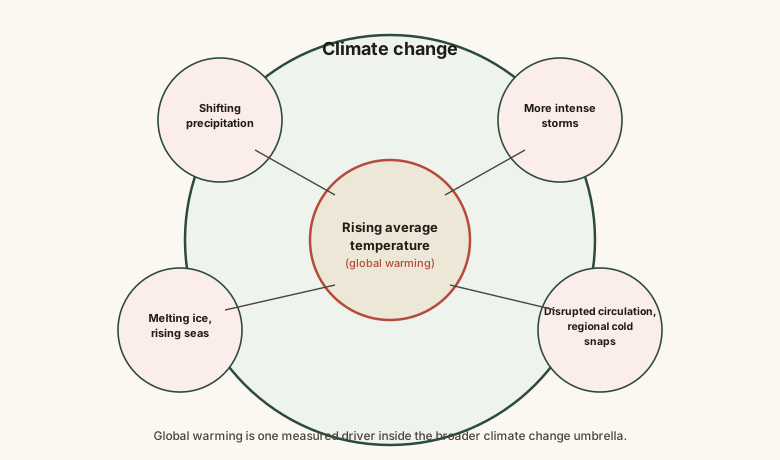
Global warming as one measurement inside the broader climate change umbrella
Global warming sits inside climate change as one specific, well-measured driver — the outer circle includes several other effects that follow from it but aren't themselves simply "warming."
Common mistakes
Common Mistakes
✕
Treating any single cold day, week, or storm as evidence against climate change.
→ Compare against the multi-decade, globally-averaged trend, not a single local event — weather is noisy on short timescales; climate is the pattern that emerges over decades.
✕
Using 'global warming' and 'climate change' as if they mean exactly the same thing in every context.
→ Use 'global warming' specifically when referring to the average temperature trend itself, and 'climate change' when referring to the broader set of resulting effects, including ones that aren't simple temperature increases.
✕
Assuming a region getting colder or wetter is inconsistent with a warming planet.
→ Regional and even seasonal cooling or increased precipitation events are documented, real parts of climate change — global averages and local, short-term experiences are not the same measurement.
Common misconception
“If climate change is real, every place on Earth should be getting uniformly hotter every year, with no exceptions.”
Climate change describes a global, multi-decade average trend, not a uniform, region-by-region, year-by-year guarantee. Some regions warm faster than others (the Arctic warms roughly twice as fast as the global average), some effects show up as more intense precipitation rather than heat, and disrupted atmospheric circulation patterns can occasionally push extreme cold into specific regions even during a warming decade. None of this contradicts the underlying trend — it's exactly the kind of regional and seasonal variability climate science accounts for.
Quick check
Does a genuinely warming global climate rule out the possibility of any region experiencing an unusually cold winter in a given year?
What to do next
What to do next
Use 'global warming' specifically when discussing the average temperature trend, and 'climate change' for the broader set of effects — precision helps avoid talking past people in a discussion.
When you see a single weather event cited as proof for or against climate change, check whether the claim is really about the multi-decade average trend or just one data point.
Look at NASA's or NOAA's actual temperature anomaly charts directly if you want to see the real trend line versus individual noisy years for yourself.
Read the extreme weather post in this cluster to see how climate change connects to storm intensity specifically, beyond the temperature-trend headline.
FAQ
FAQ
Related terms
Related terms
Global warming
The long-term rise in Earth's average surface temperature, primarily driven by human greenhouse gas emissions since the mid-20th century.
Climate change
The broader set of long-term shifts in temperature, precipitation, storm patterns, sea level, and other climate indicators, of which global warming is the primary driver but not the only observable effect.
Weather
The short-term, local state of the atmosphere — a specific day's temperature, rain, or wind — as distinct from climate, which describes long-term statistical patterns over decades.
Polar vortex disruption
A weakening or splitting of the normal circulating winds around the Arctic, which some research links to a warming Arctic, and which can push unusually cold air into mid-latitude regions even as the global average trends warmer.
This entry was researched from public sources and drafted with AI-assisted tools, then edited — errors are still possible. Spot one, or want a topic covered? Read our disclaimer.
 KnowThis