A carbon footprint estimates the total greenhouse gas emissions caused by an individual's or organization's activities, calculated by multiplying each activity's quantity by a published, activity-specific emission factor and expressing the result in a common unit — CO2-equivalent.
Reading time
— 4 min
Updated
— Aug 22, 2026
Fact-reviewed
— Aug 22, 2026
Key Takeaways
Key Takeaways
1A carbon footprint calculation is the same operation as any unit conversion: multiply an activity quantity by a fixed, published emission factor to get an estimated CO2-equivalent amount.
2The EPA publishes real, specific emission factors for activities like driving, flying, and electricity use — a credible footprint estimate cites one of these rather than an invented round number.
3Direct activities (driving, home energy use) are usually the easiest and most accurate part of a personal footprint to estimate — indirect emissions from purchased goods and services are real but much harder to measure precisely at an individual level.
The concept
A carbon footprint is an estimate of the total greenhouse gas emissions caused by your activities, converted into a single common unit so different activities can be compared and added together. Driving 100 miles in an average gasoline car produces roughly 39 kg of CO2, using the EPA's published emission factor of about 0.39 kg CO2 per mile — the same multiply-by-a-factor logic used for any unit conversion, just applied to emissions instead of length or weight.
Once the "multiply by a factor" mechanic is clear, the actual skill is choosing the right, real emission factor for the specific activity and fuel or energy source involved — a generic estimate applied to a specific situation can be meaningfully off.
Quick check
Two people each drive 200 miles per week, but one drives a car that gets 25 mpg and the other drives a hybrid that gets 50 mpg. Do they have the same transportation carbon footprint?
Worked examples
Example 1: Converting a week's commute into CO2e (baseline case)
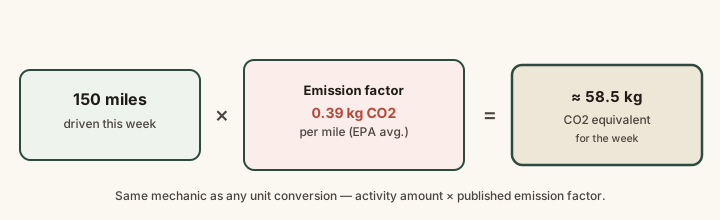
A commuter drives 150 miles per week in an average gasoline passenger vehicle. Using the EPA's published factor of approximately 0.39 kg CO2 per mile (a typical passenger vehicle average): 150 × 0.39 ≈ 58.5 kg CO2 for that week's commuting alone — over a 50-week working year, that's roughly 2,925 kg, or about 2.9 metric tons, from commuting by car alone.
Example 2: Comparing electricity footprint across regions with different grids (edge case / variation)
A household using 900 kWh of electricity in a month has a different footprint depending on how that electricity was generated. In a region with a coal-heavy grid, the EPA's regional emission factor might be around 0.7 kg CO2 per kWh, giving 900 × 0.7 = 630 kg CO2 for the month. In a region with a hydro- or nuclear-heavy grid, the factor could be closer to 0.1 kg CO2 per kWh, giving 900 × 0.1 = 90 kg CO2 for identical electricity usage — a 7x difference from the same activity, purely from the local grid's fuel mix, which is why the EPA publishes region-specific electricity emission factors rather than one national average.
Example 3: Why a full personal footprint estimate stays incomplete without indirect emissions (real-world / applied case)
Adding up direct driving and home energy use for a typical household might total 8-10 metric tons of CO2e per year, using published EPA factors. But a full lifecycle footprint also includes indirect emissions embedded in purchased goods, food, and services — manufacturing, shipping, and disposal of everything consumed. Various academic and NGO estimates suggest indirect consumption-based emissions can be comparable to or larger than direct household emissions for a typical developed-country consumer, but these are harder to estimate precisely at an individual level since they depend on detailed supply-chain data that isn't as standardized as vehicle or electricity emission factors — which is why most consumer-facing carbon calculators focus primarily on the more measurable direct-activity categories.
Quick check
Why does the EPA publish region-specific electricity emission factors instead of a single national average factor for all electricity use?
How it works (visual)
Carbon footprint as a unit conversion: activity × emission factor = CO2e
The mechanic is identical to converting miles to kilometers or pounds to kilograms — the only difference is the factor comes from a real, published, activity-specific emissions database rather than a fixed physical constant.
Common mistakes
Common Mistakes
✕
Using a rough, invented emission factor instead of a real published one.
→ Use the EPA's Greenhouse Gas Equivalencies Calculator or emission factor hub for real, activity-specific figures rather than a guessed round number.
✕
Applying a national average electricity emission factor when a region-specific one is available and meaningfully different.
→ Check whether a regional or utility-specific emission factor exists, since electricity's footprint can vary by several multiples depending on the local grid's fuel mix.
✕
Treating a personal footprint estimate covering only direct activities (driving, home energy) as a complete picture.
→ Acknowledge that indirect, consumption-based emissions from purchased goods and services are real and can be substantial, even though they're harder to estimate precisely at an individual level.
Common misconception
“Individual carbon footprint calculations are meaningless since climate change is really about large industrial and corporate emissions, not personal choices.”
Both scales matter and aren't in competition — large-scale industrial and energy-sector emissions are the largest absolute share of global totals, but transportation and residential energy use (categories individuals directly influence) are still substantial, measurable emission sources with real, EPA-published emission factors behind them. A personal footprint estimate is a legitimate, if partial, accounting tool — it simply isn't the whole global picture, the same way one household's water use isn't the whole story of regional water stress, but is still a real and measurable quantity.
Quick check
Does pointing out that industrial emissions are larger in absolute terms than personal transportation emissions mean personal carbon footprint estimates are meaningless?
Try it yourself
Estimate CO2e from an activity using a published emission factor
Estimated CO2e (kg)58.5
What to do next
What to do next
Use the EPA's Greenhouse Gas Equivalencies Calculator (epa.gov) for real emission factors rather than guessing a round number.
Check whether your electricity provider publishes a region-specific emission factor, since it can differ from the national average by several multiples.
Use the calculator above with a real emission factor for your specific activity — miles driven, kWh used, or another category with a published EPA figure.
Remember that a direct-activity footprint estimate (driving, home energy) is a real but partial picture — indirect, consumption-based emissions exist too, even if they're harder to measure precisely.
FAQ
FAQ
Related terms
Related terms
Carbon footprint
The total greenhouse gas emissions caused by a person, organization, product, or activity, typically expressed in kilograms or tons of CO2-equivalent.
CO2-equivalent (CO2e)
A standardized unit that expresses the warming impact of different greenhouse gases (methane, nitrous oxide, etc.) in terms of the amount of CO2 that would cause the same warming effect, allowing different gases to be compared and summed.
Emission factor
A published, activity-specific ratio (e.g. kg CO2 per mile driven, or per kWh of electricity) used to convert a measurable activity quantity into an estimated greenhouse gas emission amount.
Scope 1, 2, and 3 emissions
A corporate carbon-accounting framework: Scope 1 is direct emissions an entity produces itself, Scope 2 is emissions from purchased electricity, and Scope 3 is indirect emissions throughout its supply chain and product use — the same logic scales down to a household's direct (driving) versus indirect (purchased goods) footprint.
Two people each drive 200 miles per week, but one drives a car that gets 25 mpg and the other drives a hybrid that gets 50 mpg. Do they have the same transportation carbon footprint?
This entry was researched from public sources and drafted with AI-assisted tools, then edited — errors are still possible. Spot one, or want a topic covered? Read our disclaimer.
 KnowThis