What Causes Climate Change (Human-Driven Mechanisms)
Climate change today is driven overwhelmingly by human activity — primarily burning fossil fuels and clearing forests — which raises atmospheric concentrations of carbon dioxide and other greenhouse gases well above pre-industrial levels, trapping additional heat that would otherwise radiate back to space.
Reading time
— 4 min
Updated
— Aug 21, 2026
Fact-reviewed
— Aug 21, 2026
Key Takeaways
Key Takeaways
1Atmospheric CO2 has risen from about 280 parts per million before industrialization to over 420 ppm today — almost entirely from burning fossil fuels and, to a lesser extent, deforestation.
2Extra greenhouse gases don't create heat from nothing; they slow down how fast Earth radiates existing heat back to space, so energy builds up in the climate system over time.
3The physical mechanism (CO2 absorbs and re-emits infrared radiation) has been measured in laboratories since the 1850s — the open scientific question today is about the pace and regional impact of warming, not whether added CO2 traps heat.
The concept
Burning coal, oil, and natural gas releases carbon dioxide that had been locked underground for millions of years. That extra greenhouse gas builds up in the atmosphere and acts like a thickening blanket — it lets sunlight in but slows down how quickly heat radiates back out to space. NASA and NOAA measurements show atmospheric CO2 has climbed from about 280 parts per million (ppm) before the Industrial Revolution to over 420 ppm today, and global average temperature has risen alongside it by roughly 1.1°C since the late 1800s.
The "human-driven" part isn't inferred indirectly — it's confirmed by directly measuring the chemical signature of the carbon being added.
Quick check
How do scientists know the extra atmospheric CO2 is specifically from burning fossil fuels, rather than from a natural source like volcanoes or the ocean?
Worked examples
Example 1: Tracking the Keeling Curve (baseline case)
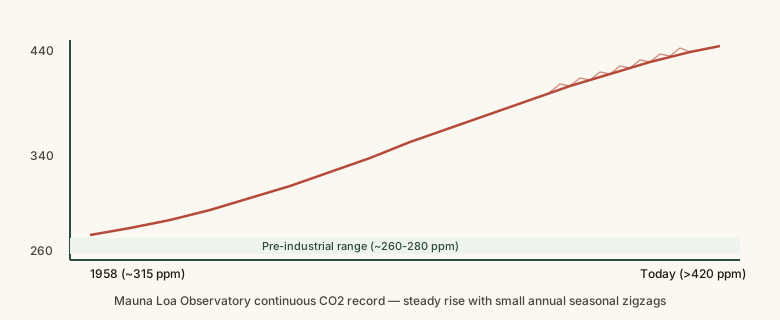
NOAA's Mauna Loa Observatory has measured atmospheric CO2 continuously since 1958. That year, concentration was about 315 ppm. By the mid-2020s, it had passed 420 ppm — a rise of over 100 ppm in roughly 65 years, a rate never seen in the 800,000-year ice core record. The curve also shows a small yearly zigzag (CO2 dips each Northern Hemisphere summer as plants absorb it, then rises each winter) riding on top of a steady upward climb — the seasonal wiggle is natural plant-cycle behavior, the upward climb underneath it is the human-driven trend.
Example 2: Comparing warming potential across greenhouse gases (edge case / variation)
Not all greenhouse gases trap heat equally. Methane (from livestock, landfills, and natural gas leaks) traps roughly 80 times more heat than CO2 per molecule over a 20-year period, but breaks down in the atmosphere in about a decade, while CO2 persists for centuries. This is why climate reporting sometimes leads with CO2 (the dominant long-term driver by total volume) and sometimes with methane (the faster lever for near-term warming reduction) — they're not competing claims, they're two different gases with different lifetimes and different potency, both contributing to the same warming trend.
Example 3: Deforestation as a double emissions source (real-world / applied case)
Clearing a forest contributes to climate change twice over: burning or decomposing the cut trees releases the carbon they had stored, and the missing forest can no longer absorb future CO2 as a carbon sink. The UN's Food and Agriculture Organization and NASA both track this — tropical deforestation alone is estimated to account for roughly 10% of global human-caused greenhouse gas emissions, making land-use change the second largest driver after fossil fuel combustion.
Quick check
Why does cutting down a forest count as a climate change contributor twice, not just once?
How it works (visual)
The Keeling Curve: atmospheric CO2, 1958 to present
The steady upward climb, sustained across nearly seventy years of continuous direct measurement at one of the cleanest-air monitoring stations on Earth, is the core data behind attributing current warming to rising CO2 — it's not modeled or estimated, it's measured air.
Common mistakes
Common Mistakes
✕
Treating 'the climate has changed before, naturally' as evidence the current change is also natural.
→ Past natural climate shifts (ice ages, etc.) had known drivers — orbital cycles, volcanic activity — that don't match the current, much faster rate of change; the current rise is attributed to CO2 specifically because its isotopic signature, timing, and magnitude match fossil fuel combustion, not a known natural driver.
✕
Assuming CO2 is a rare trace gas too small in quantity to matter.
→ Small concentration doesn't mean small effect — CO2's heat-trapping ability per molecule is well-established physics, and even a change from 280 to 420 ppm represents billions of tons of added atmospheric mass with a measurable radiative effect.
✕
Treating volcanic eruptions as a major driver of the current warming trend.
→ Human CO2 emissions are roughly 100 times larger annually than the yearly average from all global volcanic activity combined (USGS) — volcanoes matter for occasional short-term cooling from ash/aerosols, not for the multi-decade warming trend.
Common misconception
“Scientists are still fundamentally divided on whether human activity causes climate change.”
Multiple independent literature surveys (including a widely cited 2021 review covering over 88,000 climate-related studies) find that over 99% of actively publishing climate scientists agree human activity is the dominant cause of observed warming since the mid-20th century. The genuine scientific debate today is about magnitude, regional impact, and pace of future change under different emissions scenarios — not about whether the human-driven mechanism itself is real.
Quick check
What is the actual subject of ongoing scientific debate regarding climate change?
What to do next
What to do next
Check NOAA's Mauna Loa CO2 data directly (gml.noaa.gov/ccgg/trends) if you want to see the current real-time reading rather than trusting a secondhand figure.
When evaluating a claim about climate change online, ask whether it addresses the isotopic and rate-of-change evidence, or just gestures at 'climate has changed before' without engaging with why the current change is attributed to fossil fuels specifically.
Read the next post in this cluster on the greenhouse effect mechanism itself to understand exactly how trapped infrared radiation translates into measured warming.
If you want to estimate your own contribution, the carbon footprint post in this series walks through the actual arithmetic using a real published emissions factor.
FAQ
FAQ
Related terms
Related terms
Greenhouse gas
A gas that absorbs and re-emits infrared radiation, trapping heat in the atmosphere — carbon dioxide, methane, nitrous oxide, and water vapor are the main ones.
Radiative forcing
A measure, in watts per square meter, of how much a factor (like added CO2) changes the balance of incoming and outgoing energy in Earth's atmosphere — positive forcing means net warming.
Pre-industrial baseline
Atmospheric and temperature conditions from roughly 1850-1900, used as the reference point scientists compare current warming against.
Carbon sink
A natural system — oceans, forests, soil — that absorbs more carbon dioxide than it releases, partially offsetting emissions.
This entry was researched from public sources and drafted with AI-assisted tools, then edited — errors are still possible. Spot one, or want a topic covered? Read our disclaimer.
 KnowThis