The Greenhouse Effect, Applied: Why Emissions Warm the Planet
The greenhouse effect works by letting incoming sunlight reach Earth's surface freely while greenhouse gas molecules absorb and re-emit outgoing infrared radiation, delaying its escape to space; adding more of these gases increases that delay, so more energy accumulates in the atmosphere and oceans over time.
Reading time
— 4 min
Updated
— Aug 22, 2026
Fact-reviewed
— Aug 22, 2026
Key Takeaways
Key Takeaways
1The greenhouse effect is an energy-timing problem, not an energy-creation problem: sunlight comes in freely, but greenhouse gases slow down how fast the resulting heat leaves, so energy backs up in the system.
2Without any greenhouse effect at all, Earth's average surface temperature would be about -18°C (0°F) instead of the actual roughly 15°C (59°F) — a natural baseline greenhouse effect is why the planet is habitable in the first place.
3Human activity hasn't invented a new mechanism — it has intensified an existing, well-understood natural one by adding extra greenhouse gases on top of the pre-industrial baseline.
The concept
Sunlight passes through the atmosphere easily and warms Earth's surface. That surface then radiates the heat back out as invisible infrared energy, trying to escape to space. Greenhouse gases like CO2 and methane are transparent to incoming sunlight but absorb outgoing infrared, re-releasing it in every direction — including back down toward the surface. The more of these gases are in the atmosphere, the more outgoing heat gets intercepted and delayed, so the planet holds onto more energy overall.
A natural greenhouse effect has existed for billions of years and is the reason Earth isn't frozen solid — the current concern is specifically about intensifying it beyond the level life has adapted to.
Quick check
If greenhouse gases were removed from Earth's atmosphere entirely, what would happen to the planet's average temperature?
Worked examples
Example 1: The baseline greenhouse effect that already keeps Earth habitable (baseline case)
Earth's effective radiating temperature — what a satellite far away would calculate from the planet's outgoing infrared alone — is about -18°C. The actual measured surface average is about 15°C. That 33°C gap is the natural greenhouse effect, produced mostly by water vapor and a smaller, stable pre-industrial CO2 concentration around 280 ppm. This baseline effect isn't the problem; it's the reason the oceans aren't frozen.
Example 2: Water vapor as a feedback rather than a primary driver (edge case / variation)
Water vapor is actually the single largest greenhouse gas by contribution to the natural effect — yet climate reporting focuses on CO2 as the primary human-driven forcing. The distinction: warmer air holds more water vapor (a well-established physical relationship), so as CO2-driven warming raises temperatures, atmospheric water vapor rises too, amplifying the initial warming. Water vapor behaves as a fast-responding feedback riding on top of CO2's forcing, not as an independent driver humans are directly adding to — CO2 stays in the atmosphere for centuries and accumulates from direct emissions, while water vapor cycles out in days through rain and snow.
Example 3: Measuring the modern energy imbalance directly via satellite (real-world / applied case)
NASA's CERES satellite instruments measure how much energy arrives from the sun and how much Earth radiates back to space, continuously, from orbit. That measurement currently shows Earth absorbing roughly 1 watt per square meter more energy than it releases, averaged globally and over time — a small number per square meter, but multiplied across the entire surface of the planet, it represents an enormous and steadily accumulating amount of extra energy, most of which is being absorbed by the oceans.
Quick check
Why is water vapor described as a 'feedback' in the climate system rather than a primary driver of current warming, even though it's the largest greenhouse gas by volume?
How it works (visual)
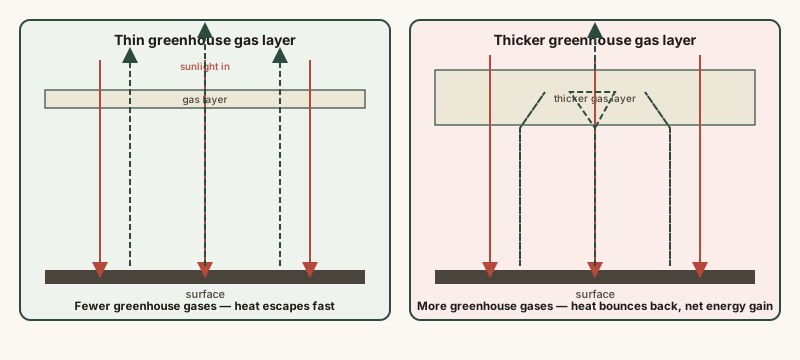
Energy flow: incoming sunlight vs. outgoing infrared, with and without added greenhouse gases
Both diagrams let in the same amount of sunlight — the difference is entirely on the outgoing side, where a thicker greenhouse gas layer bounces more infrared energy back down before it can escape, which is the entire mechanism in one picture.
Common mistakes
Common Mistakes
✕
Treating the greenhouse effect itself as inherently bad or unnatural.
→ The baseline greenhouse effect is natural and necessary for a habitable planet — the concern is specifically about intensifying it beyond the range life and infrastructure have adapted to, not the mechanism's mere existence.
✕
Assuming greenhouse gases block sunlight from reaching the surface.
→ Greenhouse gases are largely transparent to incoming shortwave sunlight — their effect is almost entirely on the outgoing longwave (infrared) side of the energy budget.
✕
Confusing water vapor's large natural role with it being the primary thing humans need to reduce.
→ Water vapor is a fast-responding feedback controlled by temperature, not a gas humans directly accumulate in the atmosphere — emissions policy targets CO2, methane, and other long-lived gases that humans add directly and that persist for decades to centuries.
Common misconception
“If the greenhouse effect keeps Earth warm and habitable, then more greenhouse gases should just make the planet more comfortably warm, with no downside.”
The natural greenhouse effect is calibrated to the climate life has evolved around and infrastructure has been built for — sea levels, growing seasons, storm patterns, and ecosystems are all tuned to a relatively narrow historical temperature range. Adding more greenhouse gases doesn't just nudge the thermostat comfortably; it shifts the whole system faster than many natural and human systems can adapt, which is the actual source of climate risk, not the existence of a greenhouse effect itself.
Quick check
What is the actual concern with adding extra greenhouse gases, given that a baseline greenhouse effect is necessary and beneficial?
What to do next
What to do next
Remember the core asymmetry: greenhouse gases are transparent to incoming sunlight but absorptive of outgoing infrared — that one-way effect is the entire mechanism.
When you see a claim that 'the greenhouse effect is fake,' check whether it's actually disputing the baseline mechanism (settled physics, observable on Venus and Mars for comparison) or the rate/magnitude of human intensification (the genuine area of ongoing research).
Look up NASA's CERES energy-budget data if you want to see the real measured imbalance rather than a modeled estimate.
Read the next post in this cluster distinguishing global warming from climate change to understand why scientists prefer the broader term.
FAQ
FAQ
Related terms
Related terms
Shortwave radiation
Sunlight arriving from the sun, mostly in the visible and ultraviolet range, which passes through the atmosphere with relatively little absorption.
Longwave radiation
Infrared energy that Earth's surface radiates back toward space after absorbing sunlight — the wavelength greenhouse gases are effective at intercepting.
Energy imbalance
The difference between the energy Earth absorbs from the sun and the energy it radiates back to space; a positive imbalance means the planet is gaining heat over time.
Runaway greenhouse effect
A hypothetical extreme feedback loop where warming causes more greenhouse gas release, causing more warming — the mechanism Venus's atmosphere is believed to have undergone; not the mechanism behind current Earth warming, which is a smaller and bounded forcing.
This entry was researched from public sources and drafted with AI-assisted tools, then edited — errors are still possible. Spot one, or want a topic covered? Read our disclaimer.
 KnowThis