Climate change doesn't create extreme weather events from nothing, but it measurably shifts the odds and intensity of many types of events — a scientific field called attribution science can now estimate, for specific real events, how much more likely or severe climate change made them compared to a world without human-driven warming.
Reading time
— 4 min
Updated
— Aug 22, 2026
Fact-reviewed
— Aug 22, 2026
Key Takeaways
Key Takeaways
1No single weather event is 'caused entirely by' climate change — extreme weather has always occurred naturally. What's changed is the odds and intensity of many event types.
2Attribution science runs climate model simulations both with and without human-driven warming, then compares how likely or severe a specific real event was in each scenario — producing a measurable statement like 'this heatwave was made twice as likely.'
3The physical link for heavy rainfall specifically follows from a simple, well-established relationship: warmer air holds more water vapor, so storms that do form can release more rain per event.
The concept
Extreme weather — heatwaves, heavy rainfall, droughts, intense hurricanes — has always happened; climate change doesn't invent new weather from scratch. What it does is shift the odds and intensity: many types of extreme events are becoming more frequent, more severe, or both, in ways scientists can now measure. Instead of asking "did climate change cause this storm," the more accurate scientific question is "how much more likely or intense did climate change make this storm compared to a world without human-driven warming" — and for a growing number of events, there's now a real, calculated answer.
This nuance — some event types have strong, well-established links, others have weaker or still-developing ones — is exactly why careful climate reporting distinguishes between event categories rather than treating "extreme weather" as one uniform claim.
Quick check
A climate scientist says 'this specific hurricane was not directly caused by climate change, but climate change made storms like it roughly 20% more intense on average.' Is this a contradiction?
Worked examples
Example 1: The 7% rule applied to a heavy rainfall event (baseline case)
If regional air temperature during a storm is 2°C warmer than the historical baseline, the Clausius-Clapeyron relation suggests the air can hold roughly 2 × 7% = 14% more water vapor than it could have at the historical baseline temperature. This doesn't guarantee every storm releases exactly 14% more rain, since actual rainfall depends on many other factors too, but it establishes the physical mechanism and rough scale by which a warmer atmosphere provides more available moisture for a given storm system to draw on.
Example 2: Rapid attribution of a real heatwave (edge case / variation)
Following the June 2021 Pacific Northwest heatwave, which set all-time temperature records in normally mild parts of the US and Canada, the World Weather Attribution research group ran rapid model comparisons and concluded the extreme heat was made dramatically more likely by human-driven climate change — their analysis suggested such an event would have been almost statistically impossible in a climate without that warming. This is a case where attribution confidence was high, given how directly heatwave probability follows from a shifted average temperature distribution.
Example 3: Lower-confidence attribution for tornado activity (real-world / applied case)
Unlike heatwaves and heavy rainfall, tornado formation depends on complex, small-scale atmospheric instability and wind shear conditions that current climate models don't resolve as precisely, and observational tornado records have historically been affected by improvements in detection technology over time, complicating trend analysis. As a result, the IPCC and most attribution researchers describe the climate change link to tornado frequency and intensity as an area of lower confidence and ongoing research, compared to the well-established links for heatwaves and heavy rainfall — an honest distinction that careful sourcing preserves rather than flattening into one blanket claim.
Quick check
Why does attribution science express higher confidence in the climate change link to heatwaves and heavy rainfall than to tornado frequency?
How it works (visual)
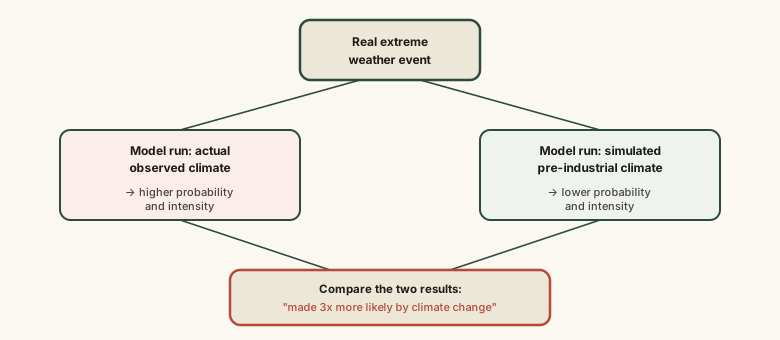
How attribution science compares a real event against a modeled world without climate change
The comparison between the two simulated worlds, not either simulation alone, is what produces the quantified attribution statement — the method inherently compares against a counterfactual rather than asserting a single event was "caused" outright.
Common mistakes
Common Mistakes
✕
Claiming a single extreme weather event was 'caused by' climate change in an absolute sense.
→ Use attribution-style language instead — climate change made the event more likely or more intense by some measurable amount, rather than being the sole, exclusive cause of an event type that also occurred before significant warming.
✕
Treating all types of extreme weather as having equally strong climate change links.
→ Recognize that confidence varies by event type — heatwaves and heavy rainfall have strong, well-established links; tornado and some hurricane-specific attributions carry more scientific uncertainty.
✕
Dismissing any single extreme event as 'just weather' with no relevance to the climate change discussion.
→ A single event isn't proof of a trend on its own, but modern attribution science can and does calculate a specific, real influence of climate change on many individual real events — it's not an all-or-nothing question.
Common misconception
“Since extreme weather has always existed throughout history, any specific storm or heatwave today can't reasonably be linked to climate change at all.”
Attribution science doesn't claim extreme weather is new — it measures how climate change has shifted the odds and intensity of specific event types compared to a modeled pre-industrial baseline. For many well-studied event categories, especially heatwaves and heavy rainfall, this produces confident, quantified findings (e.g., "this heatwave was made several times more likely"), even though similar event types occurred naturally in the past. The historical existence of extreme weather and a measurable modern climate change influence on it are not mutually exclusive claims.
Quick check
Does the fact that severe heatwaves occurred occasionally before significant human-driven warming mean modern heatwaves can't be meaningfully linked to climate change?
What to do next
What to do next
When discussing a specific extreme weather event, use attribution-style framing ('made more likely/intense by') rather than absolute causation language.
Check whether a climate change claim about extreme weather specifies the event type — confidence genuinely varies between heatwaves/rainfall (higher) and tornadoes/some hurricane metrics (lower).
Look up World Weather Attribution's published rapid studies (worldweatherattribution.org) if you want to see real quantified attribution findings for specific past events.
Remember the Clausius-Clapeyron relation (roughly 7% more atmospheric moisture per degree Celsius of warming) as the concrete physical mechanism behind intensified rainfall events specifically.
FAQ
FAQ
Related terms
Related terms
Attribution science
A research field that uses climate models to estimate how much more likely or severe a specific real weather event was made by human-driven climate change, compared to a simulated world without it.
Clausius-Clapeyron relation
A physical law establishing that warmer air can hold more water vapor — roughly 7% more per degree Celsius of warming — which is the mechanism behind climate change intensifying heavy rainfall events.
Heat dome
A persistent area of high atmospheric pressure that traps hot air over a region for an extended period, a weather pattern that climate change research suggests may be becoming more frequent or intense in some regions.
Baseline probability
How likely a given extreme weather event would have been in a hypothetical climate without human-driven warming, used as the comparison point in attribution studies.
Ocean surface pH has dropped by about 0.1 units since pre-industrial times. Since the pH scale runs from 0 to 14, does this represent roughly a 0.1/14 ≈ 0.7% change in acidity?
This entry was researched from public sources and drafted with AI-assisted tools, then edited — errors are still possible. Spot one, or want a topic covered? Read our disclaimer.
 KnowThis