 KnowThis
Key Takeaways
Key Takeaways
- 1Hurricanes are "warm-core" storms fueled by heat evaporating off warm tropical ocean water; nor'easters are "cold-core" storms fueled by the temperature clash between cold air and the warm Gulf Stream.
- 2The name comes from the wind direction hitting the coast (northeasterly), not the direction the storm itself travels — most nor'easters actually move up the coast from south to north.
- 3Because they're powered by temperature contrast rather than ocean heat, nor'easters can intensify explosively in cold months and produce blizzards — something a hurricane's warm-core engine can't do.
Nor'easter vs hurricane at a glance
| Hurricane | Nor'easter | |
|---|---|---|
| Fuel | Heat from warm tropical ocean water | Temperature contrast between cold Arctic air and milder air over the Gulf Stream |
| Core | Warm core | Cold core (extratropical) |
| Season | Atlantic season runs June 1 to November 30 | Any time of year, most frequent and violent September to April |
| Name means | Tropical cyclone with sustained winds of 74 mph or more | Winds over the coast are typically from the northeast |
| Typical hazards | Wind, storm surge, heavy rain | Heavy rain or snow, gale-force wind, rough seas, occasional coastal flooding |
| Where it forms | Tropical Atlantic and Caribbean | Between Georgia and New Jersey, within about 100 miles of the coast |
The concept
That temperature-clash engine is also why a nor'easter can do something no hurricane ever will: bury a coastline in snow.
A hurricane weakens rapidly as soon as it moves over land or cold water. Why doesn't the same thing happen to a nor'easter?
Worked examples
Example 1: A typical nor'easter forming (baseline case)
Example 2: Bombogenesis (edge case / variation)
Example 3: Coastal flooding impact (real-world / applied case)
Why can a nor'easter sometimes cause more repeated coastal flooding than a fast-moving hurricane with similar wind speeds?
How it works (visual)
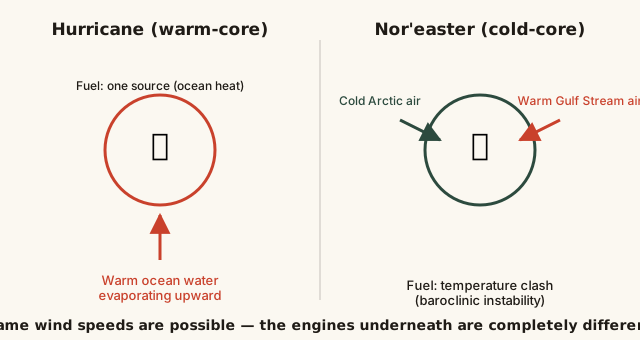
Notice the arrows feeding each storm come from different places entirely — one from below (ocean heat), one from the side (colliding air masses) — which is the whole reason these storms behave so differently even though both can produce hurricane-force winds and major coastal damage.
Common mistakes
Common Mistakes
Assuming "nor'easter" describes the direction the storm is traveling.
→ It describes the wind direction hitting the coast as the storm approaches — most nor'easters actually travel from south to north, up the coastline.
Thinking nor'easters only happen in winter.
→ They're most common and violent from September to April, but the temperature-contrast mechanism that fuels them can produce a nor'easter in any season.
Assuming a storm must be tropical to be dangerous.
→ Nor'easters routinely produce hurricane-force winds, major coastal flooding, and blizzard conditions — they're extratropical, not weaker.
Common misconception
“A nor'easter is basically just a hurricane that hits the Northeast instead of the South.”
They run on fundamentally different fuel. A hurricane is a warm-core storm that draws its entire energy from heat evaporating off warm tropical ocean water and collapses without it. A nor'easter is a cold-core, extratropical storm powered by the temperature clash between cold continental air and the warm Gulf Stream — a mechanism called baroclinic instability that has nothing to do with tropical ocean heat. That's also why a nor'easter can bring blizzard conditions, something no hurricane's warm engine can ever produce.
What to do next
What to do next
- If you live along the U.S. East Coast, follow National Weather Service nor'easter watches and warnings separately from hurricane advisories — the timing season and hazards (snow, ice, prolonged surge) differ.
- Treat a forecast "bomb cyclone" nor'easter with the same seriousness as a hurricane warning — the rapid pressure drop can produce comparable wind speeds.
- Check coastal flood risk across multiple tide cycles during a slow-moving nor'easter, not just at the storm's initial landfall.