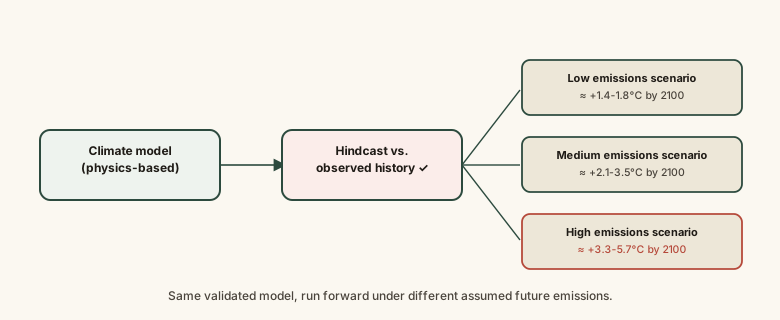
Climate models are physics-based simulations of the atmosphere, oceans, and land surface that are validated by successfully reproducing decades of already-observed climate data, then run forward under several different future greenhouse gas emissions scenarios to project a range of possible outcomes rather than a single fixed prediction.
Reading time
— 4 min
Updated
— Aug 22, 2026
Fact-reviewed
— Aug 22, 2026
Key Takeaways
Key Takeaways
1Climate models are physics-based simulations of energy, moisture, and circulation in the atmosphere and oceans — not statistical extrapolations of a trend line, and not extended weather forecasts.
2Models are validated through hindcasting: running them on the past and checking whether they reproduce already-observed, independently measured climate history before they're trusted for future projections.
3Climate projections are always presented as a range across multiple emissions scenarios and multiple independent models, not a single fixed number — the range itself reflects genuine scientific uncertainty about future human choices and natural variability, not a weakness in the physics.
The concept
A climate model is a computer program built on real physical laws — how heat moves, how water evaporates and condenses, how ocean currents circulate — applied across a 3D grid covering the entire planet. It's not the same thing as a weather forecast, which tries to predict specific conditions days ahead; a climate model instead projects long-term statistical patterns (average temperatures, precipitation trends) over decades. Scientists test these models by running them on the past first, checking whether they correctly reproduce climate history that's already been measured, before trusting their future projections.
Understanding that projections are scenario-dependent, not single fixed numbers, resolves a common source of confusion when different reports appear to cite different future temperature figures.
Quick check
Two climate reports project different global temperature increases by 2100 — one says 'about 1.8°C' and another says 'about 4°C.' Does this mean climate models are unreliable or contradictory?
Worked examples
Example 1: Hindcasting a known volcanic cooling event (baseline case)
When Mount Pinatubo erupted in 1991, it released sulfate aerosols that temporarily cooled global average temperature by about 0.5°C over the following year or two — a well-documented, independently measured event. Climate models given the same volcanic aerosol input successfully reproduce this temporary cooling dip in their simulated temperature output, which is exactly the kind of out-of-sample validation test (the model wasn't built specifically to match this one event) that builds confidence in a model's underlying physics.
Example 2: Comparing projections across the IPCC's shared socioeconomic pathways (edge case / variation)
The IPCC's Sixth Assessment Report presents projected warming under multiple named emissions scenarios (Shared Socioeconomic Pathways, or SSPs) — a low-emissions pathway projects roughly 1.4-1.8°C of warming by 2100 relative to pre-industrial levels, while a high-emissions pathway with limited climate policy projects roughly 3.3-5.7°C. These aren't competing predictions about the same future; they're the same physical model applied to genuinely different possible human emissions choices, illustrating why "what will the temperature be in 2100" doesn't have one single scientific answer independent of policy decisions made between now and then.
Example 3: The 1988 Hansen projection tracked against actual observed warming (real-world / applied case)
NASA scientist James Hansen's 1988 congressional testimony included model projections under three emissions scenarios (A, B, and C). Actual global emissions over the following decades tracked closest to his moderate "Scenario B" assumptions, and the observed global temperature record since then has tracked reasonably closely with Scenario B's projected warming — a real-world, multi-decade test of a climate model's forward-looking skill made publicly on record well before the outcome was known, not a retrospective fit.
Quick check
Why do climate scientists consider hindcasting an important test of a climate model's credibility?
How it works (visual)
From past validation to a range of future scenario-based projections
The model itself doesn't change between scenario runs — only the assumed future emissions input changes, which is why the resulting spread of projected outcomes reflects uncertainty about human choices, not uncertainty about the underlying physics.
Common mistakes
Common Mistakes
✕
Treating a climate model the same way as a short-term weather forecast.
→ Climate models project long-term statistical patterns over decades, not specific day-to-day conditions — weather forecasting and climate modeling use related physics but answer fundamentally different questions on different timescales.
✕
Assuming different cited future temperature figures mean climate scientists disagree with each other.
→ Check whether the different figures correspond to different assumed emissions scenarios — the same underlying model and physics can produce a wide range of outcomes depending only on future human emissions choices.
✕
Dismissing climate models as 'unproven' because the future hasn't happened yet.
→ Point to hindcasting — models are tested against decades of already-observed, independently measured climate history, including specific known events like volcanic cooling, before their future projections are trusted.
Common misconception
“Climate models are essentially just guesses or statistical trend lines extended into the future, with no real predictive track record.”
Climate models are physics-based simulations validated through hindcasting against decades of independently measured historical climate data, including specific documented events like volcanic-driven cooling. They also have a real, on-the-record forward-looking track record — James Hansen's 1988 congressional model projections, made under specific named scenarios well before the outcome was known, have tracked reasonably closely with subsequently observed global temperature trends under the scenario closest to actual emissions.
Quick check
What distinguishes a climate model from a simple extrapolated trend line drawn through past temperature data?
What to do next
What to do next
When you see a climate projection figure, check which emissions scenario it corresponds to before comparing it against a different cited figure.
Remember the key distinction: weather forecasts predict specific short-term conditions; climate models project long-term statistical patterns under different possible futures.
Look up NASA's or NOAA's climate modeling pages if you want to see how hindcasting validation actually works in more technical detail.
Read the extreme weather post in this cluster to see how the same modeling approach underlies attribution science for specific real events.
FAQ
FAQ
Related terms
Related terms
General circulation model (GCM)
A computer simulation that divides the atmosphere and oceans into a 3D grid and calculates how energy, moisture, and momentum move between grid cells over time, based on physical laws.
Emissions scenario
A defined set of assumptions about future greenhouse gas emissions (e.g. rapid reduction, moderate action, continued high emissions), used to run a climate model forward under different plausible futures rather than one fixed guess.
Hindcasting
Testing a climate model's validity by running it on past conditions and checking whether it correctly reproduces climate patterns and events that already happened and were independently measured.
Model ensemble
Running many independent climate models, or the same model many times with slightly varied starting conditions, and reporting the spread of results as a range rather than a single number, since no individual model perfectly captures every process.
Ocean surface pH has dropped by about 0.1 units since pre-industrial times. Since the pH scale runs from 0 to 14, does this represent roughly a 0.1/14 ≈ 0.7% change in acidity?
This entry was researched from public sources and drafted with AI-assisted tools, then edited — errors are still possible. Spot one, or want a topic covered? Read our disclaimer.
 KnowThis