Fossils & Geological Time: How Rock Layers Record Millions of Years
A fossil is preserved evidence of past life, most often formed through mineral replacement of original tissue, and dated using rock layer position combined with radiometric decay of isotopes with known half-lives.
Reading time
— 6 min
Updated
— Aug 16, 2026
Fact-reviewed
— Aug 16, 2026
Key Takeaways
Key Takeaways
1Most fossils aren't literal bone that 'turned to stone' — they form through mineral replacement, where groundwater gradually deposits minerals into buried remains, replacing the original organic material while preserving its structure in fine detail.
2Scientists date rock layers and fossils two ways: relative dating (the principle of superposition — older layers sit below younger ones) tells you the order of events, while radiometric dating, based on the fixed, known half-life of radioactive isotopes, tells you an actual age in years.
3Fossilization is extremely rare — it requires rapid burial and protection from decay, scavengers, and oxygen — which is why the fossil record captures only a tiny, biased fraction of all organisms that have ever lived.
The concept
A fossil is preserved evidence of ancient life — not just bones, but shells, footprints, leaf impressions, or even preserved burrows. Most fossils form when an organism's remains get buried quickly (protecting them from decay and scavengers) and, over a very long time, minerals dissolved in groundwater gradually replace the original material, turning it into rock while keeping its shape and fine structure. Scientists figure out how old a fossil is two ways: by looking at which rock layer it's in relative to others (deeper is usually older), and by measuring radioactive elements in the surrounding rock that decay at a fixed, known rate.
That's the mechanism behind how a fossil forms and how its age gets measured. Where the real precision comes from — and where the limits of each dating method matter — is worth working through with actual numbers.
Quick check
A fossil is found embedded in rock. Which of the following best describes how it most likely formed?
Worked examples
Example 1: Radiometric dating with carbon-14 (baseline case)
Carbon-14 has a half-life of 5,730 years, meaning after that much time, exactly half of an original sample's carbon-14 will have decayed into nitrogen-14. Using remaining fraction = 0.5^(elapsed time ÷ half-life): after exactly one half-life (5,730 years), remaining = 0.5^(5730/5730) = 0.5^1 = 50% of the original carbon-14 remains. After two half-lives (11,460 years), remaining = 0.5^2 = 25%. By measuring the ratio of remaining carbon-14 to the total carbon in a sample, and comparing it to this known decay curve, scientists calculate a sample's age directly — this is the working principle behind dating organic material like wood, charcoal, or bone from archaeological and recent geological sites.
Example 2: Why carbon dating can't date dinosaur fossils (edge case / variation)
Carbon-14 dating has a practical ceiling of around 50,000 years — after roughly nine half-lives, so little carbon-14 remains in a sample that it becomes too faint to measure reliably against background noise. Dinosaur fossils are typically tens to well over a hundred million years old, meaning any carbon-14 that was ever present decayed away almost immediately relative to that timescale, functionally erasing the isotope entirely. For rock and fossils this old, geologists instead use isotopes with far longer half-lives — potassium-argon dating (potassium-40's half-life is about 1.25 billion years) and uranium-lead dating are common choices — typically applied to volcanic ash or mineral layers found above and below the fossil-bearing rock, rather than to the fossil itself, since bone doesn't always retain the right isotopes cleanly over such vast timescales.
Quick check
A news article claims scientists 'carbon dated' a 70-million-year-old dinosaur fossil directly. What's wrong with this claim?
Example 3: Bracketing a fossil's age with volcanic ash layers (real-world / applied case)
Paleontologists often can't radiometrically date a fossil directly, so they date the rock layers around it instead. If a dinosaur fossil sits in a sedimentary rock layer between two volcanic ash layers — one below it, one above — geologists can radiometrically date the crystals in each ash layer using potassium-argon or a similar long-half-life method, since volcanic ash contains fresh, datable mineral crystals formed at the moment of eruption. If the lower ash layer dates to 71 million years and the upper one to 69 million years, the fossil between them must be somewhere in that 2-million-year window — combining the relative-dating principle of superposition (it's below the younger layer, above the older one) with two solid absolute-dating anchor points. This bracketing technique is standard practice and is exactly how most precise dinosaur fossil ages in the scientific literature are actually established.
How it works (visual)
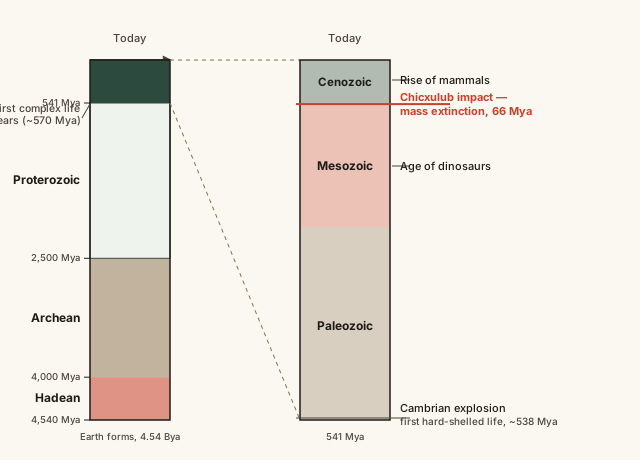
The geologic time scale: eons, eras, and major events in Earth's 4.54-billion-year history
Notice how compressed recent time is compared to the vast stretch of the Hadean, Archean, and Proterozoic eons at the bottom — those three eons alone span roughly the first 4 billion years of Earth's history, while nearly all the complex, easily fossilized life you'd recognize appears only in the much shorter Phanerozoic eon at the very top, starting around 541 million years ago. The mass extinction line at 66 million years ago marks the Chicxulub asteroid impact, which ended the age of non-avian dinosaurs and is itself dated using the same radiometric methods applied to the layer of iridium-rich sediment it left worldwide.
Common mistakes
Common Mistakes
✕
Assuming most dead organisms become fossils.
→ Fossilization is extremely rare — it requires rapid burial and protection from decay, scavengers, and oxygen. The vast majority of organisms that have ever lived left no fossil record at all.
✕
Assuming carbon dating can be used to date anything old, including rocks or dinosaur bones directly.
→ Carbon-14 dating only works reliably on organic material younger than about 50,000 years. Dinosaur-era fossils, tens of millions of years old, are dated using long-half-life isotopes like potassium-argon or uranium-lead, usually on surrounding volcanic layers.
✕
Assuming rock layers are always found in a neat, undisturbed, easy-to-read order everywhere.
→ Tectonic folding, faulting, and erosion can tilt, disturb, or completely remove layers in a given location — which is why geologists cross-check the same time period across multiple, geographically separated sites.
Common misconception
“Fossils are literal bones that gradually turned into stone.”
Most fossils form through permineralization: mineral-rich groundwater seeps through buried remains and gradually deposits minerals like silica or calcite into their pore spaces, replacing the original organic material with rock while preserving its original structure in remarkable detail — down to the microscopic level in exceptional cases, according to the USGS and Smithsonian. The original bone or tissue isn't simply hardening into stone on its own; it's being replaced, atom by atom, by different minerals entirely, over a process that typically takes thousands of years and requires very specific burial conditions to even begin.
Quick check
If a fossilized bone is chemically analyzed, why does it typically show a mineral composition different from ordinary living bone?
Try it yourself
Calculate remaining radioactive isotope after a given time (using half-life)
Percent of original isotope remaining50
What to do next
What to do next
Try the calculator above with an elapsed time of 17,190 years (three carbon-14 half-lives) to see how quickly the remaining fraction drops toward the method's practical detection limit.
Next time you visit a natural history museum, look for a fossil's age and try to guess whether it was likely dated using carbon-14 or a longer-half-life isotope, based on how old it is.
Look up your region's local geology to see which era or period its exposed rock layers date to.
Read the related entry on Earth's Structure & Plate Tectonics to see how plate movement and mountain-building expose ancient rock layers at the surface for study.
FAQ
FAQ
Related terms
Related terms
Fossil
Preserved evidence of past life, including mineral-replaced remains, molds and casts, trace fossils like footprints, or organisms preserved in amber.
Permineralization
The most common fossilization process, in which dissolved minerals carried by groundwater fill and gradually replace the pore spaces and organic structure of buried remains.
Radiometric dating
A technique for determining a rock or mineral's age by measuring the ratio of a radioactive isotope to its decay product, using the isotope's known, constant half-life.
Half-life
The fixed amount of time it takes for half of a sample of a radioactive isotope to decay into its stable decay product.
Superposition (principle of)
The geological principle that, in an undisturbed sequence of rock layers, the oldest layer sits at the bottom and each successive layer above it is younger.
Geologic time scale
The standard timeline dividing Earth's roughly 4.54-billion-year history into eons, eras, periods, and epochs, based on major changes in rock layers and fossil life.
This entry was researched from public sources and drafted with AI-assisted tools, then edited — errors are still possible. Spot one, or want a topic covered? Read our disclaimer.
 KnowThis