Energy Resources Around the World: Why Some Regions Run on Oil and Others on Geothermal
Energy resources are distributed by two separate logics — fossil fuels follow ancient sedimentary geology, while renewable potential follows present-day climate, terrain, and tectonic activity.
Reading time
— 5 min
Updated
— Aug 16, 2026
Fact-reviewed
— Aug 16, 2026
Key Takeaways
Key Takeaways
1Fossil fuels and renewable energy potential follow two completely different maps — fossil fuels follow ancient sedimentary geology from millions of years ago, while renewable potential follows today's climate, terrain, and tectonic activity.
2Coal has been found on every continent, including Antarctica, because ancient swamp forests existed on landmasses that later drifted apart via plate tectonics — coal's location is a fossilized record of continental drift.
3A country's renewable energy mix is shaped directly by its geography: Iceland runs largely on geothermal and hydro because of its volcanic, glacial terrain, not because of policy choices alone.
The concept
Energy resources aren't spread evenly across the globe. Oil and natural gas cluster heavily in the Middle East and a handful of other regions. Coal shows up on nearly every continent. Meanwhile, renewable energy potential follows a completely different map — sunny deserts are best for solar, mountainous rainy regions are best for hydropower, and volcanically active places like Iceland are uniquely suited to geothermal energy. Where a country sits on the map largely decides which energy sources are cheapest and most abundant for it to use.
That split between "ancient geology" and "present-day geography" is the key to understanding almost every regional energy story — and nowhere is it clearer than in a country that runs almost entirely on one renewable source because of a geographic accident.
Quick check
Coal deposits have been found on every continent, including Antarctica, despite Antarctica's current climate being far too cold for the swamp forests that form coal. What explains this?
Worked examples
Example 1: Why the Middle East holds so much of the world's oil (baseline case)
The Persian Gulf region sits atop an unusually large, unusually productive set of sedimentary basins that formed from an ancient shallow sea rich in marine organic matter, later buried under the right depth and temperature conditions to convert that organic matter into oil at enormous scale, and then capped by rock layers that trapped it in place rather than letting it escape to the surface. That specific, rare combination — rich source rock, ideal burial depth, and an effective trap — is why the Middle East holds roughly half of the world's proven oil reserves even though sedimentary basins exist on every continent; most other basins simply didn't hit all three conditions at the same scale.
Example 2: Iceland's near-total renewable electricity (edge case / variation)
Iceland sits directly on the Mid-Atlantic Ridge, a tectonic plate boundary where magma rises close to the surface, and is heavily glaciated with abundant meltwater runoff. That combination gives it two renewable resources most countries can't match at the same intensity: geothermal heat close enough to the surface to tap directly, and reliable hydropower from glacial and rainfall-fed rivers with significant elevation drop. As a result, Iceland generates the overwhelming majority of its electricity from geothermal and hydropower sources combined — a striking edge case showing that a country's renewable mix can be dictated almost entirely by tectonic and glacial geography rather than by policy alone, in sharp contrast to a flat, non-volcanic country with no comparable geothermal or hydro potential.
Quick check
Iceland generates the large majority of its electricity from geothermal and hydropower. What makes this possible in a way most countries can't replicate?
Example 3: Estimating years of remaining oil reserves (real-world / applied case)
Using commonly cited global figures of roughly 1,650 billion barrels of proven oil reserves against annual global production of roughly 36 billion barrels per year, dividing reserves by annual production gives a reserve-to-production ratio of about 46 years. This is the standard "years of oil left at current rates" figure often cited in energy reporting — but it's worth reading carefully: this ratio has hovered in a similar range for decades, not because consumption has stopped, but because ongoing exploration and improved extraction technology keep adding to the "known reserves" side of the equation almost as fast as production draws it down.
How it works (visual)
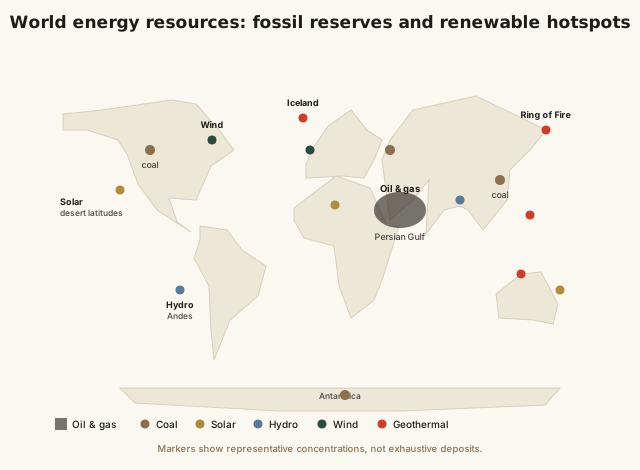
World map: major fossil fuel reserves and renewable energy hotspots
Compare the fossil fuel shading to the renewable shading and the two maps barely overlap — fossil fuel wealth follows ancient sedimentary basins from tens or hundreds of millions of years ago, while renewable potential follows today's climate and tectonic activity. A country can be poor in one map and rich in the other, which is exactly the situation many nations are now navigating as they shift their energy mix.
Common mistakes
Common Mistakes
✕
Assuming a country's fossil fuel wealth predicts its renewable energy potential, or vice versa.
→ These follow separate geologic and geographic logics — a country can have world-class solar or geothermal potential with little to no fossil fuel reserves, and the reverse is just as common.
✕
Treating the 'reserve-to-production ratio' as a literal countdown to running out.
→ It's a snapshot estimate that changes as exploration finds new reserves and technology improves extraction — the ratio has stayed roughly stable for decades precisely because of this, not because consumption stopped.
✕
Assuming renewable energy potential is equally strong everywhere.
→ Solar, wind, hydro, and geothermal potential are all geographically constrained — a landlocked, flat, cloudy, non-volcanic region genuinely has weaker options across all four than a sunny, mountainous, tectonically active one.
Common misconception
“Fossil fuel deposits form directly from the remains of dinosaurs.”
Oil and natural gas form almost entirely from the remains of ancient marine microorganisms — plankton and algae — buried in sedimentary basins and transformed by heat and pressure over millions of years; coal forms from ancient swamp-forest plants, not animals at all. Dinosaurs contributed essentially no meaningful mass to fossil fuel deposits. The dinosaur association is a marketing myth traceable in large part to Sinclair Oil's dinosaur logo, adopted in the 1930s to suggest deep geologic age — not an accurate description of what fossil fuels are actually made from.
Quick check
What are oil and natural gas actually formed from?
Try it yourself
Reserve-to-production ratio: years of a fuel remaining at current production
Years remaining at current rate45.8 years
What to do next
What to do next
Try the calculator above with your country's specific reserve and production figures, if published by its energy ministry or the EIA, to see its own reserve-to-production ratio.
Next time you see a country described as 'energy rich,' check whether that's fossil fuel wealth, renewable potential, or both — they're driven by different geography.
Look up your region's dominant renewable source (solar, wind, hydro, geothermal) and connect it to the specific geographic feature — sun, terrain, rainfall, or tectonics — that makes it viable there.
Read the related entry on Renewable vs. Non-Renewable Resources for the underlying science of why fossil fuels are finite on a human timescale and renewables aren't.
FAQ
FAQ
Related terms
Related terms
Fossil fuel
An energy source — oil, natural gas, or coal — formed from the remains of ancient organisms buried and transformed by heat and pressure over millions of years.
Reserve-to-production ratio
A resource's known remaining reserves divided by its current annual extraction rate, giving a rough 'years remaining at today's rate' estimate; it typically rises over time as exploration finds more reserves.
Geothermal energy
Energy harnessed from heat stored inside the Earth, most economically accessible in tectonically or volcanically active regions.
Sedimentary basin
A large, bowl-shaped depression in Earth's crust where sediment and organic matter accumulate over millions of years, the setting in which oil and natural gas form.
Nonrenewable resource
A resource, like oil, gas, or coal, that forms far slower than humans consume it, so it is effectively finite on a human timescale.
Iceland generates the large majority of its electricity from geothermal and hydropower. What makes this possible in a way most countries can't replicate?
This entry was researched from public sources and drafted with AI-assisted tools, then edited — errors are still possible. Spot one, or want a topic covered? Read our disclaimer.
 KnowThis