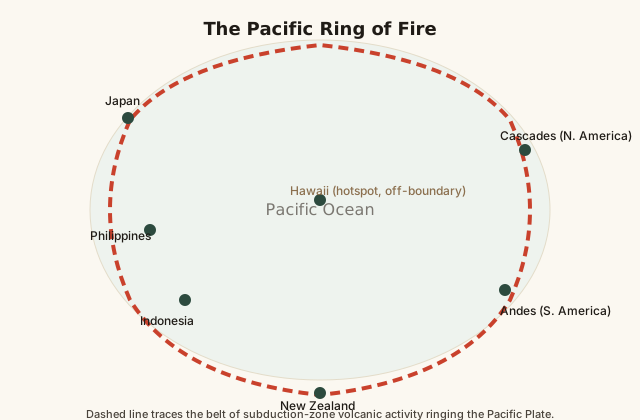
Volcanoes form mostly at tectonic plate boundaries where magma finds a path to the surface, which is why roughly 75% of the world's active volcanoes ring the Pacific Ocean along a belt geologists call the Ring of Fire.
Reading time
— 4 min
Updated
— Sep 24, 2026
Fact-reviewed
— Aug 16, 2026
Key Takeaways
Key Takeaways
1About 75% of the world's roughly 1,350 potentially active volcanoes sit along the Pacific 'Ring of Fire,' a belt that traces tectonic plate boundaries, not a coincidence of geography.
2Volcanoes erupt because magma is less dense than solid rock and forced upward by pressure, finding whatever path — a vent, a crack, a weak point — lets it reach the surface.
3'Active,' 'dormant,' and 'extinct' describe a volcano's likelihood of erupting again, not a strict on/off state — a 'dormant' volcano has erupted before and is expected to again, unlike an 'extinct' one.
The concept
A volcano is essentially a vent where molten rock, gas, and ash from deep underground can reach Earth's surface. Most of them aren't randomly scattered — they cluster heavily along the edges of tectonic plates, especially around the Pacific Ocean in a belt called the Ring of Fire, which includes well-known volcanoes in Japan, Indonesia, the Philippines, and the western coasts of North and South America.
Knowing where volcanoes form explains the map. The next question is what actually determines whether a given volcano is a real near-term risk or a landform that's effectively gone quiet for good.
Quick check
A volcano hasn't erupted in 300 years but geologists still classify it as 'dormant' rather than 'extinct.' What does that classification actually mean?
Worked examples
Example 1: Mount Fuji, a subduction-zone volcano (baseline case)
Japan sits where several tectonic plates meet and subduct beneath each other, making it one of the most volcanically active countries on Earth, home to roughly 111 active volcanoes. Mount Fuji, its most famous, is a classic subduction-zone stratovolcano built from repeated eruptions of alternating lava and ash layers. It's currently classified as active, with its last confirmed eruption in 1707-1708 — dormant in practice, but not extinct, since Japan's tectonic setting means the underlying conditions that built it haven't gone away.
Example 2: Hawaii, a hotspot volcano chain (edge case)
The Hawaiian Islands don't sit on a plate boundary at all — they're the visible result of the Pacific Plate sliding slowly northwest over a stationary mantle hotspot roughly 40 million years or more. Each island formed when it was directly over the hotspot; as the plate moved on, the volcano's magma supply was cut off and it became extinct, while a new island began forming behind it. The Big Island's Kilauea sits directly over the hotspot today and is one of the most continuously active volcanoes on Earth, while the older islands to the northwest — like Kauai — are extinct and heavily eroded.
Despite the risk, some of the most densely farmed and populated regions on Earth sit near active volcanoes — Indonesia's Java, parts of the Philippines, and areas around Mount Etna in Italy among them. Weathered volcanic ash and lava break down into mineral-rich soil, unusually fertile for growing rice, coffee, and other crops. Millions of people live within range of an eruption specifically because the same geological process that creates the hazard also created the region's agricultural productivity — a genuine tradeoff, not an oversight.
How it works (visual)
The Pacific Ring of Fire
Notice the pattern traces plate boundaries almost exactly — it's not a coincidence of geography, it's a direct map of where tectonic plates are colliding or sliding past each other around the Pacific.
Common mistakes
Common Mistakes
✕
Assuming 'dormant' means safe or effectively extinct.
→ Treat dormant volcanoes as still-monitored risks — the label means 'not currently erupting but capable of erupting again,' not 'done forever.'
✕
Assuming all volcanoes form at plate boundaries.
→ Remember hotspot volcanoes like Hawaii's form independent of plate edges, over a stationary mantle plume — a real, if less common, third mechanism.
✕
Thinking volcanic activity is purely a hazard with no benefit.
→ Recognize volcanic soil is genuinely, measurably more fertile — it's part of why so many people historically settled near active volcanic regions despite the risk.
Common misconception
“Lava is the most dangerous part of a volcanic eruption.”
For most well-known volcanoes, lava usually moves slowly enough to outrun on foot. The deadliest hazards are typically pyroclastic flows — fast-moving currents of superheated gas and volcanic material that can travel over 100 km/h — along with ashfall collapsing roofs, and volcanic gases. The 79 AD eruption that buried Pompeii killed most victims via pyroclastic flow and ashfall, not slow-moving lava.
Try it yourself
Estimate a Hawaiian-chain island's age from hotspot drift
Approximate age of that island (million years)7.14
What to do next
What to do next
Look up the nearest active or dormant volcano to where you live, or to a place you plan to visit — the Smithsonian Global Volcanism Program keeps a public, searchable database.
Next time you see a chain of islands, check whether it could be a hotspot trail like Hawaii's — the ages of the islands should increase steadily in one direction.
If you live near volcanic soil, look into what crops are traditionally grown there — it's a fast way to understand the local agricultural history.
FAQ
FAQ
Related terms
Related terms
Ring of Fire
A roughly 40,000-kilometer horseshoe-shaped belt around the Pacific Ocean where most of the world's active volcanoes and earthquakes occur, following tectonic plate boundaries.
Magma
Molten rock beneath Earth's surface; once it erupts above ground it's called lava.
Subduction zone
A boundary where one tectonic plate slides beneath another, often melting into magma that fuels volcanic activity above it.
Dormant volcano
A volcano that hasn't erupted recently but is expected to erupt again in the future, distinct from an extinct volcano that is not expected to erupt again.
This entry was researched from public sources and drafted with AI-assisted tools, then edited — errors are still possible. Spot one, or want a topic covered? Read our disclaimer.
 KnowThis