Mountains form mainly where tectonic plates collide, volcanoes erupt, or crust cracks and lifts along faults — and once formed, they're locked in a permanent tug-of-war between the forces building them up and erosion wearing them back down.
Reading time
— 4 min
Updated
— Sep 24, 2026
Fact-reviewed
— Aug 16, 2026
Key Takeaways
Key Takeaways
1Most great mountain ranges form where tectonic plates collide and crumple the crust between them — the Himalayas are still rising today because India is still colliding with Asia.
2A mountain's height is a balance, not a one-time event — uplift from tectonic forces fights a constant, ongoing battle against erosion from wind, water, and ice.
3Old mountain ranges look different from young ones: the Appalachians, once possibly taller than the Himalayas, have been worn down and rounded over roughly 300 million years of erosion.
The concept
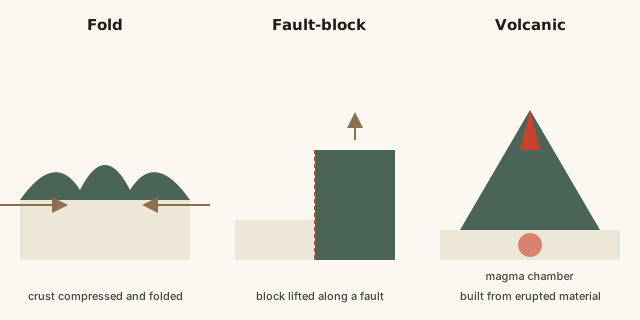
Mountains mostly form when two pieces of Earth's crust push into each other and the ground has nowhere to go but up. The most dramatic example is the Himalayas, created by India — once a separate landmass — slowly ramming into Asia over tens of millions of years and still pushing today. Not every mountain forms this way, though: volcanoes build mountains out of erupted material, and some mountains form when cracks in the crust let huge blocks of rock get pushed upward.
Formation explains where a mountain comes from. What happens next — the slow fight between uplift and erosion — explains why mountain ranges of different ages look so different from each other.
Quick check
The Appalachian Mountains are geologically much older than the Himalayas but are far shorter today. What's the main reason?
Worked examples
Example 1: Mount Everest and active fold-mountain growth (baseline case)
Mount Everest, part of the Himalayas, stands at 8,849 meters — the current official height, confirmed by a joint Nepal-China survey published in 2020, using GPS measurements taken at the summit. Because the Indian Plate is still pushing north into the Eurasian Plate, Everest is still rising, by roughly a few millimeters a year, while also shifting slightly northeast due to the same tectonic motion. It's a textbook fold-mountain case: two plates colliding, crust folding upward, and the process still actively running today.
Example 2: The Appalachians as an eroded, ancient range (edge case)
The Appalachian Mountains formed roughly 480 million years ago and were built up further through several later collisions, including the assembly of the supercontinent Pangaea around 300 million years ago. At their peak, some estimates suggest they may have reached heights comparable to the modern Himalayas or Alps. But active uplift stopped long ago, and roughly 300 million years of wind, water, and ice erosion has worn them down to a highest point — Mount Mitchell, in North Carolina — of just 2,037 meters. The rounded, worn shape of the Appalachians versus the Himalayas' sharp, jagged peaks is a direct visual record of that difference in age and ongoing activity.
Example 3: Why mountain height estimates get revised (real-world case)
Mount Everest's official height has changed more than once — a 1955 Indian survey measured 8,848 meters, and the 2020 Nepal-China joint survey revised it to 8,848.86 meters (rounded to 8,849). The revision reflects both better GPS and satellite measurement technology and the fact that Everest's height genuinely changes slowly over time due to ongoing tectonic uplift, a 2015 earthquake that may have affected regional elevation, and snow/ice depth at the summit varying by season — which is why surveys specify whether they're measuring the rock summit or the snow cap on top of it.
How it works (visual)
Three ways mountains form: fold, fault-block, and volcanic
Notice that all three mechanisms move rock upward, but through completely different physical processes — compression and folding, fracturing and block uplift, or eruption and accumulation. A single real-world mountain range can even show more than one process at once.
Common mistakes
Common Mistakes
✕
Assuming all mountains form the same way (plate collision).
→ Remember there are at least three distinct mechanisms — fold, fault-block, and volcanic — and a single mountain can involve more than one.
✕
Assuming a mountain's current height is fixed and permanent.
→ Treat height as a snapshot of an ongoing balance between uplift and erosion — it changes over geological time, and sometimes measurably within a human lifetime.
✕
Judging a mountain range's 'impressiveness' only by height.
→ Age and geological activity matter as much as height — an eroded 300-million-year-old range like the Appalachians tells a different, equally significant story than a young, still-rising range like the Himalayas.
Common misconception
“Mountains, once formed, stay the same height forever.”
Mountains are constantly changing, just slowly enough that it's invisible on human timescales without precise instruments. Active ranges like the Himalayas are still gaining height from tectonic uplift; inactive, ancient ranges like the Appalachians have been net losing height to erosion for hundreds of millions of years. "Mountain height" is really a live balance between two competing forces, not a fixed number.
Try it yourself
Estimate future height gain from steady uplift
Estimated height after that many years (meters)8,854
What to do next
What to do next
Look up which mountain range is closest to you and check whether it's still tectonically active or an old, eroded range — it changes what you're actually looking at.
Next time you see a jagged, sharp-peaked mountain versus a rounded, smooth one, guess which is geologically younger before checking — sharpness is a real, visible age clue.
Check whether your region sits near a fold, fault-block, or volcanic mountain system — it also tells you what kind of geological hazards (earthquakes, volcanic activity) are relevant nearby.
FAQ
FAQ
Related terms
Related terms
Fold mountains
Mountains formed when two tectonic plates collide and compress the crust between them into folds, like a rug pushed from both ends.
Fault-block mountains
Mountains formed when the crust cracks along faults and large blocks are pushed up or tilted, rather than folded.
Orogeny
The geological process of mountain formation, typically driven by tectonic plate collision over millions of years.
Isostasy
The equilibrium between the crust and the denser mantle beneath it — crust 'floats' on the mantle, and thicker crust (like a mountain root) sits both higher and deeper, like a large iceberg riding higher and deeper than a small one.
This entry was researched from public sources and drafted with AI-assisted tools, then edited — errors are still possible. Spot one, or want a topic covered? Read our disclaimer.
 KnowThis