Natural Resources by Region: Why Some Places Have Them and Others Don't
Natural resources are distributed unevenly across the world because the geologic processes that create them — ancient plate collisions, sedimentary burial, volcanic activity — only happened in specific places.
Reading time
— 5 min
Updated
— Sep 24, 2026
Fact-reviewed
— Aug 16, 2026
Key Takeaways
Key Takeaways
1Resources aren't scattered randomly — metal ores concentrate near ancient volcanic and tectonic activity, while oil and gas form only in sedimentary basins that buried organic matter under the right heat and pressure for millions of years.
2A small number of countries can dominate a global resource because the geology that created it is genuinely rare — the Democratic Republic of the Congo alone accounts for the large majority of the world's mined cobalt.
3Having abundant resources doesn't automatically make a country wealthy — the 'resource curse' describes how resource-rich economies can underperform resource-poor ones without strong institutions to manage the windfall.
The concept
A natural resource is anything useful pulled from the earth — oil, copper, timber, fresh water, fertile soil. These aren't spread evenly around the globe. The Middle East sits on roughly half the world's proven oil reserves. Chile and Australia dominate lithium. Central Africa holds most of the world's cobalt. This isn't random luck — it comes down to what happened to that specific patch of ground over millions or billions of years of geologic history.
Knowing how a resource forms tells you where to expect it — but it doesn't tell you what having it actually does for a country's economy, which turns out to be far less automatic than it sounds.
Quick check
Why does the Democratic Republic of the Congo produce most of the world's cobalt, rather than cobalt being spread evenly across many countries?
Worked examples
Example 1: The Central African Copperbelt (baseline case)
The Copperbelt stretches across the DRC's Katanga province and neighboring Zambia — a roughly 500-kilometer arc of sediment-hosted copper-cobalt ore formed around 800 million to 600 million years ago, when copper- and cobalt-rich fluids moved through ancient sedimentary rock and precipitated out as ore minerals. That single geologic belt is why the DRC alone supplies the large majority of the world's mined cobalt today — an essential ingredient in lithium-ion batteries — even though cobalt is a genuinely rare element in Earth's crust overall.
Example 2: Japan — an industrial power with almost no domestic resources (edge case / variation)
Japan runs one of the world's largest manufacturing economies while sitting on almost no oil, gas, or coal of its own — the country imports nearly all its energy resources. This looks contradictory until you separate resource wealth from economic wealth: Japan compensated by building trade relationships and manufacturing capability rather than extraction industries, importing raw materials, refining and assembling them into higher-value goods (electronics, cars, machinery), and exporting the finished product. It's a clear counterexample to the assumption that a strong economy requires strong domestic resources.
Quick check
Japan has almost no domestic oil, gas, or coal, yet has one of the world's largest economies. What does this best illustrate?
Example 3: The lithium-ion battery supply chain (real-world / applied case)
Building an electric-vehicle battery draws on resource geography from three separate continents. Lithium is concentrated in South America's "lithium triangle" (Chile, Argentina, Bolivia) and in hard-rock deposits in Australia, both shaped by specific evaporite basin and volcanic-rock geology. Cobalt draws heavily on the DRC's Copperbelt. Nickel and graphite draw on other regional deposits again, including Indonesia and China. No single country holds the full set of raw materials a battery needs — which is exactly why the modern battery supply chain is a genuinely global, multi-country logistics problem, not a domestic manufacturing one.
Quick check
A single electric-vehicle battery typically requires lithium, cobalt, nickel, and graphite sourced from several different countries. Why can't one country supply all of these on its own?
How it works (visual)
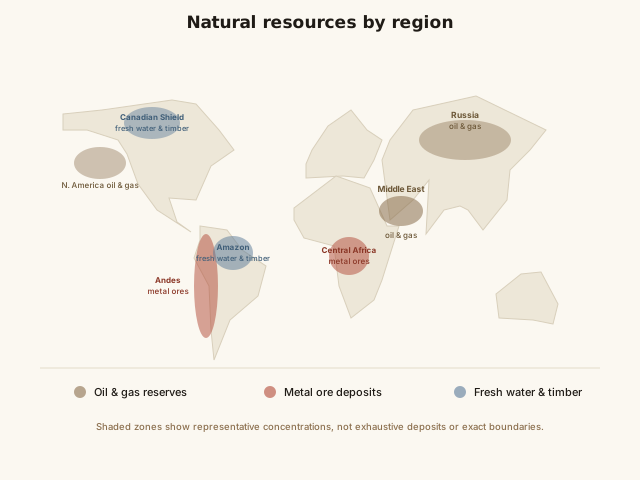
World map: major regional concentrations of fossil fuels, metals, and fresh water
Notice how the shaded regions don't line up with country borders — they follow the underlying geology: sedimentary basins for fossil fuels, ancient volcanic/tectonic belts for metal ores, and river-basin/forest geography for fresh water and timber. Political borders were drawn long after (and mostly without regard to) these geologic boundaries, which is part of why resource wealth and national wealth don't automatically line up.
Common mistakes
Common Mistakes
✕
Assuming resource wealth and national wealth are the same thing.
→ They're correlated but not equivalent — the 'resource curse' shows resource-rich countries can underperform resource-poor ones without strong institutions to manage extraction revenue.
✕
Thinking a resource is available 'wherever you dig deep enough.'
→ Ore deposits and fossil fuel basins require specific geologic histories — most of Earth's crust simply doesn't contain economically mineable concentrations of any given resource.
✕
Assuming a country's current resource map is permanent and unchanging.
→ New deposits are still being discovered and mapped, and reserve estimates rise and fall with exploration technology and market prices — 'reserves' are an economic category, not a fixed geologic fact.
Common misconception
“Countries with the most natural resources are automatically the wealthiest.”
Some of the most resource-rich countries on Earth — including several with vast oil, mineral, or timber wealth — have struggled economically, while resource-poor countries like Japan and Singapore built some of the world's strongest economies. Economists call the opposite pattern the resource curse: heavy reliance on extraction revenue can crowd out other industries, invite corruption, and leave an economy dangerously exposed to commodity price swings. Norway is the frequently cited counterexample — it manages its oil wealth through a sovereign wealth fund and strong institutions, showing the resource itself isn't the deciding factor; how it's managed is.
Quick check
Some resource-rich countries end up economically worse off than resource-poor ones. What does the term for this pattern refer to, and what actually drives it?
Try it yourself
Reserve-to-production ratio: years of a resource left at current extraction rates
Years remaining at current rate40.0 years
What to do next
What to do next
Try the calculator above with global copper reserves (~880 million tons) against annual production (~22 million tons) to see the rough reserve-to-production ratio — then note this number tends to rise over time as exploration finds more.
Next time you read about a resource-rich country's economy, ask whether the resource wealth is being converted into broad development or concentrated in a narrow extraction sector.
Look up which resources your own country imports versus produces domestically — it's usually a clearer picture of national resource geography than headlines suggest.
Read the related entry on Energy Resources Around the World to see how this same logic applies specifically to oil, gas, coal, and renewables.
FAQ
FAQ
Related terms
Related terms
Natural resource
A material or substance found in nature that has economic value — minerals, fossil fuels, timber, fresh water, and fertile soil are all examples.
Ore deposit
A concentrated pocket of a valuable mineral, dense enough to be profitably mined, formed by specific geologic processes rather than spread evenly through rock.
Sedimentary basin
A large, bowl-shaped depression in Earth's crust where layers of sediment — and often organic material that later becomes oil and gas — accumulate over millions of years.
Reserve-to-production ratio
A resource's known remaining reserves divided by its current annual extraction rate, giving a rough 'years remaining at today's rate' estimate.
Resource curse
The pattern where countries rich in natural resources sometimes end up with slower economic growth, more corruption, or more conflict than resource-poor countries, due to overreliance on extraction industries.
This entry was researched from public sources and drafted with AI-assisted tools, then edited — errors are still possible. Spot one, or want a topic covered? Read our disclaimer.
 KnowThis