 KnowThis
Key Takeaways
Key Takeaways
- 1A house loses conditioned air two different ways: air infiltration through gaps and cracks, and conduction, where heat passes directly through solid walls, windows, and doors.
- 2Weatherstripping only addresses air infiltration — it seals the physical gaps air moves through — and does nothing to slow heat conducting through an otherwise solid, well-sealed surface.
- 3A drafty room and a cold room aren't necessarily the same problem: a draft points to an air-sealing gap, while a uniformly cold surface with no draft points to a conduction (insulation) issue instead.
The concept
Once infiltration and conduction are treated as two separate problems rather than one vague "the house loses heat" issue, a room's specific symptoms — a draft you can feel with your hand versus a wall that's just uniformly cold to the touch — become diagnostic clues pointing to which fix actually applies, and often explain why some rooms run persistently colder than others in the same house. An exterior-wall gap that lets in a draft is also exactly the kind of weak point that can let a nearby supply pipe drop cold enough to freeze in hard winter weather.
A homeowner feels a distinct, moving draft of cold air near the bottom of an exterior door on a windy day. Which heat-loss mechanism does this most directly indicate?
Worked examples
Example 1: A drafty exterior door (baseline case)
A homeowner can feel cold air moving around the edges of an exterior door, especially near the bottom, whenever it's windy outside. This is a clear infiltration case — there's an actual physical gap, likely a worn or missing door sweep at the bottom and a compression seal that's lost its shape around the frame. Installing new weatherstripping — a fresh compression seal around the frame and a new door sweep at the bottom — directly closes that gap and stops the draft, because the fix matches the mechanism: a sealing problem gets a sealing solution.
Installing a new door sweep and compression seal eliminates a felt draft around an exterior door. What does the fact that this worked confirm about the original problem?
Example 2: A perfectly sealed but uninsulated attic wall (edge case / variation)
An attic knee wall has no detectable drafts anywhere but still feels cold and loses heat quickly. What does the absence of any draft, combined with the coldness, suggest?
Example 3: Sealing a whole house before adding attic insulation (real-world / applied case)
A home energy auditor recommends air-sealing and weatherstripping a house — around window and door frames, attic hatches, and plumbing penetrations — before adding new attic insulation, even though the homeowner initially just wanted more insulation. The sequencing matters because adding insulation on top of an unsealed attic floor doesn't stop warm household air from still leaking up into the attic through existing gaps; it just adds material around a problem that's still happening underneath it. Sealing the air-leak points first, then adding insulation, addresses both mechanisms in the order that actually gets the full benefit of each, rather than layering an insulation fix over an infiltration problem that's left untouched.
Why would an energy auditor recommend air-sealing a house before adding new attic insulation, rather than just adding the insulation directly?
How it works (visual)
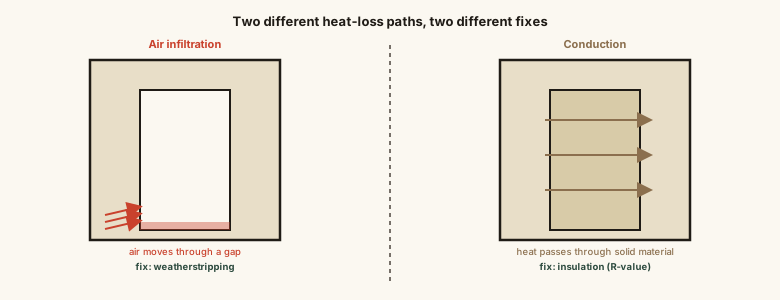
Notice that the left panel shows air actually moving through an opening, while the right panel shows heat passing through solid material with no opening at all — that difference is exactly why the same fix can't solve both.
Common mistakes
Common Mistakes
Adding more weatherstripping to a wall or door that's already sealed, expecting it to fix a cold, drafty-feeling room.
→ Check for an actual felt draft first — if there isn't one, the coldness is likely conduction, and insulation is the relevant fix, not more sealing.
Adding attic or wall insulation without air-sealing existing gaps first.
→ Seal known air-leak points — window and door frames, attic hatches, penetrations — before or alongside adding insulation, so both mechanisms are actually addressed.
Assuming a single high energy bill means one obvious culprit, without distinguishing infiltration from conduction.
→ Use a hand or a lit incense stick near suspected gaps to check for actual airflow, separately from checking for uniformly cold surfaces, before deciding which fix to invest in.
Common misconception
“Weatherstripping and insulation basically do the same job of keeping a house warm.”
They address two physically different heat-loss mechanisms. Weatherstripping seals gaps that actual air passes through — a problem called air infiltration — using compression seals, sweeps, or foam tape at doors, windows, and other openings. Insulation slows conduction, the direct transfer of heat energy through solid material like a wall or window pane, with no air movement or gap required at all. A house can have one problem without the other: a well-insulated wall can still leak air badly around its window trim, and a perfectly air-sealed room can still lose heat quickly through thin, uninsulated walls. Treating them as interchangeable means one of the two problems often goes untouched.
What to do next
What to do next
- Check doors and windows for an actual felt draft — moving air, not just a cold surface — to identify genuine infiltration points.
- Install or replace weatherstripping (compression seals, door sweeps, foam tape) specifically at confirmed air-leak points, not uniformly everywhere.
- Separately check for uniformly cold walls, ceilings, or floors with no felt draft, which point toward a conduction (insulation) issue instead.
- Air-seal known gaps before or alongside adding new insulation, so both heat-loss mechanisms are addressed rather than just one.