 KnowThis
Key Takeaways
Key Takeaways
- 1Maintenance intervals are set to a point on a component's wear curve where fixing it is still cheap — not to the point where it starts visibly failing.
- 2A system that still 'seems fine' can already be well past its efficient service window; efficiency loss and internal wear are usually invisible until they cross a failure threshold.
- 3Skipping a scheduled service doesn't just delay a cost, it usually multiplies it — deferred wear tends to cascade into damage to adjacent parts, not just the original component.
The concept
This is also why preventive maintenance is cheaper in aggregate even though it means paying for service on something that isn't obviously broken: a $15 filter change is far cheaper than the blower motor repair it prevents, the same way a $10 anode rod check is far cheaper than replacing a water heater tank that corroded through from the inside.
Why do manufacturers set maintenance intervals like '90 days' instead of just saying 'replace when it looks dirty'?
Worked examples
Example 1: HVAC air filter (baseline case)
A standard 1-inch pleated air filter is rated for roughly 60-90 days under typical household conditions. Dust loads the filter's surface gradually; airflow resistance climbs slowly enough that comfort barely changes at first, while the blower motor draws more power to push air through the increasingly clogged media. Replacing it on the 90-day mark (or sooner with pets or heavy use) keeps the system in its efficient operating range the whole time, rather than letting the blower quietly work overtime for weeks before anyone notices weaker airflow.
An HVAC filter is changed every 90 days on schedule even though the house 'always seems to have decent airflow.' What is this maintenance actually preventing?
Example 2: Water heater sediment flush (edge case / variation)
A household on hard well water flushes their water heater on the standard 'once a year' schedule. What does the wear-curve concept suggest about this choice?
Example 3: Ignoring a smoke detector's low-battery chirp (real-world / applied case)
A smoke detector begins an intermittent low-battery chirp, and the homeowner mutes it by removing the battery entirely rather than replacing it, planning to "deal with it later." This converts a scheduled, cheap maintenance action (a $2 battery swap) into an active safety gap with no built-in reminder — the chirp was the system's own preventive-maintenance signal, and disabling the alarm to silence it removes the only warning the household would otherwise get before the underlying risk (fire, in this case) actually occurs. This is the sharpest version of the wear-curve logic: some maintenance windows, if skipped, don't just cost more money later, they remove a safety margin entirely.
Why is removing a smoke detector's battery to silence a low-battery chirp a worse choice than just replacing the battery?
How it works (visual)
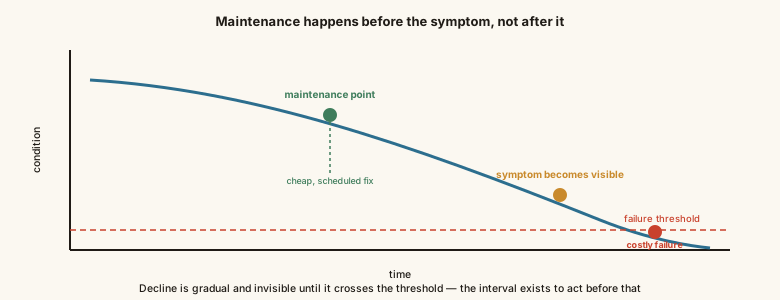
Follow the curve, not the calendar date alone — the maintenance point exists specifically because it sits before the visible-symptom point, and well before the failure threshold.
Common mistakes
Common Mistakes
Waiting for a visible or audible symptom before servicing a system.
→ Follow the published calendar interval — by the time a symptom is noticeable, meaningful wear has usually already occurred.
Applying a 'typical use' interval to a household with heavier-than-typical conditions (pets, hard water, large family).
→ Shorten the interval to match the actual load, and check more often until you've established a real pattern for your household.
Silencing a maintenance-reminder alert (like a smoke detector chirp) instead of acting on it.
→ Treat the alert as the scheduled maintenance trigger it is — replace the part, don't disable the reminder.
Common misconception
“If a system still seems to be working fine, it doesn't need scheduled maintenance yet.”
Most home systems degrade gradually and invisibly before any problem becomes noticeable — a clogged filter, a sediment-filled tank, or an aging detector battery can all be well past their efficient service life while everything still "seems fine" day to day. Manufacturer-published maintenance intervals are deliberately set before that invisible decline becomes a visible or costly problem, not at the point symptoms actually appear. Waiting for a symptom usually means the cheap window to address the issue has already closed, and the eventual cost — whether it's a burned-out blower motor or a corroded tank — is typically far higher than the maintenance itself would have been.
What to do next
What to do next
- Set recurring reminders for the highest-value quick wins: HVAC filter every 60-90 days, smoke/CO detector battery checks monthly with full replacement yearly, water heater flush annually.
- Adjust intervals upward in frequency for any system under heavier-than-typical load (pets, well water, large household, older equipment).
- Treat any maintenance-reminder alert (chirps, warning lights, indicator strips) as the scheduled action itself, not a nuisance to silence.
- Keep a simple written log (paper or phone note) of the last service date for each major system, since 'I think I did that a while ago' isn't a reliable interval tracker.