 KnowThis
Key Takeaways
Key Takeaways
- 1Hardwood is solid wood all the way through, which is why it can be sanded and refinished — but that same solid wood structure is what makes it swell and warp with moisture.
- 2Laminate is a printed photograph of wood over a compressed wood-fiber core — it looks convincing but the core is still wood fiber, so standing water is still its main weakness.
- 3Vinyl is the only one of the three that's genuinely waterproof end to end, but it can't be sanded or refinished — physical damage means replacing the plank, not repairing it.
The concept
Because the three materials trade the same properties differently, the "right" choice depends on the room: a kitchen or bathroom weighs moisture resistance heavily, while a formal living room might weigh long-term refinishability and authentic feel more heavily than water resistance.
Why can a solid hardwood floor be sanded and refinished, while a laminate floor generally cannot?
Worked examples
Example 1: Choosing flooring for a dry, low-traffic formal room (baseline case)
A formal living room sees light foot traffic and has no plumbing fixtures nearby, so moisture exposure is minimal. Here, hardwood's main tradeoffs (moisture sensitivity, higher upfront cost) matter least, while its main advantages (authentic material, decades of usable life through refinishing, resale value) matter most — this is the scenario hardwood is best suited for, and where laminate or vinyl's water resistance offers little practical benefit to offset their lack of refinishability.
In a dry, low-traffic formal room, which of hardwood's tradeoffs matters least?
Example 2: A bathroom or laundry room (edge case / variation)
Why does vinyl typically become the preferred choice in a bathroom, when hardwood might be preferred in a formal living room?
Example 3: A rental property choosing floors for durability and turnover cost (real-world / applied case)
A landlord replacing flooring across several rental units weighs upfront cost against how the floor holds up between tenants and how cheaply damage gets fixed. Laminate often wins this specific comparison: it's cheaper than hardwood upfront, handles moderate wear reasonably well, and — while it can't be refinished — individual damaged planks in click-lock laminate can sometimes be swapped out without redoing the whole floor, unlike a scratch or gouge in vinyl sheet goods, which may require a larger patch. The "right" floor here isn't the most durable material in the abstract, it's the one whose specific tradeoffs match the actual cost pattern (frequent turnover, budget-sensitive repairs) the property faces.
Why might a landlord choose laminate over both hardwood and vinyl for rental units, even though vinyl is more water-resistant?
How it works (visual)
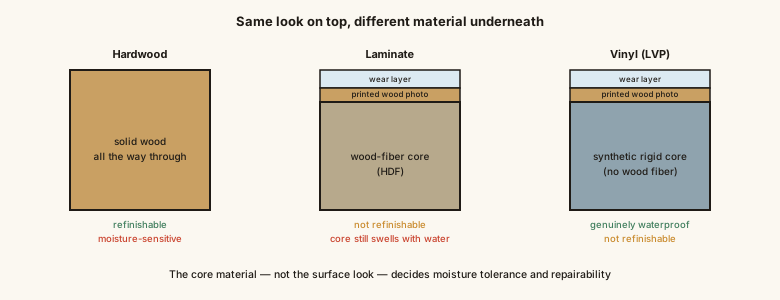
The layer structure explains the tradeoff directly: hardwood is uniform wood (refinishable, moisture-sensitive), laminate has a wood-fiber core under a printed layer (cheaper, still moisture-sensitive at the core), and vinyl has a synthetic core under its printed layer (waterproof, not refinishable).
Common mistakes
Common Mistakes
Treating the three flooring types as a strict best-to-worst quality ranking.
→ Compare them by which property (refinishability, water resistance, cost) matters most for the specific room, since each type trades those properties differently.
Assuming any vinyl or laminate product is automatically 'waterproof' the way marketing implies.
→ Check whether the specific product is rated waterproof (common in modern LVP) versus merely water-resistant (more common in laminate), and remember subfloor seams can still let water in underneath.
Installing solid hardwood in a room with routine high moisture exposure for the aesthetic, without a moisture-management plan.
→ In bathrooms, laundry rooms, or basements, favor vinyl or engineered wood products designed for moisture exposure, or add a dedicated moisture barrier if hardwood is non-negotiable.
Common misconception
“Laminate flooring is basically the same as vinyl, just a different name for a similar cheap wood-look floor.”
The two are built from fundamentally different materials. Laminate's structural core is compressed wood fiber (high-density fiberboard) topped with a printed photographic layer — it is still a wood-based product underneath, which is why standing water at a seam remains a real risk for laminate. Vinyl's core, particularly in modern luxury vinyl plank, is a fully synthetic material with no wood fiber anywhere in the product, which is what allows it to be genuinely waterproof rather than merely water-resistant. They can look nearly identical from a photo, but their response to water exposure is a fundamentally different, material-level difference, not a marketing distinction.
Try it yourself
A simple way to compare flooring options beyond sticker price — dividing installed price per square foot by expected lifespan in years gives a rough annualized cost, which can favor a pricier, longer-lasting material over a cheaper, shorter-lived one.
What to do next
What to do next
- Match the flooring type to the room's actual moisture exposure first — that's usually the deciding factor, not appearance.
- For wet-prone rooms (bathrooms, laundry, basements), favor a product explicitly rated waterproof, not just water-resistant.
- If long-term refinishability and resale value matter for a specific room, weigh solid hardwood's moisture tradeoff against that benefit deliberately, rather than defaulting to it purely for looks.
- Compare options using cost per year of expected life, not just sticker price per square foot, especially when comparing a pricier, longer-lived material against a cheaper, shorter-lived one.