 KnowThis
Key Takeaways
Key Takeaways
- 1Wood absorbs and releases moisture from the air constantly, and its dimensions change as its internal moisture content changes — this never fully stops, even in a finished floor.
- 2Almost all of that movement happens across the grain (a board's width), not along it (its length), which is why gaps appear between boards, not at their ends.
- 3Installers leave a hidden expansion gap around a hardwood floor's perimeter specifically to give this constant movement somewhere to go without the floor buckling against the walls.
The concept
This is also the reason acclimating new flooring — leaving it in the actual room for days before installation — matters: it lets the wood reach roughly the same moisture content it will live at long-term, before it's locked into place, reducing how much it needs to move after installation.
Why do gaps typically appear between the sides of hardwood boards in dry winter air, rather than at the ends of the boards?
Worked examples
Example 1: Winter gapping in a heated home (baseline case)
A hardwood floor installed in late summer, when indoor humidity was relatively high, develops small, fairly uniform gaps between boards each winter once the heating system starts running and indoor air dries out. This is expected seasonal cross-grain shrinkage, not a defect — the boards lose moisture to the drier air and shrink slightly in width. Because the expansion gap around the room's perimeter was sized for this, the shrinkage doesn't damage anything; it's simply visible between boards until humidity rises again in the following months.
A hardwood floor develops small gaps between boards every winter once the heat turns on. What does this most likely indicate?
Example 2: Cupping after a plumbing leak (edge case / variation)
Why does a hidden leak under a hardwood floor cause cupping specifically, rather than uniform gapping like a seasonal humidity change would?
Example 3: A floor installed without an expansion gap (real-world / applied case)
A DIY hardwood installation is run tight to the walls on all sides, with no expansion gap left before baseboard is installed, because the installer assumed a snug fit would look cleaner. When the following summer's humidity rises, the floor has nowhere to expand into and can buckle upward in the middle of the room, or push hard enough against walls to damage trim or drywall. This is the practical failure mode the expansion gap exists to prevent — the swelling itself was entirely predictable, and the damage came specifically from not leaving it anywhere to go.
A hardwood floor installed with zero expansion gap buckles upward the following summer. What actually caused the buckling?
How it works (visual)
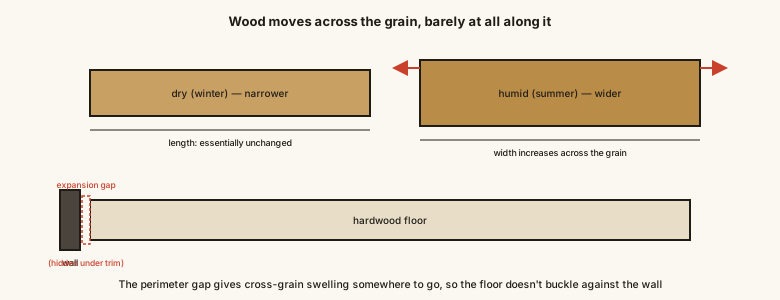
The board barely changes length at all — nearly all the visible movement in a hardwood floor happens across each board's width, which is exactly where the hidden expansion gap is designed to absorb it.
Common mistakes
Common Mistakes
Installing a hardwood floor tight against the walls with no expansion gap.
→ Leave the manufacturer-recommended gap (commonly around 1/2 inch) around the entire perimeter, hidden under baseboard or shoe molding.
Installing new flooring immediately after delivery without letting it acclimate to the room.
→ Let boards sit in the actual installation room, per the manufacturer's recommended acclimation period, so they reach the room's real moisture content before being locked into place.
Assuming seasonal gapping means the floor was installed wrong or the wood is defective.
→ Recognize normal, reversible seasonal gapping (opens in dry winter air, closes in humid summer air) as expected wood behavior, distinct from cupping or buckling caused by an actual installation or moisture problem.
Common misconception
“A hardwood floor that develops gaps between boards was installed incorrectly.”
Seasonal gapping is normal, expected behavior for solid hardwood, not a sign of poor installation. Wood is hygroscopic — it continuously absorbs and releases moisture from the surrounding air, and its dimensions change almost entirely across the grain (a board's width) as that moisture content shifts. Gaps that open in dry winter air and close again once humidity rises in warmer months are the visible, reversible sign of this normal process working as expected. A genuine installation problem looks different: uneven cupping, permanent buckling, or gaps that never close back up, typically tied to an actual moisture source like a leak or a floor installed with no expansion gap at all.
Try it yourself
A rough way to see why wider boards need a proportionally larger expansion allowance — total expected movement scales with a board's width and how much its moisture content is expected to swing seasonally.
What to do next
What to do next
- Always acclimate new hardwood flooring in its actual installation room per the manufacturer's stated period before installing it.
- Confirm an expansion gap was left at the room's perimeter (or leave one yourself on a DIY job) before installing baseboard or trim.
- Use a humidifier in winter and, if needed, a dehumidifier in summer to keep indoor humidity in a stable, moderate range and reduce the size of seasonal movement.
- Investigate promptly if you notice cupping, permanent buckling, or gaps that don't close seasonally — these point to an actual moisture source (like a leak), not normal seasonal movement.