 KnowThis
Key Takeaways
Key Takeaways
- 1R-value measures thermal resistance — how strongly a material resists conductive heat flow — not thickness, weight, or any single physical dimension by itself.
- 2The rate of heat flow through a material follows a real formula: heat flow (BTU per hour) equals area times temperature difference, divided by R-value, so doubling the R-value roughly halves the heat lost through that surface.
- 3Compressing insulation, leaving gaps, or letting it get wet can cut its effective R-value well below the number printed on the package, even though the material itself hasn't changed.
The concept
Because R-value is a rate-of-resistance number rather than a fixed physical barrier, it behaves predictably in a formula — which is exactly what makes it possible to estimate real heat loss through a wall, roof, or window rather than just comparing labels.
What does a material's R-value actually measure?
Worked examples
Example 1: Estimating heat loss through an attic on a cold day (baseline case)
An attic floor has 500 square feet of insulation rated at R-30, and the indoor-to-attic temperature difference is 40°F. Using heat flow = area × temperature difference ÷ R-value: 500 × 40 ÷ 30 ≈ 667 BTU per hour escaping through that surface. That single number is what makes R-value practically useful — it converts a resistance rating into an actual estimate of how much heat a given area is losing per hour under real conditions, the same kind of number a heating system has to make up for continuously.
Example 2: Compressed insulation performing below its rated R-value (edge case / variation)
An R-19 fiberglass batt is compressed into a joist cavity shallower than its designed thickness. What happens to its effective R-value?
Example 3: Comparing heat loss through a well-insulated wall versus an old, poorly insulated one (real-world / applied case)
Two identical 100-square-foot exterior walls face a 30°F temperature difference on a winter night — one insulated to R-13, the older standard for many decades-old homes, and one upgraded to R-21. Heat loss through the R-13 wall: 100 × 30 ÷ 13 ≈ 231 BTU per hour. Through the R-21 wall: 100 × 30 ÷ 21 ≈ 143 BTU per hour — roughly 38% less heat escaping through the same size wall under the same conditions. That gap, repeated across every wall, the ceiling, and the floor of a house, is a large part of why upgrading insulation in an older home can noticeably reduce how hard a heating or cooling system has to work to hold a setpoint.
Two identical walls face the same temperature difference — one insulated to R-13, one to R-21. What is true about heat loss through them?
How it works (visual)
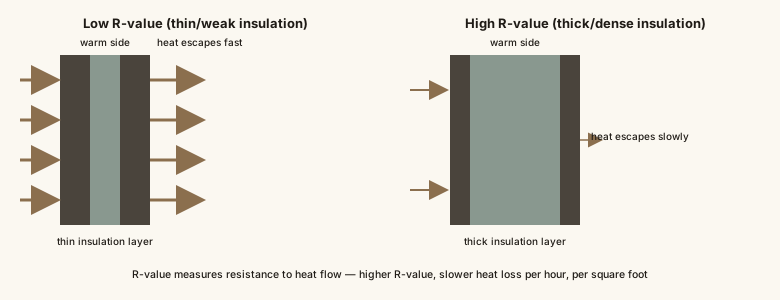
The arrows in the diagram represent the same underlying physical process in both walls — conductive heat flow — with R-value acting as the resistance that determines how much of it gets through per hour.
Common mistakes
Common Mistakes
Assuming the R-value printed on a package is exactly what's performing inside the finished wall or attic.
→ Account for compression, gaps around obstacles, and thermal bridging through framing, all of which can lower real-world performance below the rated number.
Stuffing insulation tightly into a space to "fit more in," believing more material packed in means better performance.
→ Install insulation at its full, uncompressed thickness — compressing it reduces the trapped air pockets responsible for its insulating value.
Treating R-value as if it measures something other than heat resistance, like soundproofing or fire resistance.
→ Check separate ratings for sound transmission or fire resistance specifically — R-value is exclusively about resistance to conductive heat flow.
Common misconception
“A thicker layer of insulation always has a higher R-value than a thinner one.”
Thickness and R-value are related but not the same thing — different insulation materials achieve very different R-values at the same thickness, because R-value depends on the material's ability to trap still air (or, for rigid foam, on its cell structure), not on thickness alone. A thin layer of a high-performance rigid foam board can match or exceed the R-value of a much thicker layer of a lower-performing material. Comparing insulation by thickness alone, without checking the actual R-value rating, can lead to a real-world performance gap that a quick visual comparison wouldn't catch.
Try it yourself
Enter a surface's area, the temperature difference across it, and its R-value to estimate the rate of heat flow (heat flow = area × temperature difference ÷ R-value).
What to do next
What to do next
- Check that existing insulation is installed at its full, uncompressed thickness, especially in shallow joist bays or around obstructions.
- Look for and seal gaps around insulation, since even small uninsulated gaps let a disproportionate amount of heat through compared to their size.
- Compare insulation options by their actual R-value rating, not by thickness or price alone, when planning an upgrade.
- Read Why Some Rooms Are Always Hotter or Colder Than Others next to see how uneven insulation contributes to room-to-room temperature differences.