 KnowThis
Key Takeaways
Key Takeaways
- 1Most real roof leaks originate at a seam — flashing around a chimney, vent, or valley — not in the middle of an intact shingle field.
- 2Granule loss and curling shingles are genuine aging signs, but cosmetic wear alone doesn't mean an active leak; attic-side moisture is the more reliable confirmation.
- 3Catching a small flashing gap or a handful of damaged shingles early is a repair; ignoring the same problem long enough turns it into a full roof-deck replacement.
The concept
Once flashing and valleys are understood as the roof's actual weak points, the specific things worth checking — granule loss, lifted flashing edges, and attic-side moisture — stop being a random inspection checklist and start reading as a targeted search for where water is most likely to be getting through.
A roof's shingle field looks generally intact, but a homeowner notices a small water stain on the attic ceiling directly below a chimney. Where should they look first for the actual problem?
Worked examples
Example 1: Granule loss on an aging roof (baseline case)
A homeowner notices sandy grit collecting in the gutters and bald, darker patches appearing on some shingles after two decades on the roof. This is ordinary aging granule loss, and on its own it's a signal to start planning for eventual replacement, not an emergency. A shingle with moderate granule loss but no cracking or curling is still functionally shedding water — the loss becomes urgent mainly once it's severe enough that the asphalt layer underneath is visibly exposed and brittle, since that's when the shingle itself can start to fail structurally rather than just cosmetically.
A 20-year-old asphalt roof shows granule loss and a few darker patches, but no cracking, curling, or interior leaks. What does this most likely indicate?
Example 2: Lifted flashing after a windstorm (edge case / variation)
A roof's shingles are only a few years old, but a windstorm has visibly lifted a section of flashing around a vent pipe. How urgent is this, relative to the shingles' age?
Example 3: A water stain that only appears during heavy rain (real-world / applied case)
A ceiling stain in an upstairs room only shows up during heavy, wind-driven rain and disappears the rest of the time, leading a homeowner to wonder whether it's really a problem worth addressing. This intermittent pattern is actually a meaningful clue rather than a reason to dismiss it: it points toward a small gap — often at a valley or flashing seam — that only lets water through once wind pressure and volume exceed a certain threshold, rather than a constant leak. Left unaddressed, water intermittently reaching the roof deck and underlayment through the same small gap, storm after storm, degrades the wood decking underneath over time even though the visible ceiling stain seems to come and go harmlessly.
A ceiling stain appears only during heavy, wind-driven rain and disappears otherwise. What does this pattern suggest about the underlying problem?
How it works (visual)
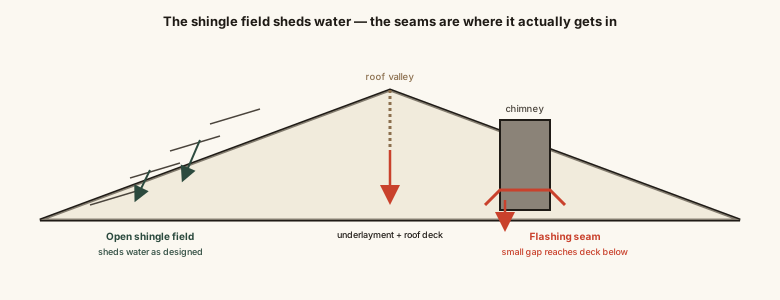
The flat shingle field on the left of the diagram sheds water exactly as designed — the vulnerability is concentrated at the seam on the right, where a single small gap can let water reach the wood deck underneath even while every shingle around it stays intact.
Common mistakes
Common Mistakes
Judging a roof's condition only from the ground, without checking flashing around chimneys, vents, and valleys up close.
→ Have flashing and valley areas specifically inspected, ideally from a ladder or by a professional, since these fail before the shingle field usually shows visible wear.
Dismissing an intermittent leak because it isn't visible except during the heaviest storms.
→ Treat storm-dependent leaks as a real, active gap that's simply below the threshold to show constantly — address it before it worsens or the underlayment degrades further.
Assuming a roof's age alone determines whether it needs repair, ignoring mechanical damage like storm-lifted flashing.
→ Check for physical damage after any severe wind or hail event regardless of the roof's overall age — flashing damage is independent of shingle wear.
Common misconception
“If the shingles look fine from the ground, the roof doesn't need repair.”
Most real roof leaks start at a seam — flashing around a chimney, vent, or skylight, or a valley where two slopes meet — not in the open shingle field that's easiest to see from the ground. A roof can have a genuinely leak-prone flashing gap while the shingles around it look completely intact, because flashing and shingles are two separate seals doing two different jobs. The more reliable way to judge whether a roof actually needs repair is to check the seams up close and to look for attic-side moisture, rather than relying on how uniform the shingle field looks from the driveway.
What to do next
What to do next
- Check the attic for water stains, damp insulation, or daylight visible through the roof deck at least once a year and after any major storm.
- Inspect flashing around chimneys, vents, skylights, and valleys specifically — not just the general shingle field — for lifted edges, cracks, or corrosion.
- Take note of any leak that only appears during heavy or wind-driven rain rather than dismissing it as harmless because it isn't constant.
- Get a professional inspection before a roof reaches the end of its typical 20-30 year service life, or immediately after any storm that could have damaged flashing.