 KnowThis
Key Takeaways
Key Takeaways
- 1A gutter's only job is to move a roof's runoff to a controlled discharge point — the downspout — instead of letting it fall straight off the roof edge.
- 2A clog doesn't stop the water; it just forces it over the gutter's front edge in an uncontrolled sheet, which is what actually damages fascia, siding, and the foundation.
- 3Most gutter-related home damage traces back to water pooling somewhere it was never supposed to reach, not to the debris itself.
The concept
Clogged gutters also feed a specific cold-weather problem: meltwater with nowhere to drain can refreeze at the roof edge into an ice dam, which backs up under shingles instead of running off the roof the way it should.
Once the water's journey is understood as a controlled path that clogging interrupts, the specific damage patterns homeowners notice — rotted fascia, streaked siding, a damp basement corner — stop looking like separate problems and start looking like the same overflow showing up at different points along its accidental new route.
A homeowner notices water pooling in a gutter and spilling over the front edge during a rainstorm, rather than draining through the downspout. What does this most directly indicate?
Worked examples
Example 1: Leaves clogging a downspout in fall (baseline case)
Autumn leaf drop is the single most common cause of gutter clogs — a downspout opening is often only a few inches wide, and a mat of wet leaves can plug it completely after just one storm. The gutter run above the blocked downspout fills and overflows at its lowest point, usually right above a doorway or window, since that's often where a downspout is placed. Clearing the clog restores normal flow immediately with no lasting damage, provided it's done before the fascia has been exposed to repeated overflow for an extended period.
Why does a downspout tend to clog before the rest of the gutter run, even when leaves are scattered along the whole length?
Example 2: A gutter that overflows only during heavy storms (edge case / variation)
A gutter drains normally in light rain but overflows in heavy storms, with no complete blockage visible. What does this pattern suggest?
Example 3: Years of overflow showing up as a damp basement corner (real-world / applied case)
A homeowner notices a persistently damp corner in the basement, always on the same side of the house, and eventually traces it back to a gutter on that side that has been overflowing unnoticed for years — the downspout was slowly narrowing with mineral buildup and roof grit rather than fully blocking all at once. Years of that redirected water saturating the soil next to the foundation on that one side created enough hydrostatic pressure to push moisture through a hairline seam in the foundation wall. Clearing and repairing the gutter is a necessary first step, but the existing dampness may also need its own remediation — the point is that the gutter fix addresses the ongoing cause, not necessarily the damage already done.
A basement has a persistently damp corner on one specific side of the house, and a long-overflowing gutter is found directly above that side. What does this connection illustrate?
How it works (visual)
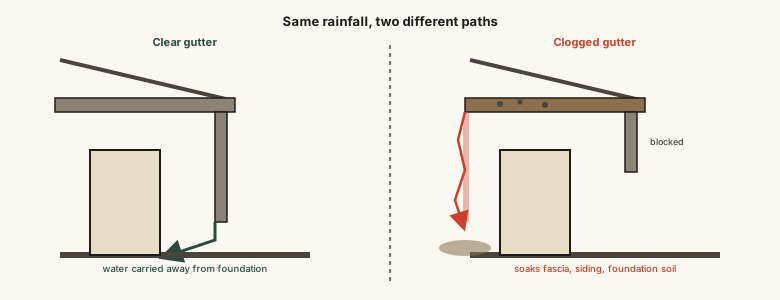
The two panels carry the exact same rainfall — the only difference is whether the downspout is open. That single difference decides whether the water ends up several feet from the house or soaking straight into the foundation soil.
Common mistakes
Common Mistakes
Cleaning the visible gutter trough but never checking whether the downspout itself is clear.
→ Run water through the downspout after clearing the trough — the narrowest point is usually where the real blockage hides.
Assuming a gutter that looks fine on a dry day has no problem, without checking it during or right after rain.
→ Check gutters during or immediately after a real rainstorm, when a partial restriction actually reveals itself as overflow.
Waiting until a downspout empties directly at the foundation line instead of extending it away from the house.
→ Add a downspout extension or splash block so discharged water lands several feet from the foundation, not right against it.
Common misconception
“Gutter cleaning is a cosmetic chore — leaves in a gutter don't really hurt anything.”
The leaves themselves aren't the damage — the damage comes from where the water goes once it can't follow its intended path. A clogged gutter forces the same volume of water that would have been carried safely to a downspout to instead pour over the front edge, directly onto fascia boards not built for constant water exposure, and down into the soil right against the foundation. Left unaddressed across multiple seasons, that redirected water is a documented, common cause of fascia rot, siding damage, and basement moisture — not a hypothetical worst case, but the ordinary outcome of water finding the only path still open to it.
What to do next
What to do next
- Clean gutters at least twice a year — typically late spring and late fall — and more often if overhanging trees drop debris year-round.
- Check downspouts specifically, not just the gutter trough, by running water through them after clearing visible debris.
- Watch gutters during an actual rainstorm at least once a season to catch a partial restriction that only shows up under heavy flow.
- Make sure every downspout discharges several feet away from the foundation, adding an extension or splash block if it currently doesn't.