 KnowThis
Key Takeaways
Key Takeaways
- 1Drywall cracks form where stress concentrates — most often at the corners of door and window openings, along taped seams, or where framing members shift relative to each other.
- 2A crack's shape and location are diagnostic: diagonal cracks from an opening's corner usually mean framing stress, while straight cracks along a seam usually mean the tape bond itself failed.
- 3Most drywall cracks are cosmetic and reflect normal seasonal building movement, but a widening crack paired with a sticking door or an uneven floor is worth a closer structural look.
The concept
Once cracking is understood as stress finding the weakest available point, the location and shape of a specific crack stop looking random and start reading as a fairly reliable clue to its cause.
Why do drywall cracks tend to form at the corners of door and window openings rather than in the middle of an open wall?
Worked examples
Example 1: A diagonal crack at a door frame corner (baseline case)
A homeowner notices a thin diagonal crack running from the top corner of an interior door frame up toward the ceiling. This is the most common drywall crack pattern in framed houses, and it typically reflects ordinary seasonal wood movement in the header above the door concentrating stress at that corner. Repairing it with flexible mesh tape and joint compound — or, along a stubborn hairline seam, a flexible caulk-based crack filler instead of a rigid patch — then repainting, is usually sufficient — the underlying movement is normal and the same spot may need a touch-up again in future years, but it isn't a sign of a structural problem on its own.
A thin diagonal crack appears at the top corner of an interior door frame, with no other symptoms in the house. What does this most likely indicate?
Example 2: A straight crack that keeps returning along a seam (edge case / variation)
Why might a drywall crack along a taped seam keep reappearing even after being filled with joint compound each time?
Example 3: A widening crack paired with a sticking door (real-world / applied case)
A crack above a doorway has grown noticeably wider over several months, and the door in that same frame has started sticking and needing more force to close. Unlike the first two examples, this combination — a growing crack plus a functional symptom in the same framing — is a reasonable prompt to have the situation looked at by a professional, since it suggests the framing itself may be shifting rather than settling into a stable seasonal pattern. Cosmetic repair alone won't address a cause like this, and repeatedly patching over a widening crack without investigating the framing risks masking a problem that's still actively getting worse. Locating the nearby framing first with a stud finder can also help confirm whether the crack lines up with a specific framing member rather than running randomly across open drywall.
A crack above a doorway keeps widening over several months, and the door in that frame has started sticking. What does this combination suggest, compared to a single stable crack on its own?
How it works (visual)
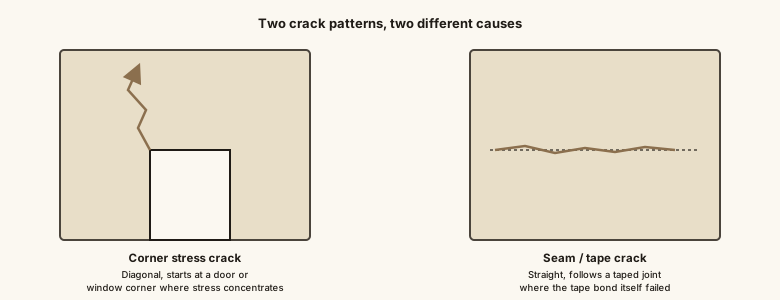
The shape alone narrows down the likely cause: diagonal and near an opening points to framing stress, while straight and along a seam points to a tape bond failure.
Once a crack is patched, the repair's durability also depends on giving the topcoat enough time to fully cure, not just dry — a still-curing paint film over a fresh patch is softer and more prone to showing texture or damage than one that's had its full cure time.
Common mistakes
Common Mistakes
Filling a crack with rigid spackle or joint compound alone and expecting it to stay closed at a spot with ongoing minor movement.
→ Use flexible mesh tape embedded in joint compound over seams, and treat repeatedly returning cracks as a sign the underlying joint needs re-taping, not just refilling.
Assuming every crack is a foundation emergency and panicking over a single hairline crack with no other symptoms.
→ Judge a crack by its width, whether it's growing, and whether it's paired with other symptoms like sticking doors — most hairline cracks are cosmetic seasonal movement.
Painting directly over a freshly patched crack without letting the joint compound fully dry and without a coat of primer first.
→ Let the patch dry completely and prime it before painting, since unprimed patched areas absorb paint differently and show up as a visible flashing spot.
Common misconception
“Any crack in a wall means the house's foundation is failing.”
The overwhelming majority of drywall cracks are the result of ordinary seasonal movement in wood framing, humidity-driven expansion and contraction, or a taped seam losing adhesion — not foundation failure. A crack becomes a genuine structural concern mainly when it's wider than roughly 1/8 inch, keeps growing rather than stabilizing, or shows up alongside other symptoms like sticking doors, misaligned windows, or visibly sloped floors. A single stable hairline crack near a door or ceiling seam, on its own, is almost always cosmetic and reflects the building simply moving the way buildings do.
What to do next
What to do next
- Note the crack's shape and location — diagonal near an opening usually means framing stress, straight along a seam usually means a tape bond failure.
- Measure the crack's width and check back periodically to see whether it's stable or actively widening before deciding how to respond.
- Repair seam cracks with flexible mesh tape and fresh joint compound rather than just filling the visible gap, especially if the crack has returned before.
- Get a professional structural opinion if a crack keeps widening and is paired with a sticking door, a misaligned window, or a sloped floor nearby.