 KnowThis
Key Takeaways
Key Takeaways
- 1Most electronic stud finders are capacitive sensors — they detect a change in material density behind the wall, not metal.
- 2A separate, simpler type — the magnetic stud finder — really does detect metal, but only the nails or screws already fastening drywall to a stud, not the stud itself.
- 3Capacitive stud finders need to be calibrated on known-empty wall first, and can be fooled by wiring, plumbing, or double-layered drywall, which is why a second confirmation pass matters.
The concept
Once you know the tool is reading density (or fastener metal) rather than the stud material directly, the calibration step and the double-check habit both make a lot more sense as necessary steps, not extra caution.
Why does a common electronic stud finder light up over a wooden stud, since wood isn't metal or magnetic?
Worked examples
Example 1: A straightforward scan across a standard interior wall (baseline case)
A user holds a capacitive stud finder flat against a section of wall known to be hollow, presses the calibration button, then slides it steadily sideways. As it crosses into a region backed by a wood stud, the measured capacitance shifts past the calibrated threshold and the indicator lights up — a straightforward density change from air to solid wood, detected exactly as designed.
Example 2: A false positive from wiring inside the wall (edge case / variation)
Why might a capacitive stud finder falsely indicate a stud where there's only electrical wiring inside the wall?
Example 3: Choosing between capacitive and magnetic before hanging a heavy shelf (real-world / applied case)
Before mounting a heavy shelf, a homeowner uses a capacitive stud finder to locate the approximate edges of a stud, then confirms the exact center by locating the nail heads already in the drywall with a magnetic stud finder — since a stud edge found capacitively is only a density boundary, not a precise center point, and finding two nail lines with the magnetic tool pins down the stud's true middle for a stronger, centered anchor point. Locating the stud is only half the question, though — how much weight that mounting point can actually hold still depends on the fastener and the framing behind it, not just finding solid wood to drive into.
Why might someone use both a capacitive and a magnetic stud finder together before driving a heavy-duty fastener?
How it works (visual)
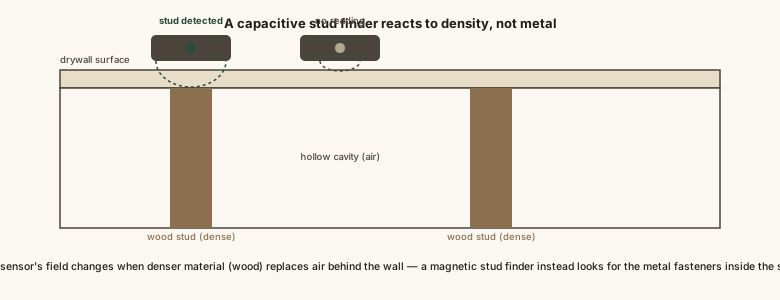
Same tool, same field — the only thing that changes between a hit and a miss is how much the material behind the wall disturbs that field.
Common mistakes
Common Mistakes
Skipping calibration on empty wall before scanning, which leaves the sensor's baseline set incorrectly.
→ Always start a capacitive stud finder flat against wall you're confident is hollow and let it calibrate before sliding toward a suspected stud.
Trusting a single scan pass and driving a large fastener based on it alone.
→ Confirm with a second pass at a different height, and check that the reading's width and spacing are consistent with a real stud, not wiring or plumbing.
Assuming a capacitive stud finder works the same way over any wall thickness or double layer of drywall without recalibrating.
→ Recalibrate directly on the actual wall surface being scanned — a different thickness or a second drywall layer shifts the baseline the sensor needs.
Common misconception
“A stud finder detects metal, the way a metal detector does.”
Most stud finders sold and used today are capacitive sensors that detect a shift in a small electric field caused by denser material — wood, in the case of a stud — sitting behind the wall. They have nothing to do with metal detection and will register a stud made of ordinary lumber with no metal in it at all. A magnetic stud finder does exist and genuinely uses a magnet, but even that one isn't detecting the stud directly — it's detecting the metal nails or screws already fastening the drywall to the stud, which is a real but indirect proxy for the stud's location.
What to do next
What to do next
- Calibrate a capacitive stud finder on wall you know is hollow before sliding it toward a suspected stud.
- Scan a second time at a different height and confirm the reading width matches a stud, not wiring or plumbing.
- For heavy or load-bearing fasteners, confirm the exact stud center with a magnetic stud finder or a small pilot hole check.
- Recalibrate after moving to a wall of different thickness or construction, rather than trusting a single carried-over baseline.