 KnowThis
Key Takeaways
Key Takeaways
- 1The hook's wobble is an intentional design, not a manufacturing defect — it's riveted with slack roughly equal to the hook's own metal thickness.
- 2Pulling the tape over an outside edge slides the hook to the outer limit of that slack, while pushing into an inside corner slides it to the inner limit — both keep the printed zero accurate.
- 3A bent, damaged, or overly loose hook breaks this compensation and throws off every measurement taken with it, usually in a consistent, easy-to-miss direction.
The concept
Once the true-zero design is visible, a bent or overly loose hook stops looking like a minor cosmetic issue and starts looking like exactly what it is — a broken calibration that shifts every reading taken with that tool.
Why is a tape measure's end hook deliberately attached with a small amount of play instead of rigidly fixed?
Worked examples
Example 1: Measuring the length of a board (baseline case)
A carpenter hooks the tape over one end of a board and pulls the blade to the other end. Pulling tension slides the hook to the outer limit of its slot, so the printed zero effectively starts right at the board's edge. The reading at the far end gives the board's true length with no adjustment needed for the hook's own thickness.
Example 2: Measuring the inside depth of a drawer (edge case / variation)
When measuring an inside dimension by pushing the tape's case against a surface, what actually becomes the accurate zero reference point?
Example 3: Catching a bent hook before it ruins a cut list (real-world / applied case)
A DIYer notices several cut pieces come out consistently about a sixteenth of an inch longer than measured. Checking the tape, they find the hook has been bent outward slightly from a drop, so it now sits proud of its normal outer travel limit even when pulled taut — adding extra length to every outside measurement. Replacing the tape (or straightening the hook carefully back to its designed travel) restores accurate readings; simply remeasuring with the same damaged hook would have repeated the same consistent error.
A tape measure is consistently producing outside measurements that read slightly longer than the true length. What's the most likely explanation given how the hook is designed to work?
How it works (visual)
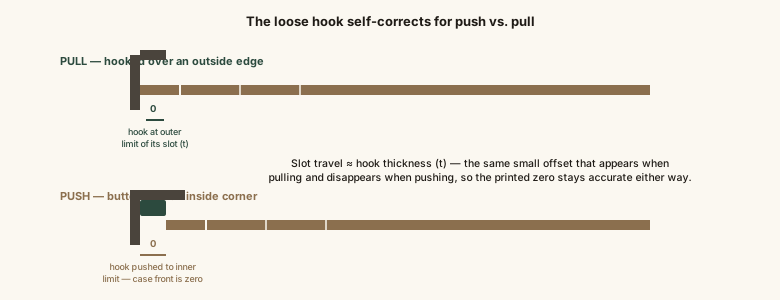
Same physical hook, same small amount of slack — it just lands at a different limit of its travel depending on whether the tape is being pulled or pushed.
Common mistakes
Common Mistakes
Assuming the hook's wobble is a defect and trying to tighten or glue it rigid.
→ Leave the hook's slight play alone — it's a deliberate true-zero design, and rigidly fixing it breaks accuracy for one of the two measurement styles.
Continuing to use a tape after the hook has visibly bent or the rivet slot has worn oversized.
→ Check the hook periodically by hand for a small, consistent slide, and replace the tape if the hook is bent, cracked, or excessively loose.
Not accounting for which style of measurement (pull vs. push) is actually happening when reading a tricky inside corner.
→ For inside measurements, make sure the case is pushed flush against the surface rather than trying to hook onto an inside edge that isn't really there.
Common misconception
“A wobbly hook on a tape measure means it's cheaply made or broken.”
A small amount of hook play is a deliberate feature on quality tape measures, called a true-zero hook, sized to roughly match the thickness of the hook metal itself. It's specifically what lets the same tool give an accurate zero point whether you're pulling it over an outside edge or pushing its case into an inside corner. A hook with genuinely no play at all would actually be less accurate for one of those two common uses — the wobble is functioning as intended, not failing.
What to do next
What to do next
- Check your tape's hook by hand — it should slide a small, consistent distance, not stay rigid or flop loosely.
- Use an outside (pull) measurement by hooking cleanly over an edge, and an inside (push) measurement by pushing the case flush against the surface.
- Replace a tape measure whose hook is visibly bent, cracked, or has worn well beyond its original small travel range.
- For critical cuts, double-check a suspicious tape against a second, known-accurate one before trusting a full cut list to it.