 KnowThis
Key Takeaways
Key Takeaways
- 1The striking face drives a nail through momentum and energy transfer — a fast-moving mass dumps its kinetic energy into the nail head on impact, not through leverage.
- 2The claw pulls a nail out as a true class-one lever: the hammer head resting on the wood is the fulcrum, the short claw is the load arm, and the long handle is the effort arm.
- 3Because the handle is much longer than the claw's distance to the nail, a moderate hand pull gets multiplied into a much larger force at the nail — that ratio is the hammer's mechanical advantage.
The concept
Once you see the claw as a lever, a few field habits make sense on their own: slipping a wood block or scrap under the hammer head partway through a long pull, and always pulling toward yourself rather than pushing away, both keep the fulcrum stable and the lever angle efficient.
What actually acts as the fulcrum when a claw hammer pulls a nail?
Worked examples
Example 1: Driving a nail flush (baseline case)
A carpenter starts a nail with a few light taps to seat the tip in the wood, then swings the hammer with more speed for the following strikes. Each strike is a separate energy-transfer event: the moving head decelerates almost instantly against the nail head, and that sudden deceleration is what produces the large, brief driving force — not the hammer's weight sitting on the nail, which would do nothing on its own.
Example 2: A nail that won't budge, and repositioning mid-pull (edge case / variation)
Why does slipping a block of wood under the hammer head help partway through pulling a long, stubborn nail?
Example 3: Choosing a swing for a small finish nail vs. a large framing nail (real-world / applied case)
For a small finish nail, a light, controlled swing supplies more than enough kinetic energy to drive it, and a heavier swing risks marring the surrounding wood. For a large framing nail, a slower but heavier-headed framing hammer swung with full arm motion delivers substantially more energy per strike, driving the nail in fewer hits. In both cases the underlying mechanism is identical — energy transfer on impact — but the mass and speed are matched to the size of the nail and the acceptable margin for error.
Why might a carpenter deliberately choose a heavier hammer for large framing nails rather than just swinging a lighter hammer harder?
How it works (visual)
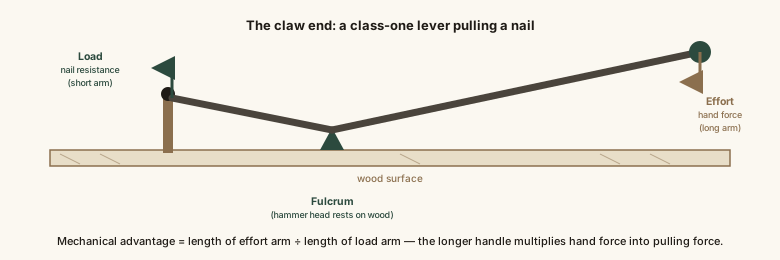
The same hammer head that transfers energy on the driving side becomes a fixed pivot point on the pulling side — one tool, two distinct mechanisms.
Common mistakes
Common Mistakes
Choking up too far on the handle when pulling a stubborn nail, shortening the effort arm without realizing it.
→ Grip near the end of the handle so the full length works as the effort arm and delivers maximum mechanical advantage.
Continuing to pull once the handle has rotated nearly flat against the wood, forcing the wrist instead of the lever.
→ Slip a scrap block under the hammer head to reset the fulcrum height and restore an efficient lever angle.
Trying to drive large nails with rapid, light taps instead of fewer, well-aimed heavier strikes.
→ Match hammer weight and swing to nail size — a heavier head or faster swing delivers more energy per strike, needing fewer hits.
Common misconception
“A heavier hammer always drives a nail better than a lighter one.”
Driving force comes from kinetic energy, which depends on both mass and the square of swing speed — so speed matters more per unit of extra effort than added weight does. A lighter hammer swung faster can deliver more energy on impact than a heavier one swung slowly and cautiously. Hammer weight mainly changes how much swing speed is needed to reach a given energy, and how much control and comfort the user has, not a fixed guarantee that heavier always wins.
What to do next
What to do next
- When pulling a nail, grip near the end of the handle so the full length works as the effort arm.
- Slip a scrap block under the hammer head partway through a long pull to reset the lever angle.
- Match hammer weight and swing speed to the nail size — light and fast for small nails, heavier for large ones.
- Keep the striking face flat against the nail head on impact to transfer energy directly instead of glancing off at an angle.