 KnowThis
Key Takeaways
Key Takeaways
- 1A flathead's straight slot has no built-in centering — an off-axis push can slide the blade sideways and out, often stripping the slot or scratching the surrounding surface.
- 2A Phillips head's cross-shaped recess has tapered walls that self-center the bit and are engineered to cam out straight up once torque crosses a threshold.
- 3Cam-out in a Phillips head was originally a deliberate safety feature for machine-driven assembly, not a manufacturing flaw — it kept powered drivers from overtightening and snapping screws or stripping thin sheet metal.
The concept
Once the geometry is visible, the practical guidance follows directly: match the driver size exactly to the screw, keep the tool square to the recess, and expect a Phillips screw to cam out on purpose well before a flathead ever would.
Why is a flathead screwdriver more prone to sliding sideways out of the slot than a Phillips screwdriver is?
Worked examples
Example 1: Driving a wood screw with a Phillips bit (baseline case)
A Phillips bit is pressed into a screw head; the tapered cross walls pull the tip into alignment even if it started slightly off-center. As the screw seats and resistance builds, the driver reaches the recess's designed torque threshold and the bit cams straight up out of the recess rather than skidding across the wood — a mildly abrupt but predictable stopping point that signals the screw is at or near fully driven.
Example 2: A worn-out Phillips recess forcing premature cam-out (edge case / variation)
Why does a worn or rounded-off Phillips screw head tend to cam out at a much lower torque than a fresh one?
Example 3: Choosing a driver for an old cabinet hinge screw (real-world / applied case)
A homeowner removing an old cabinet hinge finds a flathead screw with a slightly damaged slot edge. Because a flathead has no self-centering geometry to fall back on, they select a blade that matches the slot width exactly and press straight down with steady force to avoid the blade riding up and further damaging the slot. On an equivalent Phillips screw, a slightly undersized bit would risk premature cam-out and rounding the recess further, so matching bit size matters for both — but for different underlying reasons tied to each recess's geometry.
For a damaged flathead slot, why does matching the blade width exactly matter so much?
How it works (visual)
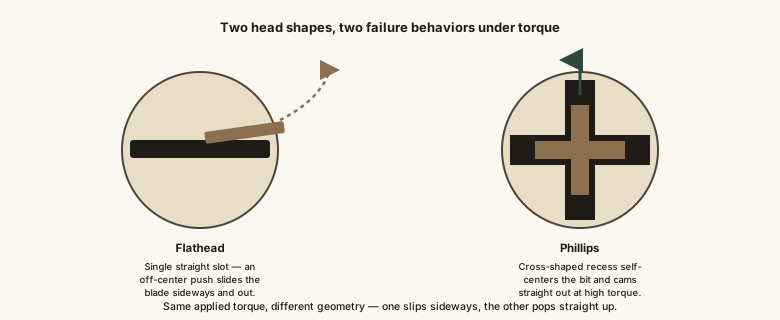
Same applied torque, two very different failure paths — one drifts sideways with no warning, the other pops straight up by design.
Common mistakes
Common Mistakes
Using an undersized or mismatched driver tip, which makes cam-out or sideways slip happen much sooner than expected.
→ Match the driver size and type exactly to the screw head before applying force, not just whichever bit is closest at hand.
Pushing at an angle instead of keeping the driver perpendicular to the screw head.
→ Keep the driver square to the recess — angled force is what turns a stable grip into a slip on either screw type.
Assuming a Phillips screw is fully tight the moment the driver cams out.
→ Recognize cam-out as a torque limit built into the recess, not necessarily full tightness — check the joint and re-drive with steady pressure if needed.
Common misconception
“A Phillips screwdriver camming out means the tool or the screw is defective.”
Cam-out is a deliberate, engineered behavior, not a flaw. The Phillips recess was designed in the 1930s specifically so that powered screwdrivers on assembly lines would stop transmitting torque once a screw reached a safe tightness, protecting thin sheet metal and small fasteners from being overtightened and stripped or snapped. A screwdriver popping out of a Phillips head at high torque is usually the tool doing exactly what its shape was designed to do — the real problem case is when it happens too early, which points to a worn recess or a mismatched bit rather than a defect in the design itself.
What to do next
What to do next
- Match driver size and type exactly to the screw head before applying pressure — never grab the nearest bit as a default.
- Keep the driver perpendicular to the screw head throughout the turn to avoid inducing a sideways slip.
- Replace or avoid reusing screws with visibly worn or rounded recesses, since they cam out at unreliable, lower torque.
- Reach for a hex or square-drive fastener instead of Phillips when a joint needs to be torqued to a precise, high value.