 KnowThis
Key Takeaways
Key Takeaways
- 1Torque equals force multiplied by lever-arm length — the distance from the bolt (the pivot) to where you're applying force on the handle.
- 2A longer wrench, or gripping farther out on the handle, produces more torque from the same hand force, because it increases the lever-arm length.
- 3Only the part of your force that's perpendicular to the handle actually contributes to torque — pulling at an angle wastes some of the effort.
The concept
Once torque is understood as force times distance (with only the perpendicular part of that force counting), both the "use a longer wrench" trick and the existence of torque-specifying wrenches stop being separate facts and become the same underlying formula applied two different ways.
Why does a longer wrench handle make it easier to loosen a stubborn bolt using the same amount of hand force?
Worked examples
Example 1: Loosening a bolt with a standard wrench (baseline case)
Someone applies 30 pounds of force straight down on a wrench handle, at a point 8 inches (about 0.67 feet) from the bolt, with the force perpendicular to the handle. The resulting torque is 30 pounds × 0.67 feet, or roughly 20 pound-feet — enough to break a moderately tight bolt free. Because the pull is straight down and perpendicular to the handle, all of that force contributes to torque with nothing wasted.
Example 2: The same pull, but at an angle (edge case / variation)
Two people apply the same 30 pounds of force to the same wrench at the same distance from a bolt, but one pulls straight down and the other pulls at a shallow angle. Why does the straight-down pull produce noticeably more torque?
Example 3: Tightening a wheel lug nut to a specified torque (real-world / applied case)
A wheel lug nut has a manufacturer-specified torque of 100 pound-feet. Rather than tightening it by feel with an ordinary wrench, a mechanic uses a torque wrench pre-set to that value, which provides a clear click or resistance change once 100 pound-feet is reached regardless of the exact handle length or grip position used. This matters because both undertightening (risking the nut loosening over time) and overtightening (risking stripped threads or a warped brake rotor) are real failure modes — a torque wrench removes the guesswork that an ordinary wrench's "tight enough" feel can't reliably replace.
Why is a torque wrench used for a fastener like a wheel lug nut instead of just tightening it firmly with an ordinary wrench?
How it works (visual)
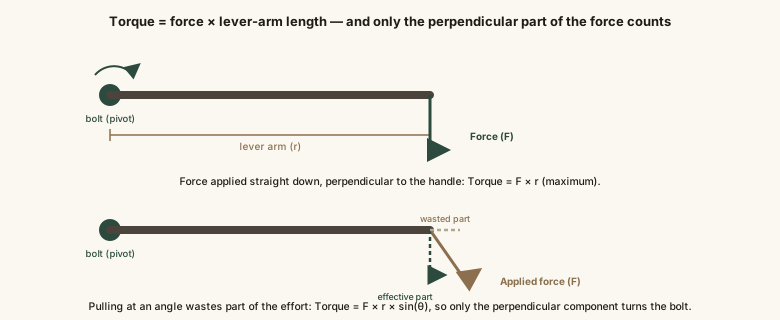
Same hand, same effort, same handle length — the only thing separating full torque from a weaker, wasted pull is the angle the force is applied at.
Common mistakes
Common Mistakes
Pulling on a wrench at a shallow angle instead of perpendicular to the handle, wasting effort without realizing it.
→ Position your body and grip so the applied force is as close to perpendicular to the handle as possible for maximum torque from the same effort.
Using a cheater bar to extend a wrench on a fastener with a real torque specification.
→ Use an actual torque wrench set to the fastener's specified value instead — extending leverage on a spec'd bolt risks overtightening and damage.
Assuming 'tight' by feel is close enough for fasteners with a genuine torque requirement.
→ Look up the specified torque value and use a torque wrench for fasteners where under- or over-tightening carries real consequences, like wheel lug nuts.
Common misconception
“A longer wrench handle always makes any bolt easier and safer to tighten or loosen.”
A longer handle does increase torque for the same hand force, which is genuinely useful for a stuck or corroded fastener. But for a bolt with a specified torque value, more leverage is a liability, not an advantage — it makes it easier to unintentionally exceed the bolt's safe tightening limit, which can strip threads, warp a component, or snap the fastener outright. Extra leverage is a tool for overcoming resistance, not a universal improvement, which is exactly why torque wrenches exist to cap torque at a known, safe value rather than simply maximizing it.
Try it yourself
Turn an applied force and the distance from the bolt into the resulting torque, in pound-feet.
What to do next
What to do next
- Position your pull as close to perpendicular to the wrench handle as possible to get full torque from your effort.
- Grip farther out on a wrench handle (or use a longer wrench) when more torque is genuinely needed, not just more strength.
- Look up the specified torque value for any fastener where it matters, and use a torque wrench rather than tightening by feel.
- Avoid cheater bars or handle extensions on fasteners with a known torque specification, since they make overtightening easy.