 KnowThis
Key Takeaways
Key Takeaways
- 1A circuit breaker protects the wiring in your walls from overheating — it's a fire-prevention device first, not primarily a shock-prevention device for people.
- 2Breakers trip through two distinct mechanisms: a slow thermal response (a bending bimetallic strip) for sustained overloads, and a near-instant magnetic response for short circuits.
- 3A breaker that hasn't tripped isn't proof a circuit is running safely — its threshold is calibrated to protect the wire, not to flag every inefficient or risky setup below that line.
The concept
Once both trip paths are visible, a breaker's job comes into focus: it's calibrated to the wire behind it, not to a person's safety margin — which is exactly why other devices exist to cover ground faults and arcing that a breaker alone won't catch.
What is a standard residential circuit breaker primarily designed to protect?
Worked examples
Example 1: A sustained overload trips the thermal path (baseline case)
A circuit rated for 15 amps ends up carrying a steady 20 amps because several appliances are plugged into the same outlets at once. The bimetallic strip inside the breaker heats gradually as that extra 5 amps keeps flowing, bending further each second. After roughly a minute or two of this sustained overload, the strip bends far enough to release the trip lever, and the breaker shuts the circuit off — well before the wire itself would have reached a damaging temperature.
Example 2: A short circuit trips the magnetic path almost instantly (edge case / variation)
Why does a short circuit trip a breaker so much faster than a sustained overload does?
Example 3: A breaker that keeps tripping when a vacuum and a hair dryer run together (real-world / applied case)
A household breaker trips every time someone runs a vacuum cleaner while a hair dryer is also plugged in on the same circuit. Individually, each appliance draws current comfortably within the circuit's rating. Together, their combined draw pushes the circuit into a sustained overload, and the thermal trip mechanism does exactly what it's designed to do. The breaker isn't malfunctioning — it's correctly flagging that two ordinary appliances, added together, exceed what that particular circuit and wire gauge were built to carry at once.
A breaker trips reliably whenever two specific appliances run on the same circuit together, but never when either runs alone. What does this most likely indicate?
How it works (visual)
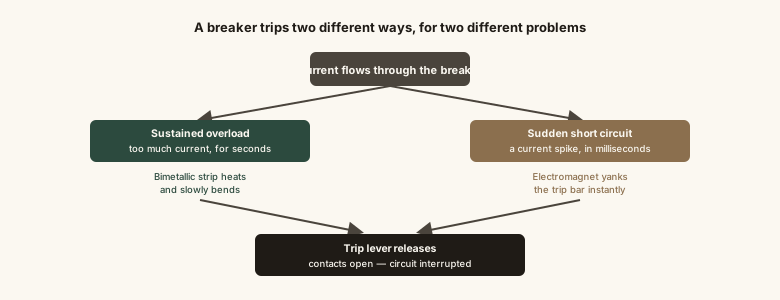
Both paths end the same way — the contacts open and the circuit goes dead — but the trigger and the timing behind each are genuinely different physical events inside the same small device.
Common mistakes
Common Mistakes
Assuming a circuit breaker is what keeps a person from getting shocked while using an outlet.
→ Understand a breaker as wiring and fire protection specifically — ground-fault shock protection is a separate device, a GFCI, doing a different job.
Treating a breaker that hasn't tripped as confirmation that a circuit's current load is fine.
→ Remember the breaker's threshold is set to protect the wire from damage, not to flag every load that's inefficient, marginal, or worth spreading across more than one circuit.
Repeatedly resetting a breaker that keeps tripping without figuring out why.
→ Treat a breaker that trips repeatedly as it doing its job correctly — reduce the load on that circuit, or have a licensed electrician investigate if it trips with little or no load at all.
Common misconception
“A circuit breaker is what protects you from being electrocuted if you touch a live wire.”
A standard circuit breaker reacts to excess current flowing through the circuit's wiring — a sustained overload or a short circuit — not to current passing through a person's body. A person touching a live wire and completing a path to ground typically doesn't draw anywhere near enough current to trip a standard 15- or 20-amp breaker, because the human body's resistance limits that current to a level far below the breaker's trip threshold, even though it can still be lethal. The device built specifically to sense that kind of leak and cut power in milliseconds is a ground-fault circuit interrupter, or GFCI — a separate mechanism entirely.
What to do next
What to do next
- Learn to recognize the difference between a breaker that trips occasionally under a heavy combined load (usually normal) and one that trips instantly or with almost no load (worth having checked).
- Note which outlets and rooms share a circuit, so you can spread heavy appliances like space heaters or hair dryers across different circuits.
- Never replace a breaker with one rated for a higher amperage than the wiring it protects — that removes the very protection the wire depends on.
- Have a licensed electrician inspect a breaker or panel that trips repeatedly for no clear load-related reason, rather than repeatedly resetting it.