 KnowThis
Key Takeaways
Key Takeaways
- 1Overloading a circuit means drawing more current than the wire's rated ampacity, and the resulting heat rises with the square of the current — not in a straight line — so a moderate-looking overload generates disproportionately more heat.
- 2A breaker not tripping isn't the same as a circuit running with no downside — a circuit can sit near its rated capacity for long stretches, staying warmer than an ordinary load, without reaching the threshold that trips the breaker.
- 3The commonly cited 80% continuous-load guideline exists because sustained near-capacity loads are treated more conservatively than brief, occasional ones.
The concept
Once the current-squared relationship is visible, a lot of overload behavior makes more sense: why a circuit can seem "fine" for a while under a heavy load, and why the margin engineers build in isn't just conservative padding.
If the current through a wire doubles, roughly what happens to the heat generated in that wire?
Worked examples
Example 1: Several space heaters push a circuit past its rating (baseline case)
Two portable space heaters, each drawing about 12.5 amps, are plugged into outlets on the same 15-amp, 120-volt circuit and run at the same time. The combined draw of roughly 25 amps is well above the circuit's 15-amp rating. The wire heats up faster than it would under a normal load, and within a couple of minutes the breaker's thermal trip mechanism responds to the sustained overcurrent and cuts the circuit off — the overload never gets the chance to persist long enough to seriously damage the wire's insulation.
Example 2: A circuit running just under its rating for hours at a time (edge case / variation)
A circuit draws current steadily just under its breaker's rating for several hours without tripping. What does this scenario illustrate?
Example 3: Sizing safe continuous wattage for a home workshop circuit (real-world / applied case)
Someone planning equipment for a home workshop wired with a 20-amp, 120-volt circuit wants to know how much continuous wattage it can safely support if the equipment will run for hours at a stretch. Applying the commonly used 80% continuous-load margin: 20 amps × 120 volts × 0.8 = 1,920 watts. That number, not the circuit's full 2,400-watt theoretical capacity (20 × 120), is the more conservative planning figure appropriate for equipment expected to run continuously — leaving headroom for the sustained heating a continuous load produces, rather than assuming the breaker's full rating is the safe operating target.
Why would someone planning continuous equipment loads for a 20-amp, 120-volt circuit use 1,920 watts as a planning figure instead of the circuit's full 2,400-watt theoretical capacity?
How it works (visual)
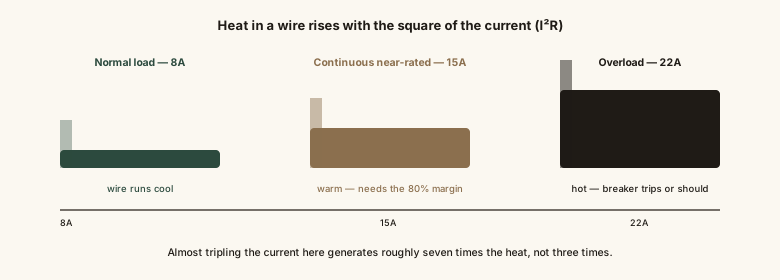
The jump in heat between the middle and right panels is bigger than the jump in current alone would suggest — that gap is the I²R relationship showing up directly.
Common mistakes
Common Mistakes
Assuming heat in an overloaded wire rises in direct proportion to the extra current, rather than much faster.
→ Remember that resistive heating scales with current squared — even a moderate overload can generate disproportionately more heat than the current figure alone suggests.
Treating a breaker that hasn't tripped as proof a sustained, near-capacity load is running safely.
→ Apply the more conservative continuous-load guideline (commonly 80% of the breaker's rating) for anything expected to run at or near full draw for hours at a time, rather than planning up to the breaker's full trip threshold.
Adding up appliances by how many outlets they use rather than by their actual combined current draw.
→ Calculate the combined amperage of everything running on a circuit at once, and compare that total against the circuit's rated ampacity, not against the number of outlets available.
Common misconception
“As long as the breaker hasn't tripped, the circuit is running at a safe level.”
A breaker's trip threshold is calibrated to prevent the wire from reaching a genuinely damaging temperature — it isn't calibrated to flag every load that runs hotter than ideal. A circuit can sit for hours at current just under the breaker's rating, especially with a continuous load, without ever tripping, while still running measurably warmer than a brief, moderate load at the same current would. That gap is exactly why continuous loads are conventionally planned for at a lower percentage of the breaker's rating — the absence of a trip is not the same as confirmation that a sustained load is running with a comfortable safety margin.
Try it yourself
Enter a breaker's amperage rating and the circuit's voltage to see a conservative continuous-load wattage figure, using the commonly cited 80% safety margin. This is a general planning estimate, not a substitute for a licensed electrician's assessment of a specific circuit.
This applies the commonly cited 80% continuous-load margin as a general planning convention, not a specific code requirement for any particular circuit — actual safe capacity depends on the wiring, breaker, and installation, which a licensed electrician can assess directly.
What to do next
What to do next
- Add up the actual amperage draw of everything likely to run on a circuit at once, rather than assuming a circuit is fine simply because the breaker hasn't tripped yet.
- Apply extra caution — and a lower planning margin, like the commonly cited 80% figure — for any load expected to run continuously for three hours or more.
- Spread heavy, simultaneous loads like space heaters or workshop equipment across more than one circuit where possible.
- Have a licensed electrician evaluate a circuit that runs warm, trips repeatedly, or needs to support a heavier continuous load than it currently handles.