 KnowThis
Key Takeaways
Key Takeaways
- 1A GFCI exists to catch a specific danger a standard breaker misses entirely: a small amount of current leaking to ground, including through a person, at a level far too low to trip a normal breaker.
- 2It works by continuously comparing outgoing and returning current on the same circuit and tripping within milliseconds the instant the two no longer match.
- 3GFCIs are required in locations where water and electricity are most likely to meet — kitchens, bathrooms, garages, outdoor outlets, and similar damp or grounded locations — because that combination is what makes a ground fault through a person far more likely.
The concept
Because a GFCI is watching for an imbalance rather than an overload, it reacts to a completely different kind of danger than a standard breaker does — which is exactly why building codes require both, in different combinations, in different rooms of a home.
What is a GFCI actually detecting when it trips?
Worked examples
Example 1: A plugged-in appliance falls into a sink of water (baseline case)
A hair dryer plugged into a bathroom GFCI outlet is accidentally knocked into a sink partly filled with water while still on. Current begins flowing from the hot wire, through the water, and potentially through anyone in contact with it, back to ground — a path that completely bypasses the normal return route through the neutral wire. The GFCI's sensing coil detects the resulting imbalance almost immediately and cuts power to the outlet within a fraction of a second, well before a standard breaker would register anything unusual on the circuit at all.
Example 2: A GFCI breaker protecting an entire circuit, not just one outlet (edge case / variation)
An outlet has no test or reset buttons on its face, but tripping a nearby GFCI outlet also cuts power to it. What does this indicate?
Example 3: Where building codes require GFCI protection in a typical home (real-world / applied case)
A homeowner renovating a kitchen finds that outlets near the sink and countertop need to be GFCI-protected, along with outlets in the bathroom, garage, unfinished basement, and any outdoor location. The common thread across all of these spaces is proximity to water, damp conditions, or a grounded concrete floor — exactly the conditions that make a person's body a more likely path for stray current to reach ground, and exactly why electrical codes single these locations out rather than requiring GFCI protection uniformly throughout the entire house.
Why do electrical codes typically require GFCI protection in kitchens, bathrooms, garages, and outdoor outlets specifically?
How it works (visual)
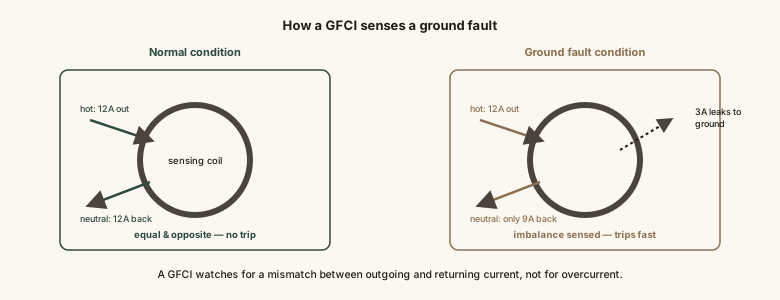
The sensing coil itself never needs to know what caused the imbalance — a person, a wet appliance, a damaged cord — only that outgoing and returning current no longer match.
Common mistakes
Common Mistakes
Assuming a standard circuit breaker already provides the same shock protection a GFCI does.
→ Understand that a breaker reacts to overcurrent in the wiring, while a GFCI reacts to a much smaller current imbalance — they cover different hazards, and a circuit can need both.
Never testing a GFCI outlet's test and reset buttons, assuming it will simply work forever without maintenance.
→ Test GFCI outlets periodically using their built-in test button, since electronic sensing components can fail over time, sometimes without a visible sign.
Assuming an outlet must have its own visible GFCI buttons to be GFCI-protected.
→ Check whether the outlet is wired downstream of a GFCI outlet or breaker elsewhere on the circuit — a plain-looking outlet can still be protected.
Common misconception
“A GFCI outlet means you can't get any shock at all from that outlet.”
A GFCI dramatically reduces the risk of a lethal shock from a ground fault by cutting power within milliseconds, but it doesn't prevent every kind of shock. A brief, small shock can still be felt before the device trips, and a GFCI doesn't protect against contact between the hot and neutral wires where current returns through its normal path rather than leaking to ground — that scenario doesn't create the imbalance a GFCI is built to detect. A GFCI also isn't a substitute for a circuit breaker's overcurrent protection; the two devices guard against different failure modes and often work together on the same circuit.
What to do next
What to do next
- Identify which outlets in your home are GFCI-protected, either directly or through a downstream connection, especially in kitchens, bathrooms, garages, and outdoor areas.
- Test GFCI outlets periodically with their built-in test and reset buttons to confirm the sensing mechanism is still functioning.
- Have a licensed electrician add GFCI protection to any wet-location outlet that currently lacks it, rather than attempting a rewiring project yourself.
- Keep in mind that a GFCI and a standard breaker protect against different hazards, so tripping one doesn't mean the other has also detected a problem.