 KnowThis
Key Takeaways
Key Takeaways
- 1There is no visual test that reliably shows whether a wire is carrying voltage — intact insulation and standard wire colors both look identical whether a wire is live or dead.
- 2A flipped breaker is a strong indicator, not proof, that a specific wire is de-energized — mislabeled panels and shared-neutral wiring are real, documented reasons a wire can stay live even after the labeled breaker is off.
- 3The verification method licensed electricians rely on is a non-contact voltage tester used with a test-test-test procedure — this is general knowledge about how that verification works, not a substitute for hiring a licensed electrician for actual wiring work.
The concept
None of this is a how-to for testing your own home's wiring — it's an explanation of why professionals treat every wire as live until proven otherwise, and why that proof takes a specific, verifiable form rather than a glance or a flipped switch.
Why do professionals treat a flipped breaker as a strong signal, but not as final proof, that a specific wire is de-energized?
Worked examples
Example 1: The standard verification sequence before electrical work begins (baseline case)
Before beginning work on a household circuit, an electrician switches off the breaker labeled for that circuit at the panel. Rather than treating the switched-off label as sufficient, they follow the test-test-test sequence: confirm the voltage tester works on a known-live source, use it to check the wire they intend to work on, then confirm the tester still works on that same known-live source afterward. Only once all three checks agree does the wire get treated as verified de-energized — the labeled breaker position was the starting signal, not the final confirmation.
Example 2: A mislabeled panel from a past renovation (edge case / variation)
In a home with an outdated or mislabeled breaker panel, what does testing the wire directly accomplish that switching off the labeled breaker alone does not?
Example 3: A shared-neutral circuit that stays partly energized (real-world / applied case)
Two circuits in an older home share a single neutral wire — a wiring style sometimes used to save on wire runs. One circuit's breaker is switched off for planned work, but the shared neutral wire is still carrying return current from the second circuit, which remains active. Someone relying only on the switched-off breaker as proof of safety would have no way to know this from the panel alone. A direct voltage test on the actual wire, rather than an assumption based on the breaker position, is what reveals that the neutral is still carrying current — precisely the kind of wiring detail that makes professional verification, not a flipped switch, the real safety step.
Why can a shared-neutral wiring setup leave a wire energized even when its own circuit's breaker is switched off?
How it works (visual)
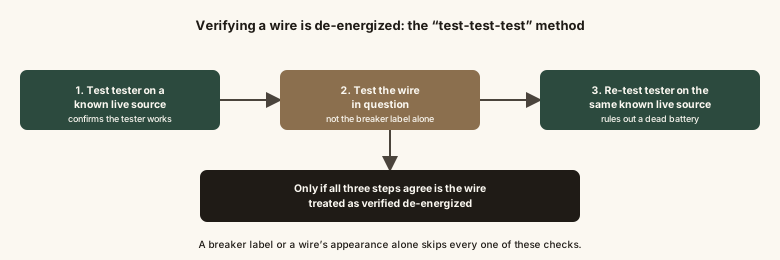
Each of the three steps exists to rule out a specific failure — a dead or defective tester, a mislabeled breaker, or a wiring configuration that keeps a wire energized from an unexpected source.
Common mistakes
Common Mistakes
Assuming a wire is safe because its insulation looks intact and undamaged.
→ Recognize that a wire's outward appearance carries no information at all about whether it's currently energized — intact insulation looks the same whether a wire is live or dead.
Treating a switched-off breaker, by itself, as final proof that a specific wire is de-energized.
→ Understand that a breaker label can be wrong, and that a flipped breaker is a strong first signal, not a substitute for direct verification with a voltage tester.
Testing a wire with a voltage tester only once, without first and afterward confirming the tester itself is working.
→ Follow the test-test-test method — a tester with a dead battery gives the same 'not live' reading as an actually de-energized wire, which is exactly why the bracketing check exists.
Common misconception
“If a breaker is switched off and the wire looks normal, it's safe to assume the wire is dead.”
Neither signal is reliable on its own. A wire's appearance gives no indication of whether it's energized, and a switched-off breaker only reflects what the panel's label claims — panels are commonly mislabeled after past renovations, and wiring configurations like a shared neutral can leave a wire carrying current from an entirely different, still-active circuit. The verification method professionals actually rely on is direct measurement with a non-contact voltage tester, following a test-test-test sequence that also confirms the tester itself is functioning. This is general knowledge about how that verification works — it isn't a substitute for hiring a licensed electrician to actually perform electrical work.
What to do next
What to do next
- Treat every wire as live until it has been verified de-energized by direct testing — never rely on appearance or a breaker label alone.
- Understand that panel labels can be wrong, especially in homes with a history of renovations or additions, so a labeled breaker is a starting point, not a final answer.
- Recognize the term lockout/tagout as the formal procedure professionals use to keep a verified de-energized circuit from being switched back on during work.
- For any actual electrical work — testing, repairing, or modifying household wiring — hire a licensed electrician rather than attempting to verify or handle wiring personally.