 KnowThis
Key Takeaways
Key Takeaways
- 1Electrical resistance depends on a wire's cross-sectional area — a thinner wire of the same material and length has meaningfully more resistance than a thicker one.
- 2Resistive heating scales with current squared times resistance, so a thin wire forced to carry a large current heats up dramatically faster than a thick wire carrying that identical current.
- 3This is exactly why every wire gauge has a rated ampacity, and why circuit breakers are sized to match the installed wire, not the appliance plugged into it.
The concept
Once resistance and resistive heating are understood as functions of a wire's cross-sectional area, wire gauge charts, breaker sizing, and extension cord warnings all become the same underlying physics applied to different situations.
A homeowner uses a thin lamp-cord-style extension cord to power a high-draw space heater rated well above the cord's ampacity. What is the actual danger mechanism?
Worked examples
Example 1: Comparing resistance of two wire gauges (baseline case)
A 100-foot run of 14-gauge copper wire has meaningfully more resistance than the same 100-foot length of thicker 10-gauge copper wire, purely because of the smaller cross-sectional area of the 14-gauge wire — both are the same material (copper) and the same length, so cross-sectional area is the only variable. This is precisely why the National Electrical Code assigns different ampacity ratings to each gauge: 14-gauge is commonly rated around 15 amps for standard household circuits, while 10-gauge is commonly rated around 30 amps, reflecting how much more current the thicker wire can carry before generating unsafe amounts of resistive heat.
Why does a thinner 14-gauge copper wire have more electrical resistance than a thicker 10-gauge copper wire of the exact same length?
Example 2: The same current through both gauges (edge case / variation)
Forcing the identical 20-amp current through both a 14-gauge and a 10-gauge wire, why does the thinner 14-gauge wire become the more dangerous one?
Example 3: Why circuit breakers are matched to wire gauge (real-world / applied case)
A residential electrician wiring a new kitchen circuit selects both the wire gauge and the circuit breaker together, matching a 20-amp breaker to 12-gauge wire, per NEC ampacity tables — never sizing a breaker based on the appliances that might eventually be plugged in. The breaker's entire job is to interrupt current before the installed wire's resistive heating becomes dangerous, so a breaker rated higher than the wire's safe ampacity would let a genuinely hazardous overload continue undetected, while a breaker rated lower would trip needlessly on normal loads the wire could safely handle.
Why do electricians size circuit breakers to match the installed wire's ampacity, rather than to the appliances expected to be plugged in?
How it works (visual)
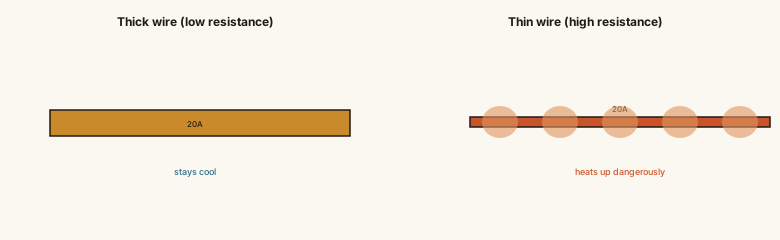
The current entering each wire is identical in this diagram — the heat difference comes entirely from each wire's cross-sectional area and the resistance that area determines.
Common mistakes
Common Mistakes
Using an extension cord or wire gauge based only on whether it physically fits, without checking its ampacity rating.
→ Match wire gauge (and any extension cord) to the actual current the connected device will draw, using published ampacity tables.
Assuming a circuit breaker protects any device plugged into it, regardless of the wire gauge feeding that outlet.
→ Remember the breaker is sized to protect the installed wire specifically — running a high-draw device through a too-thin extension cord can overheat the cord well before the breaker trips.
Thinking wire thickness is purely about physical durability, not electrical safety.
→ Recognize that thickness (cross-sectional area) directly determines resistance and therefore how much current a wire can carry without dangerous resistive heating.
Common misconception
“Any wire can safely carry any amount of current, as long as it doesn't physically melt or break under the load.”
A wire's cross-sectional area directly determines its electrical resistance, and resistance is what turns current into heat — a thinner wire has meaningfully more resistance than a thicker one of the same material and length, so it generates more heat carrying the identical current. Because resistive heating scales with the square of current, even a moderate overload on an undersized wire can produce dangerous, fire-risk levels of heat well before any visible physical failure occurs. This is exactly why every wire gauge carries a published ampacity rating, and why circuit breakers are deliberately matched to the specific wire gauge they protect, not to whatever might eventually be plugged in downstream.
Try it yourself
Uses R = resistivity x length / cross-sectional area. Copper's resistivity is about 1.68 x 10⁻⁸ ohm-meters.
What to do next
What to do next
- Check that any extension cord you use is rated for the actual amperage of the device plugged into it, especially for space heaters or high-draw appliances.
- Never assume a circuit breaker protects a downstream extension cord or accessory wire — it's sized only to the home's own installed wiring.
- If a cord or wire feels warm to the touch during normal use, treat it as a sign of undersized wiring for the load, not something to ignore.
- When adding a new circuit or outlet, follow National Electrical Code ampacity tables to match wire gauge to the expected current draw and breaker size.