 KnowThis
Key Takeaways
Key Takeaways
- 1A bird's feet aren't insulated from electricity — it's safe because both feet touch the exact same wire, meaning there's no voltage difference across its body for current to flow through.
- 2Current only flows through a path when there's a voltage difference between its two ends — the wire's absolute voltage relative to the ground doesn't matter if the bird never touches anything at a different voltage.
- 3The danger appears immediately if a second contact point at a different voltage is introduced — a grounded pole, a second wire, or a human touching both the line and the ground at once.
The concept
Once voltage difference (not absolute voltage) is understood as the actual trigger for current flow, it becomes possible to predict exactly which real-world scenarios near power lines are safe and which are lethal.
A bird is perched safely with both feet on the same high-voltage wire. What would make the situation suddenly dangerous for the bird?
Worked examples
Example 1: A bird with both feet on one wire (baseline case)
A bird lands on a transmission line carrying 25,000 volts relative to ground, with both feet planted on the same wire, a few inches apart. Because both feet are on the same conductor, the voltage difference between them is effectively zero — real transmission wire has some resistance per unit length, but over a few inches that translates to a difference of a tiny fraction of a volt, far too small to drive any meaningful current through the bird's body. The bird can preen, sleep, or fly off from that same wire indefinitely, completely unaffected by the wire's enormous voltage relative to the distant ground.
Why doesn't the transmission line's 25,000-volt potential (relative to ground) create a dangerous shock for a bird perched with both feet on it?
Example 2: A bird whose wingtip brushes a grounded pole (edge case / variation)
Why does a bird's wingtip touching a grounded pole while its feet remain on an energized wire create a dangerous situation, when standing on the wire alone did not?
Example 3: Why linework safety training bans two-point contact (real-world / applied case)
Utility line workers are trained never to simultaneously contact two points at different voltages — for example, an energized line and a grounded structure — while working near live equipment. Specialized techniques like "bare-hand" live-line work exist specifically to eliminate this risk: a worker is electrically bonded to the same conductor they're working on before touching it, matching their entire body to that wire's voltage, the same protection the bird gets automatically by keeping both feet on one wire. Insulated tools and protective equipment serve the same underlying goal — preventing any part of the worker's body from providing a conductive path between two different voltages.
Why does bonding a lineman electrically to an energized wire before contact make it safe to work on, using the same underlying principle as the bird example?
How it works (visual)
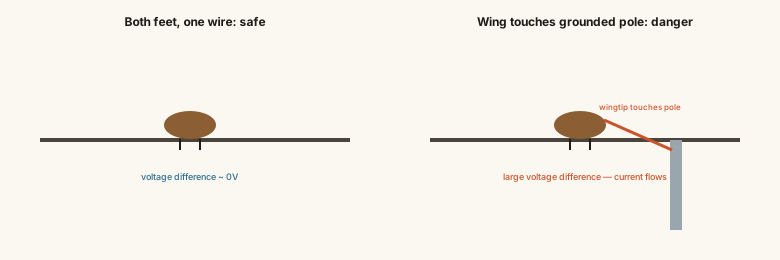
The wire's voltage relative to ground is identical in both panels — what changes is whether the bird's own body ever bridges two genuinely different voltages.
Common mistakes
Common Mistakes
Assuming a bird on a wire is protected by some natural insulation in its feet or feathers.
→ Recognize the actual mechanism: both feet touching the same wire means no voltage difference exists across its body — insulation isn't the reason at all.
Believing high voltage alone is what makes something dangerous, regardless of contact configuration.
→ Focus on voltage difference across an actual conductive path — a person standing on an insulated surface can safely touch a single high-voltage point, just like the bird does.
Underestimating the danger of large wingspans or objects bridging a wire and a grounded structure.
→ Treat any object or body large enough to simultaneously touch two different-voltage points near power lines as a serious electrocution risk.
Common misconception
“A bird can sit on a high-voltage power line because its feet or feathers insulate it from the electricity.”
A bird's feet and feathers provide no special electrical insulation. It's safe because both of its feet touch the exact same wire, at essentially the same electrical potential — the voltage difference across its body is nearly zero, and current only flows when a real voltage difference exists across a conductive path. The wire's absolute voltage relative to the distant ground is irrelevant to the bird, since it never contacts anything at that different (ground) potential. The instant a bird's wing or body bridges the wire and a genuinely different-voltage point — a grounded pole, a second wire, a transformer — a real voltage difference appears across its body, and the outcome is typically fatal. This is precisely why bird electrocution on utility infrastructure happens almost exclusively through two-point contact, not single-wire perching.
Try it yourself
Ohm's law: current equals voltage difference divided by resistance. Try a near-zero voltage difference (like a bird's two feet on one wire) versus a large one (like touching a wire and a grounded object).
What to do next
What to do next
- Never assume any part of a power line or electrical equipment is 'safe' to touch just because a bird can perch on it — the bird's safety depends on a configuration a person can't replicate.
- Stay well clear of any situation where you, an object, or a vehicle could simultaneously contact a power line and a grounded structure or the earth.
- If a vehicle contacts a downed power line, stay inside unless there's fire risk, since stepping out creates exactly the two-point-contact hazard this concept describes.
- Report downed or low-hanging power lines to the utility company immediately rather than attempting to move or inspect them.