 KnowThis
Key Takeaways
Key Takeaways
- 1Whether something floats or sinks depends on its density relative to the fluid it's in, not on its total weight — a massive object can float, and a tiny object can sink.
- 2A steel ship floats because its hollow hull spreads the same mass of steel over a large enough volume that the ship's overall average density is lower than water's.
- 3Archimedes' principle explains it directly: an object floats if it can displace a weight of fluid equal to its own total weight before going fully underwater.
The concept
Once density (not weight) is understood as the deciding factor, it becomes possible to predict floating behavior for almost any object, from a coin to a cruise ship, just by comparing average density to the fluid's density.
A large hollow plastic ball and a small solid steel ball bearing are placed in a bucket of water. The plastic ball weighs far less in total than the steel ball. What happens?
Worked examples
Example 1: A solid steel bolt sinking (baseline case)
A solid steel bolt, with a density around 7,850 kg/m³, is dropped into a tank of fresh water, which has a density of about 1,000 kg/m³. Since the bolt's density is nearly eight times that of water at every point throughout its solid volume, it can never displace enough water to generate a buoyant force equal to its own weight — even fully submerged, the water it displaces weighs far less than the bolt itself. The bolt sinks straight to the bottom, exactly as Archimedes' principle predicts for any object denser than its surrounding fluid throughout its entire volume.
Why does a solid steel bolt sink in water, when analyzed through Archimedes' principle?
Example 2: The same steel, shaped into a floating hull (edge case / variation)
The exact same mass of steel sinks as a solid bolt but floats when shaped into a hollow hull. What changed?
Example 3: Why a punctured hull sinks a ship (real-world / applied case)
A cargo ship's hull is breached below the waterline, and seawater begins flooding into one of its compartments, displacing the air that had been keeping the ship's average density below water's. As more compartments flood, the volume of enclosed air shrinks while the ship's total mass (now including the flooded seawater) increases, pushing its overall average density up. If enough compartments flood, the ship's average density eventually exceeds water's, and it can no longer displace enough water to support its own weight at any depth — it sinks. Watertight compartment design exists specifically to limit how much of a ship's buoyant air volume any single breach can compromise, buying time and often preventing total loss.
Why does flooding from a hull breach eventually cause a ship to sink, when the same steel structure normally floats?
How it works (visual)
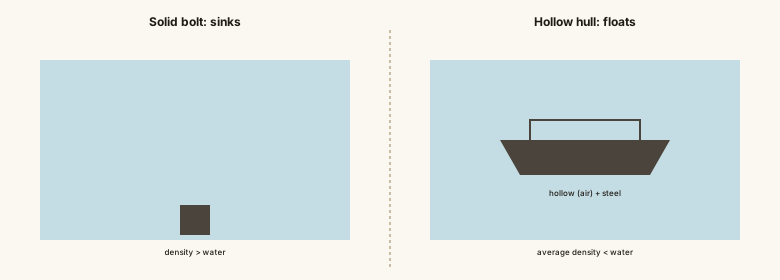
The mass of steel is identical in both panels — the only difference is how much volume (and enclosed air) that mass is spread across, which is exactly what average density measures.
Common mistakes
Common Mistakes
Predicting whether an object will float based on its total weight rather than its density relative to the fluid.
→ Compare average density (mass divided by total volume, including any hollow or enclosed space) to the fluid's density instead — weight alone doesn't determine the outcome.
Assuming a material like steel or rock can never float under any circumstances.
→ Recognize that shape matters — spreading the same mass across enough enclosed volume (a hollow hull, a life jacket's foam) can bring the overall average density below the fluid's.
Underestimating how flooding even a small number of compartments can sink a large vessel.
→ Remember that flooding both adds mass and removes buoyant air volume simultaneously, which can push average density past the tipping point faster than intuition suggests.
Common misconception
“Heavier objects sink and lighter objects float — weight is what determines it.”
Floating and sinking depend on an object's density compared to the fluid it's in — not its total weight. A massive steel cargo ship floats because its hollow shape spreads the same steel mass across a large enough volume (mostly enclosed air) that its overall average density drops below water's, while a small, solid steel bolt sinks because its density, uniformly higher than water's throughout, never changes no matter how little it weighs in absolute terms. Archimedes' principle makes this precise: an object floats only if it can displace a weight of fluid equal to its own total weight before going fully underwater — a condition governed by density and shape, never by weight alone.
Try it yourself
Compare the result to water's density (1,000 kg/m³, or 1 g/cm³) to predict whether an object of that overall density would float or sink.
What to do next
What to do next
- Next time you see a heavy object float or a light one sink, ask what its overall average density is compared to the fluid, not how much it weighs.
- Try floating a ball of aluminum foil, then crumple it tightly into a dense wad — the same mass will behave very differently depending on enclosed volume.
- Connect this to how life jackets work: foam has very low density, lowering a wearer's overall average density enough to float even fully clothed.
- Read the related entry on Density & Buoyancy for the full Archimedes' principle derivation and more worked density calculations.