Density & Buoyancy: Why Some Things Float and Others Sink
An object floats when it's less dense than the fluid it's in, and sinks when it's more dense — buoyant force depends on the volume of fluid displaced, not the object's weight alone.
Reading time
— 5 min
Updated
— Sep 25, 2026
Fact-reviewed
— Aug 16, 2026
Key Takeaways
Key Takeaways
1Whether an object floats depends on its density compared to the fluid it's in, not on how heavy or big it is in absolute terms.
2A massive steel ship floats because its overall shape — mostly hollow, air-filled space — makes its average density lower than water, even though solid steel itself sinks.
3Buoyant force equals the weight of the fluid an object displaces (Archimedes' principle) — more displaced fluid means more upward push, regardless of what the object is made of.
The concept
Density is how tightly packed matter is inside an object — a brick and a similarly sized sponge can weigh very differently because the brick packs far more mass into the same space. Whether something floats depends on comparing its density to the fluid around it: less dense than water, it floats; more dense, it sinks. A solid steel ball sinks, but a hollow steel ship floats, because the ship's shape spreads that same steel (plus a lot of empty, air-filled space) across a much bigger volume, lowering its average density below water's.
That relationship between weight, displaced fluid, and buoyant force is exactly what makes a battleship float and a paperclip sink — and it becomes concrete once real numbers go into Archimedes' formula.
Quick check
A block of solid steel sinks in water, but a steel ship many times heavier floats. What's the key difference?
Worked examples
Example 1: Comparing densities to predict floating (baseline case)
A wooden block has a mass of 60 grams and a volume of 100 cm³, giving a density of 60 ÷ 100 = 0.6 g/cm³. Water's density is 1.0 g/cm³. Since 0.6 is less than 1.0, the block floats — and roughly 60% of its volume sits below the waterline, because it needs to displace exactly 60 grams (60 cm³) of water to support its own 60-gram weight. A denser wood, like ebony at roughly 1.2 g/cm³, would sink in plain water for the identical reason in reverse.
Example 2: A solid steel block versus a hollow steel ship hull (edge case / variation)
Solid steel has a density around 7.8 g/cm³ — nearly 8 times water's density, so a solid steel block always sinks, no exceptions. But shape a fixed mass of that same steel into a hollow hull enclosing a large air-filled volume, and the ship's overall density (steel mass ÷ total hull volume, including the air inside) drops well below 1.0 g/cm³. A real cargo ship's hull might weigh tens of thousands of tonnes yet float, because its total enclosed volume is large enough that the average density of "ship" — steel plus air plus cargo — comes in under water's density. Damage the hull enough to let water flood that air-filled volume, and average density rises back above 1.0 g/cm³, and the ship sinks — this is the entire physical mechanism behind flooding sinking a ship.
Quick check
A ship's hull is damaged and floods with water, replacing the air inside it. Why does this cause the ship to sink?
Example 3: Why a submarine can float or sink on command (real-world / applied case)
A submarine controls its own average density using ballast tanks — chambers that can be filled with either seawater or compressed air. To dive, the crew floods the tanks with seawater, increasing the submarine's average density above the surrounding water's, so buoyant force can no longer support its weight and it sinks. To surface, compressed air is pumped in to push the water back out, lowering average density below the surrounding water again, restoring enough buoyant force to rise. Submarines can even hold a precise depth by adjusting ballast until average density exactly equals the surrounding water's density — relative density of exactly 1, neither rising nor sinking, called neutral buoyancy.
How it works (visual)
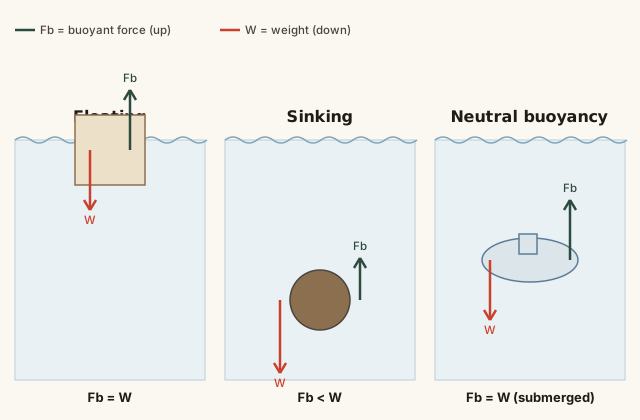
Buoyant force versus weight for floating, sinking, and neutral buoyancy
Floating is a balance: the object sinks just deep enough that the weight of the water it displaces equals its own weight, then stops. Sinking means even at full submersion — displacing the maximum possible volume of water — the buoyant force still can't catch up to the object's weight. Neutral buoyancy, used by submarines and scuba divers, is the special case where those two forces are exactly balanced while fully submerged.
Common mistakes
Common Mistakes
✕
Assuming heavier objects always sink and lighter objects always float.
→ Weight alone doesn't determine floating — density (mass relative to volume) does. A massive steel ship floats; a small steel bolt sinks, because their densities, not their weights, differ from water's.
✕
Thinking buoyant force depends on how deep an object is submerged.
→ Buoyant force depends on the volume of fluid displaced, not depth — a fully submerged object displaces the same volume (and feels the same buoyant force from that displacement) whether it's just below the surface or far underwater, ignoring fluid density changes with depth.
✕
Believing an object floats because it 'weighs less' in water.
→ The object's actual weight doesn't change in water — an upward buoyant force is added, partially or fully counteracting gravity. That's why objects genuinely feel lighter when held underwater, even though their mass hasn't changed.
Common misconception
“Objects float because they are lightweight, and heavy objects always sink.”
Floating depends entirely on density relative to the surrounding fluid, not absolute weight. An aircraft carrier can weigh over 90,000 tonnes and float easily, while a single dense steel ball bearing weighing a few grams sinks instantly. The carrier's hull shape spreads its mass across an enormous hollow volume, keeping its average density below water's — weight alone never determines the outcome without accounting for volume.
Quick check
A small pebble sinks in water, but a large inflatable raft carrying several people floats easily. What determines this outcome?
Try it yourself
Density (mass ÷ volume)
Density (g/cm³) — below 1.0 floats in water0.6
Buoyant force (Archimedes' principle: F = ρ × g × V)
Buoyant force (newtons)98
What to do next
What to do next
Next time you see a large ship, remember it floats because of shape and average density, not because steel is somehow lightweight.
Try the density calculator above with an ice cube's numbers (density ~0.92 g/cm³) to see why ice floats in liquid water.
Notice how much lighter your body feels in a pool versus on land — that's buoyant force partially counteracting gravity, not an actual change in your weight.
Read the related entry on Matter & States of Matter to connect density changes to phase transitions like ice forming from liquid water.
FAQ
FAQ
Related terms
Related terms
Density
Mass per unit volume of a substance, typically measured in grams per cubic centimeter (g/cm³) or kilograms per cubic meter (kg/m³).
Buoyant force
The upward force a fluid exerts on an object submerged or floating in it, equal to the weight of the fluid the object displaces.
Archimedes' principle
The rule that buoyant force on an object equals the weight of the fluid it displaces — named for the Greek mathematician who reportedly discovered it in a bathtub.
Displacement
The volume of fluid pushed out of the way by a submerged or floating object.
Relative density
The ratio of a substance's density to a reference substance's density (usually water) — a relative density below 1 means the substance floats in water.
This entry was researched from public sources and drafted with AI-assisted tools, then edited — errors are still possible. Spot one, or want a topic covered? Read our disclaimer.
 KnowThis