Heat & Temperature: What's Actually Different Between Them
Temperature measures how fast particles are moving on average; heat is the total thermal energy transferred between objects, and the two don't always move together.
Reading time
— 5 min
Updated
— Aug 16, 2026
Fact-reviewed
— Aug 16, 2026
Key Takeaways
Key Takeaways
1Temperature is the average speed of particles; heat is the total energy transferred — a huge pot of lukewarm water can hold more heat energy than a small cup of boiling water.
2Specific heat capacity explains why sand burns bare feet in seconds while nearby ocean water stays comfortable — water resists temperature change far more than sand does per gram.
3Heat moves three ways — conduction (contact), convection (fluid movement), and radiation (waves) — and most real heating and cooling (a room, a body, a planet) uses more than one at once.
The concept
Temperature tells you how hot or cold something is on a scale (like °C). Heat is the energy that actually flows between two things when one is hotter than the other — heat always moves from hot to cold until both reach the same temperature. They sound like the same idea, but a swimming pool at 28°C and a cup of tea at 28°C are at the identical temperature, yet the pool holds vastly more total heat energy simply because it has so much more water.
Specific heat capacity is the number that turns "temperature versus heat" from a definition into something you can calculate directly — and it explains a surprising amount of ordinary experience once you put real values in.
Quick check
A small metal spoon and a large pot of water are both left in the same sunny room for hours and reach the same temperature. Which holds more total heat energy?
Worked examples
Example 1: Heating a cup of water on a stove (baseline case)
To raise 250 grams of water by 20°C (say, from 25°C to a warm 45°C), the energy needed is mass × specific heat × temperature change: 250 g × 4.18 J/g°C × 20°C = 20,900 joules. That number is the direct reason a kettle takes real, measurable time and real electrical energy to heat water — it isn't arbitrary, it's this exact calculation running on your stovetop or heating element.
Example 2: Why beach sand burns your feet but the ocean doesn't (edge case / variation)
Dry sand has a specific heat capacity of roughly 0.83 J/g°C — about a fifth of water's 4.18 J/g°C. Under the same intense midday sun, sand's temperature can shoot up 30-40°C above air temperature within hours, easily reaching 60-70°C — hot enough to burn bare skin — while nearby ocean water, absorbing the same sunlight per gram, might rise only a few degrees because it takes roughly 5 times more energy to produce the same temperature increase. This isn't about sand absorbing more sunlight; it's that the same energy input produces a much bigger temperature swing in a low-specific-heat material like sand.
Quick check
Coastal cities tend to have milder summers and winters than inland cities at the same latitude. What's the main physical reason?
Example 3: How a thermos keeps drinks hot (real-world / applied case)
A vacuum-insulated thermos slows down all three heat transfer methods at once. The vacuum layer between its inner and outer walls removes almost all the matter that could carry heat by conduction or convection — no air, no material path for particles to pass energy along. The remaining heat loss path is radiation, which is why the inner surface is typically a reflective, mirror-like coating — reflecting radiant heat back inward rather than absorbing and re-emitting it outward. Blocking all three pathways at once is why a good thermos can keep coffee hot for 12+ hours, far longer than an uninsulated cup.
How it works (visual)
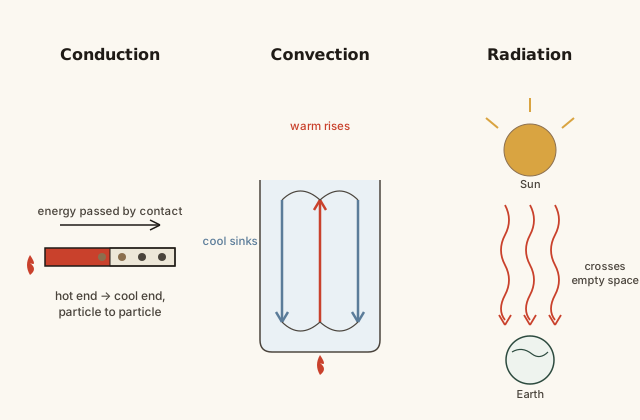
Three ways heat moves: conduction, convection, radiation
Conduction dominates in solids where particles are locked close together (a metal spoon in hot soup). Convection dominates in fluids that can physically flow (a pot of boiling water, a heated room, ocean currents) — warmer fluid becomes less dense, rises, cools, and sinks again in a loop. Radiation is the only one of the three that needs no medium at all, which is the only reason the Sun's heat can cross the vacuum of space to reach Earth.
A flame is one of the few everyday heat sources that also generates its own heat rather than just transferring it — worth a closer look in Combustion & Fire Science — but once that heat exists, it spreads to its surroundings through the exact same conduction, convection, and radiation covered here.
Common mistakes
Common Mistakes
✕
Using 'heat' and 'temperature' interchangeably.
→ Temperature is average particle speed; heat is total transferred energy. Two objects can be at the same temperature while holding very different amounts of total heat energy, depending on their mass and specific heat capacity.
✕
Assuming metal objects are always colder than wood or fabric objects in the same room.
→ They're at the same room temperature — metal just conducts heat away from your hand much faster than wood, so it feels colder even though a thermometer would read the same value for both.
✕
Thinking a bigger flame or heater always heats something up faster in proportion to its size.
→ How fast temperature rises also depends on the object's mass and specific heat capacity — the same heat source raises a small object's temperature much faster than a large one.
Common misconception
“Metal feels colder than wood in the same room because metal actually is colder.”
A thermometer would show metal and wood objects sitting in the same room at the exact same temperature. Metal simply conducts heat away from your hand far faster than wood does, because metal is a much better thermal conductor. Your skin senses the rate of heat leaving your hand, not the object's actual temperature — which is why metal feels cold and, by the same mechanism, feels scorching hot far faster than wood does when both are heated.
Quick check
A metal spoon and a wooden spoon are both left in the same 20°C room overnight. Why does the metal spoon feel colder to the touch?
Try it yourself
Energy needed to change temperature (Q = mcΔT)
Energy required (joules)20,900
What to do next
What to do next
Touch a metal object and a wooden or fabric object in the same room and notice the temperature 'feels' different, even though a thermometer would show them identical.
Next time you're at a beach or pool deck, notice how much hotter dry sand or concrete gets than the water — that's specific heat capacity, not different sunlight exposure.
Try the calculator above with sand's specific heat (~0.83 J/g°C) instead of water's (4.18) to see how much less energy the same temperature rise takes.
Read the related entry on Matter & States of Matter to connect heat transfer to phase changes like melting and boiling.
FAQ
FAQ
Related terms
Related terms
Temperature
A measure of the average kinetic energy of particles in a substance — how fast they're moving on average, not how much total energy is present.
Heat
Thermal energy that flows from a hotter object to a colder one due to a temperature difference, measured in joules.
Specific heat capacity
The amount of energy needed to raise 1 gram of a substance by 1°C — different substances need very different amounts of energy for the same temperature rise.
Thermal conductor
A material that transfers heat quickly, typically metals, because their particles (and free electrons) pass energy along efficiently.
Thermal insulator
A material that transfers heat slowly, such as air, wood, or foam, because its particles are poor at passing energy along.
Conduction
Heat transfer through direct contact between particles, like a metal spoon heating up in hot soup.
Convection
Heat transfer through the movement of a fluid (liquid or gas), like warm air rising and cool air sinking in a room.
Radiation
Heat transfer through electromagnetic waves, requiring no medium — how the Sun's heat reaches Earth through the vacuum of space.
This entry was researched from public sources and drafted with AI-assisted tools, then edited — errors are still possible. Spot one, or want a topic covered? Read our disclaimer.
 KnowThis