Simple Machines: How Levers, Pulleys, and Ramps Trade Force for Distance
A simple machine changes the amount of force needed to do a job by changing the distance over which that force is applied — it never reduces the total work required.
Reading time
— 7 min
Updated
— Sep 24, 2026
Fact-reviewed
— Aug 19, 2026
Key Takeaways
Key Takeaways
1There are six simple machines — lever, pulley, wheel and axle, inclined plane, wedge, and screw — and every complex machine (a car, a can opener, a pair of scissors) is built from combinations of them.
2A simple machine trades force for distance: push with less force over a longer distance, or more force over a shorter one. Ignoring friction, the total work stays the same either way.
3Mechanical advantage tells you exactly how much a machine multiplies your force — a longer effort arm on a lever, or more supporting ropes on a pulley system, means a bigger multiplier.
The concept
A simple machine is a basic tool that makes a job easier — not by creating extra energy, but by letting you trade force for distance. A ramp lets you push a heavy box up to a truck bed using less force than lifting it straight up, but you push it over a much longer path. A pair of scissors, a wheelbarrow, a doorknob, and a bottle opener are all simple machines, or combinations of them, hiding in plain sight.
That trade-off — less force for more distance, or vice versa — sounds abstract until you put real numbers on a real lever, which is exactly where mechanical advantage stops being a definition and starts being something you can calculate and use.
Quick check
A machine lets you lift a heavy load using only 1/5 the force you'd need to lift it directly. What must be true about the distance you push?
Worked examples
Example 1: A seesaw-style lever lifting a load (baseline case)
A lever has its fulcrum placed so the effort arm is 2 meters long and the load arm is 0.5 meters long. Mechanical advantage = effort arm ÷ load arm = 2 ÷ 0.5 = 4. That means 25 kg of push force on the long end can balance and lift 100 kg of load on the short end — at the cost of your end of the lever having to travel 4 times farther than the load actually rises. This is the exact setup behind a claw hammer pulling a nail, a wheelbarrow tipping its load, and a bottle opener popping a cap.
Example 2: A block-and-tackle pulley system (edge case / variation)
Pulleys work on the same principle but count differently: mechanical advantage equals the number of rope segments actually supporting the load, not a length ratio. A single fixed pulley (mechanical advantage 1) only changes the direction of your pull — useful for a flagpole, but it doesn't reduce effort at all. Add a second, movable pulley attached to the load, and now two rope segments support it, giving mechanical advantage 2 — lifting a 40 kg load takes only about 20 kg of pulling force, but you have to pull the rope through twice the distance the load rises. Add more movable pulleys and the advantage keeps climbing, which is how construction cranes and sailing-ship rigging lift loads far heavier than any person could move directly.
Quick check
A pulley system has 3 rope segments supporting the load. Roughly how much easier is lifting compared to pulling the load straight up with no pulley?
Example 3: Why a longer ramp makes moving furniture easier (real-world / applied case)
An inclined plane's mechanical advantage equals the ramp's length divided by its height. A 3-meter-long ramp rising to a 1-meter-high truck bed has mechanical advantage 3, meaning pushing a heavy appliance up it takes roughly 1/3 the force of lifting it straight up — at the cost of walking it 3 times farther than the 1-meter rise. This is why moving crews use the longest ramp that will fit rather than the shortest: a shallower, longer ramp always trades more distance for less required force, which matters directly for how much a person can safely push versus lift.
Example 4: A screwdriver as a wheel and axle (real-world / applied case)
A wheel and axle is really just a lever that spins in a full circle instead of swinging back and forth — the "effort arm" is the wheel's radius, and the "load arm" is the axle's radius. A screwdriver handle with a 1.5 cm radius turning a 0.3 cm-radius metal shaft has mechanical advantage = 1.5 ÷ 0.3 = 5: the twisting force delivered at the tip is 5 times what your fingers apply to the wide handle, at the cost of your fingers sweeping through 5 times the distance the shaft's surface actually turns. This is exactly why a screwdriver with a fat handle is easier to turn than one with a thin handle, and why a car's steering wheel is wide rather than the size of the steering column it turns — a wider wheel means more mechanical advantage for the same arm effort.
Example 5: An axe as a wedge, and a car jack as a screw (real-world / applied case)
A wedge is two inclined planes back to back, and its mechanical advantage is its length divided by its thickest width — a splitting axe head 20 cm long and 3 cm thick at the back has mechanical advantage ≈ 20 ÷ 3 ≈ 6.7, meaning the downward force of the swing gets converted into roughly 6.7 times that much outward force splitting the wood apart sideways, along the grain. A screw is an inclined plane wrapped around a cylinder, and its mechanical advantage is the circumference the handle travels per turn divided by how far the screw advances in that same turn (its thread pitch). A car jack with a 15 cm handle radius and a thread pitch of 0.3 cm per turn has mechanical advantage = (2 × π × 15) ÷ 0.3 ≈ 314 — which is exactly why one person can lift a 1,500 kg car by hand with a jack handle, turning it many times to raise the car a small amount with each full turn.
Quick check
A car jack lets one person lift a car that weighs far more than they do, but they have to turn the handle many times to raise it just a few centimeters. What does this illustrate?
How it works (visual)
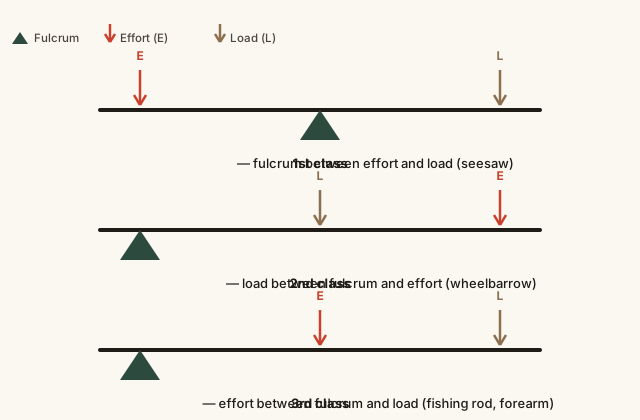
Lever classes: fulcrum, effort, and load positions
Levers come in three classes based on where the fulcrum, effort, and load sit relative to each other. A first-class lever (seesaw, scissors) has the fulcrum in the middle. A second-class lever (wheelbarrow, bottle opener) has the load in the middle, always giving a mechanical advantage greater than 1. A third-class lever (a broom, a fishing rod, the human forearm lifting a hand weight) has the effort in the middle — it always has a mechanical advantage less than 1, trading force for extra speed and reach instead, which is exactly why your arm is built for fast, wide-reaching swings rather than raw lifting force at the hand.
Common mistakes
Common Mistakes
✕
Thinking a simple machine reduces the total work needed to do a job.
→ In an ideal, frictionless machine, total work stays exactly the same — the machine only changes the balance of force versus distance, never the total energy required.
✕
Assuming every lever makes lifting easier.
→ Only levers with the fulcrum positioned to give a mechanical advantage greater than 1 reduce required force. A third-class lever, like a fishing rod, does the opposite — it trades force for extra speed and reach.
✕
Believing a single fixed pulley reduces the force needed to lift something.
→ A lone fixed pulley only changes the direction of the pull (down instead of up) — its mechanical advantage is exactly 1, so it doesn't reduce effort at all. Force reduction requires adding movable pulleys.
Common misconception
“Simple machines let you do less work overall, which is why they make hard jobs 'easy.'”
Simple machines don't reduce total work — they only reshape it. Ignoring friction, force times distance stays constant: a machine that lets you push with a quarter of the force always makes you push over roughly four times the distance. In practice, real machines do lose some effort to friction, which means the true output work is always slightly less than the input work, never more — the popular idea of a machine that outputs more energy than it takes in (a "perpetual motion machine") has never been demonstrated to work and would violate the conservation of energy.
Quick check
Why can't a real machine (accounting for friction) ever output more work than the effort put into it?
Try it yourself
Lever mechanical advantage (effort arm ÷ load arm)
Mechanical advantage (×)4
Wheel and axle mechanical advantage (wheel radius ÷ axle radius)
Look at a pair of scissors and identify the fulcrum, effort, and load — it's a first-class lever pair, doubled.
Next time you use a ramp, a hand truck, or a bottle opener, notice which direction the trade-off runs: less force, more distance, or the reverse.
Try the calculator above with a real door — the hinge is the fulcrum, and pushing near the handle (long effort arm) is far easier than pushing near the hinge (short effort arm).
Read the related entry on Forces & Motion to connect mechanical advantage back to F = ma and Newton's laws.
Try the wheel-and-axle and screw calculators above with a car jack's or screwdriver's real dimensions to see how large the mechanical advantage of a screw actually gets.
FAQ
FAQ
Related terms
Related terms
Simple machine
A basic mechanical device that changes the size or direction of a force using a single applied force — six types exist: lever, pulley, wheel and axle, inclined plane, wedge, and screw.
Mechanical advantage
The ratio of output force (or load) to input force (or effort) a machine provides — a mechanical advantage of 4 means 1 unit of effort force can move 4 units of load force.
Fulcrum
The fixed pivot point a lever rotates around.
Effort arm
The distance from the fulcrum to the point where effort (input) force is applied on a lever.
Load arm
The distance from the fulcrum to the load (resistance) being moved on a lever.
Work
Force applied over a distance, measured in joules — work equals force multiplied by the distance moved in the direction of the force.
Wedge
Two inclined planes joined back to back, used to split or force objects apart — an axe head, a knife, and a doorstop are all wedges.
Wheel and axle
A larger wheel rigidly attached to a smaller connected shaft (the axle); turning the wheel through a large circle rotates the axle with much greater force over a smaller circle, or vice versa.
Screw
An inclined plane wrapped around a cylinder in a spiral; the thread's pitch (distance advanced per full turn) determines how much a rotational force is multiplied into a linear force.
This entry was researched from public sources and drafted with AI-assisted tools, then edited — errors are still possible. Spot one, or want a topic covered? Read our disclaimer.
 KnowThis