 KnowThis
Key Takeaways
Key Takeaways
- 1Energy comes in many forms — kinetic, potential, thermal, chemical, electrical — but it's always the same underlying quantity, just converted.
- 2The law of conservation of energy says the total amount in a closed system never changes, even though its form constantly does.
- 3A falling object is the clearest everyday example: potential energy converts to kinetic energy as height converts to speed.
The concept
Kinetic and potential energy are the two forms easiest to see in motion, but they're not the only ones a reader is likely to run into. Thermal energy is really just kinetic energy at the particle level — a hot object's atoms and molecules are vibrating and colliding faster than a cold object's, and temperature is a measure of that average particle motion. Chemical energy is stored in the bonds holding atoms together in a molecule; breaking and re-forming those bonds during a reaction — burning wood, digesting a meal, discharging a battery — releases some of that stored energy, usually as heat and light. A stretched rubber band or a compressed spring stores elastic potential energy, released the instant it's allowed to snap back. Electrical energy is the organized flow of charge through a circuit (covered in depth in Electricity & Magnetism Basics), and radiant energy — sunlight, radio signals, the warmth you feel standing near a fire without touching it — is energy carried by electromagnetic waves, the one form that can cross empty space with nothing to carry it. All of them are governed by the same conservation law: a burning log converts chemical energy into thermal and radiant energy, a battery converts chemical energy into electrical energy, but the total energy involved never changes, only its form.
That trade-off between potential and kinetic energy is the easiest place to actually see conservation of energy happening, rather than just stating it as a rule.
You drop a ball from a height and, ignoring air resistance, it speeds up as it falls. Where is its potential energy going?
Worked examples
Example 1: A rolling ball's kinetic energy (baseline case)
Example 2: A pendulum swinging (edge case / variation)
Example 3: Why a hybrid car's regenerative brakes save fuel (real-world / applied case)
A hybrid car uses regenerative braking to recapture energy while slowing down. What form does the car's kinetic energy convert into?
Example 4: Where the energy in a meal actually goes (real-world / applied case)
How it works (visual)
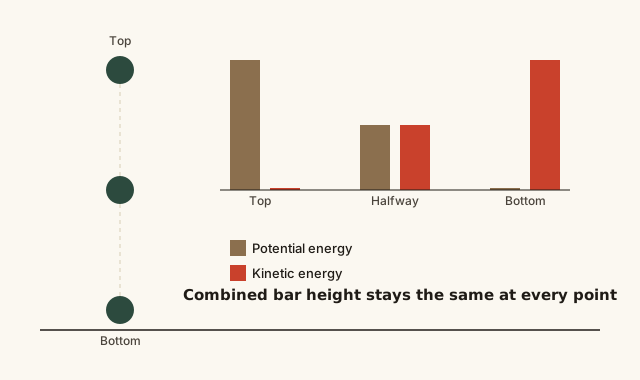
At the top, the ball's energy bar is entirely potential energy and the kinetic bar is empty. Partway down, the bars are roughly even. At the bottom, potential energy has shrunk to zero and kinetic energy has grown to fill the same total height — the combined bar height, representing total energy, never changes.
Common mistakes
Common Mistakes
Saying energy gets 'used up' or 'lost' when something stops moving.
→ Energy converts, it doesn't vanish — a stopped object's kinetic energy became heat, sound, or another form, and the total is unchanged.
Assuming doubling an object's speed doubles its kinetic energy.
→ Kinetic energy depends on velocity squared (KE = ½mv²) — doubling speed quadruples kinetic energy.
Thinking potential energy only means gravitational (height-based) energy.
→ Potential energy is any stored energy based on position or condition — a stretched spring, a compressed gas, and a charged battery all store potential energy without any height involved.
Common misconception
“Some machines can create free energy or run forever without any energy input, if designed cleverly enough.”
Every real system loses some energy to friction, air resistance, or electrical resistance, which converts useful mechanical or electrical energy into heat that can't easily be recovered. No design eliminates this — perpetual motion machines have been proposed for centuries and every single one, once tested rigorously, has violated the law of conservation of energy or the second law of thermodynamics. Patent offices in the US and UK now reject perpetual motion machine applications outright without even testing the device.
Try it yourself
What to do next
What to do next
- Try the calculators above with the same object at different speeds to feel how much faster kinetic energy grows than speed does.
- Next time you see regenerative braking mentioned in a car's specs, remember it's just conservation of energy applied deliberately instead of wasted as heat.
- Watch a pendulum or swing set and try to spot the exact instant its kinetic energy is at maximum — it's the lowest point, moving fastest.