How Hydration Actually Affects Physical Performance
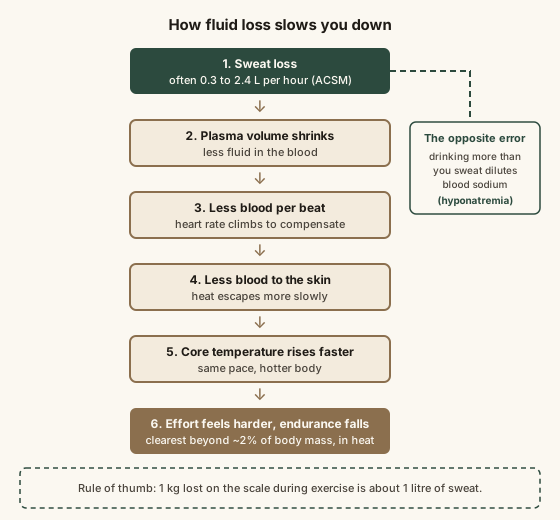
Sweating during exercise removes water from the blood plasma. With less plasma, the heart pumps less blood per beat, heart rate rises to compensate, and less blood can be sent to the skin to release heat, so core temperature climbs faster at the same pace and effort feels harder. The American College of Sports Medicine's position stand on exercise and fluid replacement reports that body water losses above roughly 2% of body mass can degrade aerobic performance, most clearly in warm or hot conditions, while effects in cool weather are smaller; reviews find effects on strength and power are smaller and less consistent. Sweat rates vary widely, often 0.3 to 2.4 litres per hour, so weighing before and after exercise (1 kg lost is about 1 litre) is the practical way to estimate personal losses. The opposite error also matters: drinking well beyond sweat losses during long events can dilute blood sodium and cause exercise-associated hyponatremia, which is why consensus statements warn against weight gain during exercise. This article is general educational information, not medical advice.
Reading time
— 5 min
Updated
— Oct 7, 2026
Fact-reviewed
— Oct 7, 2026
This entry explains the physiology of hydration and exercise, cited to the American College of Sports Medicine, the National Athletic Trainers' Association, peer-reviewed reviews and MedlinePlus. It is general education, not medical advice. Fluid needs vary with health conditions and medications. If you have heart, kidney or other medical conditions, ask your doctor about fluids and exercise. Confusion, fainting, vomiting, severe headache or collapse during or after exercise, especially in heat, is an emergency: call your local emergency number.
Key Takeaways
Key Takeaways
1Sweat drains water from your blood plasma. With less blood, the heart pumps less per beat, heart rate climbs, and the body sheds heat more slowly.
2Per the ACSM position stand, losing more than about 2% of body mass in fluid can degrade endurance, most clearly in heat. Strength and power are affected less, and less consistently.
3Overdrinking is the opposite risk: gaining weight during long exercise can dilute blood sodium (hyponatremia). Weighing before and after is the simplest way to learn your own sweat rate.
The concept
Think of your blood as the delivery truck and the cooling system at the same time. It carries oxygen to your muscles and carries heat out to your skin. When you sweat, the water mostly comes out of your blood. Less blood means the truck is smaller, so your heart has to beat faster to deliver the same load, and there's less to spare for cooling. You get hotter sooner, and the same pace feels harder. A small loss barely matters. Once you've lost about 2% of your body weight, around 1.4 kg for a 70 kg person, endurance usually starts to suffer, especially on a hot day. But drinking far more than you sweat isn't safe either.
Halfway through a hot run at a steady pace, a runner's heart rate keeps creeping up even though their speed hasn't changed. What's the main physiological reason?
Worked examples
Example 1: Measuring a sweat rate (baseline case)
A 70 kg runner weighs in before a one-hour run on a warm morning, drinks 0.3 litres during it, and weighs 68.8 kg afterwards. The scale shows 1.2 kg lost, which is about 1.2 litres of fluid. Add back the 0.3 litres they drank and the sweat rate is about 1.5 litres per hour. The net loss is 1.2 ÷ 70 = 1.7% of body mass, just under the roughly 2% range where the ACSM and NATA say endurance tends to suffer. On a longer or hotter run at the same sweat rate, they'd cross it. This weigh-in method is the one both position statements describe for estimating individual losses.
Example 2: The marathoner who drank too much (edge case)
A 60 kg recreational marathoner expects a five-hour finish and, worried about dehydration, drinks a full cup at every aid station. Their sweat rate at that slow pace in cool weather is modest, so intake outpaces losses. They finish 1 kg heavier than they started. That gain is the red flag the 2015 hyponatremia consensus statement describes: extra water has diluted blood sodium. Mild cases may cause bloating, nausea or headache; severe cases cause confusion, seizures or collapse and need emergency care. The lesson isn't "drink less" across the board. It's that slower, longer events in cool weather are where overdrinking risk is highest, and weight gain during exercise is the clearest warning sign.
Example 3: Same loss, different sport and weather (applied case)
An 80 kg soccer player loses 2.4 kg during a 90-minute match on a hot afternoon: 2.4 ÷ 80 = 3% of body mass. That's well past the 2% range, and in heat the ACSM position stand reports the clearest drops in endurance and in the ability to repeat high-intensity running late in a game. Compare a weightlifter who loses 0.8 kg (1%) in a cool gym session. For short, maximal lifts, reviews such as Judelson and colleagues (2007) find effects on strength and power are smaller and less consistent. The same physiology applies to both, but how much it matters depends on the duration, the heat, and how far past 2% the loss goes.
Quick check
A 75 kg cyclist weighs 73.5 kg after a two-hour ride in which they drank nothing. Roughly what share of body mass did they lose, and is it in the range linked to reduced endurance?
How it works (visual)
How fluid loss slows you down
Common mistakes
Common Mistakes
✕
Following a fixed 'drink X litres per hour' rule copied from someone else.
→ Sweat rates vary several-fold. Weigh yourself before and after typical sessions to learn your own losses, as the ACSM and NATA suggest.
✕
Believing more fluid is always safer.
→ Drinking well beyond sweat losses, especially in long, slow events, can cause hyponatremia. Finishing heavier than you started is a warning sign.
✕
Starting hard exercise already dehydrated, then trying to catch up mid-session.
→ Start sessions normally hydrated. It's much harder to reverse a deficit during exercise, when the gut absorbs fluid more slowly.
✕
Assuming the same fluid loss matters equally in every sport and climate.
→ Endurance in heat is the most sensitive case. Short strength sessions in cool conditions are much less affected.
Common misconception
“If you're thirsty, it's already too late, and any amount of dehydration ruins performance.”
Small losses are normal and mostly harmless. The ACSM position stand ties clear declines in aerobic performance to losses above about 2% of body mass, most strongly in heat, and reviews find strength and power are affected less consistently. Thirst is an imperfect signal, but the 2015 hyponatremia consensus statement notes that drinking to thirst protects many people in long events from the more dangerous error of overdrinking. The useful question isn't "am I slightly dehydrated?" but "how much do I usually lose, and in what conditions?"
What to do next
What to do next
Weigh yourself (minimal clothing, after using the toilet) before and after a typical session, and add back what you drank to estimate your hourly sweat rate.
Repeat the check in hot and cool weather. Your numbers will differ, and the hot-weather number is the one that matters most.
Treat finishing a long session heavier than you started as a sign you drank more than you needed.
Use urine colour, thirst and body weight together as rough checks; no single sign is perfect.
If you have a medical condition or take medications that affect fluid or sodium balance, ask your doctor before changing how much you drink. This article isn't medical advice.
FAQ
FAQ
Related terms
Related terms
Plasma volume
The liquid portion of the blood. Sweat draws water from it, which is why heavy sweating reduces how much blood the heart has to pump.
Sweat rate
How much fluid a person loses through sweat per hour. It varies with body size, intensity, heat, humidity, clothing and fitness, often from about 0.3 to 2.4 litres per hour.
Cardiovascular drift
The gradual rise in heart rate during steady exercise, at the same pace, as plasma volume falls and the body sends more blood to the skin for cooling.
Exercise-associated hyponatremia
An abnormally low blood sodium level during or after exercise, most often from drinking more fluid than the body loses. It can be dangerous and needs medical care.
Euhydration
A normal state of body water, neither meaningfully dehydrated nor overloaded with fluid.
This entry was researched from public sources and drafted with AI-assisted tools, then edited — errors are still possible. Spot one, or want a topic covered? Read our disclaimer.
 KnowThis