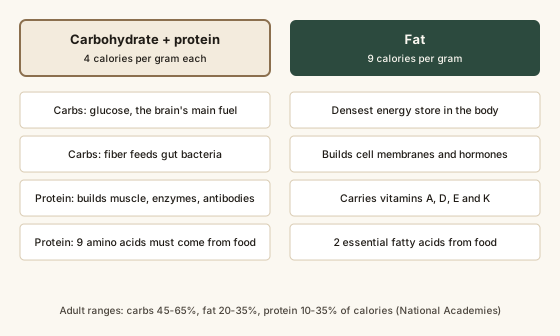
Macronutrients are the three nutrients the body needs in large amounts: carbohydrate, protein and fat. Carbohydrates provide 4 calories per gram and are broken down mainly to glucose, the brain's preferred fuel; the National Academies set the adult RDA for carbohydrate at 130 grams a day, based on the brain's glucose needs, and fiber, a carbohydrate humans can't digest, feeds gut bacteria. Protein also provides 4 calories per gram and supplies amino acids for muscle, enzymes, hormones and antibodies; 9 of the 20 amino acids are essential and must come from food, and the adult RDA is 0.8 grams per kilogram of body weight. Fat provides 9 calories per gram, is the body's densest energy store, forms cell membranes and some hormones, and is needed to absorb vitamins A, D, E and K; linoleic acid and alpha-linolenic acid are essential fatty acids. The National Academies' Acceptable Macronutrient Distribution Ranges for adults are 45–65% of calories from carbohydrate, 20–35% from fat and 10–35% from protein. Alcohol also provides calories (7 per gram) but isn't a nutrient the body needs.
Reading time
— 5 min
Updated
— Sep 27, 2026
Fact-reviewed
— Sep 27, 2026
Key Takeaways
Key Takeaways
1Carbohydrates are the main fuel for your brain and hard-working muscles; fiber, a carbohydrate you can't digest, feeds gut bacteria.
2Protein supplies the amino acids that build and repair muscle, enzymes, hormones and antibodies.
3Fat is your densest energy store (9 calories per gram vs 4), builds cell membranes and is needed to absorb vitamins A, D, E and K.
The concept
Macronutrients are the three things in food you need by the handful rather than the pinch: carbohydrates, protein and fat. All three give you energy, but each has a different main job. Carbs are fast fuel: your brain runs mostly on the sugar they break down into, and muscles lean on them during hard exercise. Protein is building material, used to repair muscle, make enzymes and keep your immune system stocked. Fat is long-term storage and structure: it packs the most energy per bite, forms the walls of every cell, and carries certain vitamins into your body. You need all three. The debate is mostly about how much of each and from which foods. If you train hard, fluid matters alongside fuel: how hydration affects physical performance explains why even modest fluid loss makes the same effort feel harder.
Every Nutrition Facts label lists grams of each macronutrient. Multiply by 4, 4 and 9 and you'll land close to the label's calorie count (see how to read a nutrition label).
Try it yourself
Calories from macronutrients
Approximate calories250
Uses 4 kcal/g for carbohydrate and protein and 9 kcal/g for fat. Labels round, and fiber provides fewer calories, so results are approximate.
Quick check
Why is fat the body's main long-term energy store rather than carbohydrate?
Worked examples
Example 1: Checking a label (baseline case)
A granola bar label lists 30 g carbohydrate, 10 g protein and 10 g fat. Calories from each: 30 × 4 = 120 from carbs, 10 × 4 = 40 from protein, 10 × 9 = 90 from fat, for 250 total. As shares: 48% carbohydrate, 16% protein and 36% fat. Fat is only 20% of the bar's macronutrient grams but 36% of its calories, because each gram carries more than twice the energy. That's why small amounts of oil, butter or nuts add calories quickly.
Example 2: Protein needs by body weight (edge case)
The RDA of 0.8 g per kilogram means a 70 kg (154 lb) adult needs about 56 g of protein a day, and a 90 kg (198 lb) adult about 72 g. A common mistake is applying 0.8 g per pound, which gives 123 g for the 70 kg person, more than double. Higher intakes aren't necessarily harmful for healthy people and are often recommended for older adults and strength athletes (roughly 1.0–1.6 g/kg in many sports nutrition guidelines), but the unit matters, and people with kidney disease may need to limit protein.
Example 3: Building a day within the ranges (real-world use)
Someone eating 2,000 calories a day can fit anywhere in these ranges: 225–325 g carbohydrate (45–65%), 44–78 g fat (20–35%) and 50–175 g protein (10–35%). A sample day: oatmeal with milk and berries, a lentil and rice bowl with vegetables and olive oil, Greek yogurt, and salmon with potatoes and salad lands around 50% carbohydrate, 30% fat and 20% protein, well within all three ranges, with fiber from the oats, lentils, fruit and vegetables. The ranges leave room for very different cuisines; the quality of each source (whole grains vs refined sugar, fish vs processed meat) matters as much as the percentages. Fiber is a good example: it's a carbohydrate your body can't digest, so it feeds your gut microbes instead, as what gut health actually means explains.
Quick check
In the granola bar, why is fat 36% of calories but only 20% of the macronutrient grams?
How it works (visual)
What each macronutrient does
Common mistakes
Common Mistakes
✕
Treating any one macronutrient as the enemy.
→ All three have essential roles. Focus on the quality of sources and total calories rather than eliminating a macronutrient.
✕
Confusing grams per pound with grams per kilogram for protein.
→ The RDA is 0.8 g per kilogram. Divide your weight in pounds by 2.2 to get kilograms first.
✕
Cutting fat so low that meals barely contain any.
→ Include some fat, such as olive oil, nuts or fish, so vitamins A, D, E and K can be absorbed.
Common misconception
“Carbs make you gain weight; fat makes you fat.”
Weight change depends on total energy intake versus expenditure over time, and calories from any macronutrient count. Fat is more calorie-dense, so it adds up faster by weight, and refined carbohydrates and sugary drinks are easy to overconsume. But whole-food sources of both, such as whole grains, legumes, fruit, nuts and olive oil, are part of eating patterns linked to good health. The type and amount matter more than the macronutrient label.
What to do next
What to do next
Check the macronutrient grams on three foods you eat often and multiply by 4, 4 and 9.
Work out your protein RDA: your weight in kilograms × 0.8.
Swap one refined-carb food this week for a high-fiber one (oats, beans, whole-grain bread).
Make sure most meals include a little fat so fat-soluble vitamins get absorbed.
FAQ
FAQ
Related terms
Related terms
Macronutrient
A nutrient needed in large amounts (grams a day) that provides energy: carbohydrate, protein or fat.
Essential amino acid
One of 9 amino acids the body can't make, so it must come from food.
Essential fatty acid
A fat the body can't make: linoleic acid (omega-6) and alpha-linolenic acid (omega-3).
AMDR
Acceptable Macronutrient Distribution Range: the share of calories from each macronutrient linked to lower chronic disease risk while meeting nutrient needs.
Glycogen
The stored form of glucose in the liver and muscles, used for quick energy.
This entry was researched from public sources and drafted with AI-assisted tools, then edited — errors are still possible. Spot one, or want a topic covered? Read our disclaimer.
 KnowThis