 KnowThis
Key Takeaways
Key Takeaways
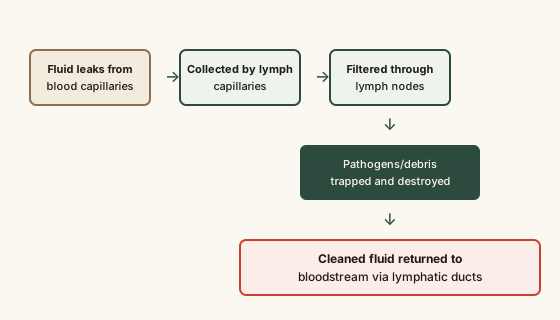
- 1The lymphatic system collects fluid that leaks from blood vessels into tissue, filters it through lymph nodes, and returns it to the bloodstream.
- 2Unlike the circulatory system, it has no central pump like the heart — it relies mainly on muscle movement and one-way valves to keep fluid flowing.
- 3Lymph nodes swelling is usually a sign the immune system is actively responding to something trapped there, not a problem with the lymph node itself.
The concept
Because lymph flow depends so heavily on muscle movement rather than a dedicated pump, regular physical activity has a real, mechanical role in supporting healthy lymphatic drainage — not just a general wellness claim.
Someone notices a lymph node in their neck feels swollen and slightly tender while they have a cold. What is this swelling most commonly a sign of?
Worked examples
Example 1: A minor cut becoming inflamed (baseline case)
Example 2: Swollen lymph nodes with no obvious cause (edge case / variation)
Example 3: Lymphedema after lymph node removal (real-world / applied case)
Why can removing lymph nodes (sometimes necessary in cancer treatment) lead to chronic swelling (lymphedema) in the affected area?
How it works (visual)
Common mistakes
Common Mistakes
Assuming any swollen lymph node signals a serious problem.
→ Understand that temporary swelling during a known infection is a normal immune response — persistent, unexplained swelling is what warrants medical evaluation.
Believing lymphatic drainage products or massages can 'detox' the body in a medically meaningful way.
→ Be skeptical of specific detox claims — the lymphatic system does real filtering work, but that's a distinct claim from marketed 'lymphatic detox' products, which generally lack rigorous supporting evidence for those specific claims.
Overlooking the connection between physical inactivity and fluid buildup.
→ Recognize that regular movement has a real, mechanical role in supporting lymph flow, since the system lacks its own dedicated pump.
Common misconception
“The lymphatic system is basically a minor, secondary part of the body that doesn't do much on its own.”
It performs essential, non-optional functions: draining excess tissue fluid that would otherwise accumulate, filtering that fluid for pathogens as a core part of immune defense, and — in the small intestine specifically — absorbing certain dietary fats. When part of this system is compromised, as in lymphedema after lymph node removal, the real consequences make clear it's doing continuous, necessary work, not something the body could simply do without.
What to do next
What to do next
- If a lymph node stays swollen for more than a couple of weeks without an obvious infection, or is accompanied by other unexplained symptoms, see a doctor rather than assuming it's routine.
- Stay physically active — regular movement supports lymph flow mechanically, since the system has no dedicated pump of its own.
- Be skeptical of specific medical claims made by 'lymphatic detox' products — verify any specific health claim against a credible medical source before acting on it.
- This is general educational information, not medical advice — for any specific health concern, consult a qualified healthcare provider.