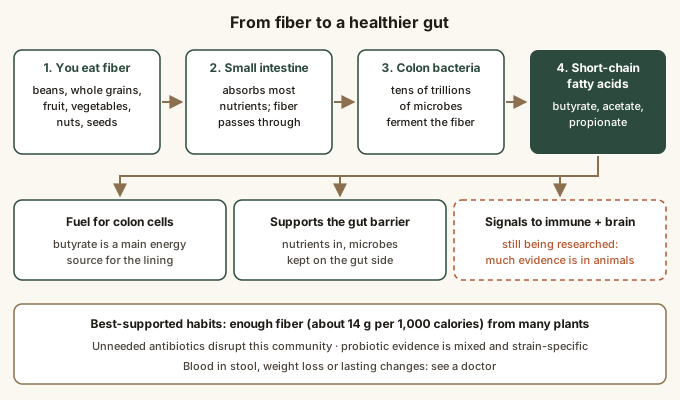
Gut health has no single clinical definition. In practice it means two things: a digestive tract that breaks down food, absorbs nutrients and moves waste without persistent trouble, and a gut microbiome, the trillions of bacteria and other microbes living mostly in the large intestine, that is diverse and well fed. Those microbes ferment dietary fiber the body can't digest into short-chain fatty acids such as butyrate, which fuel the cells lining the colon and help keep the gut barrier intact. Research links the microbiome to digestion, immune function and signaling with the brain, but much of the evidence beyond digestion comes from animal or observational studies. The best-supported habits are eating enough fiber from a variety of plants (U.S. Dietary Guidelines suggest about 14 grams per 1,000 calories), and using antibiotics only when they're needed. Probiotic supplements have mixed evidence, and persistent digestive symptoms belong with a doctor.
Reading time
— 6 min
Updated
— Oct 9, 2026
Fact-reviewed
— Oct 9, 2026
This entry explains what the research says about gut health, cited to NIH, CDC and peer-reviewed studies. It is health literacy, not medical advice, and it can't diagnose or treat anything. Persistent digestive symptoms, or questions about supplements, diet changes or antibiotics for your situation, belong with your doctor.
Key Takeaways
Key Takeaways
1"Gut health" isn't a diagnosis. It means a digestive tract that works without persistent trouble, plus a diverse, well-fed community of microbes living mostly in your colon.
2Those microbes eat the fiber you can't digest and turn it into short-chain fatty acids like butyrate, which fuel the cells lining your colon. Feed them fiber from many different plants and they do more of that.
3The strongest evidence supports fiber, plant variety and avoiding unnecessary antibiotics. Probiotic supplements and gut-brain claims are promising but far less proven than the marketing suggests.
The concept
Think of your gut as a long processing plant with a garden at the end. The first part, your stomach and small intestine, breaks food down and pulls out most of the nutrients. Whatever your body can't break down, mostly fiber, moves on to the large intestine. That's where the garden is: tens of trillions of bacteria and other microbes. They eat the leftovers and, in return, make small acids that feed the cells lining your colon and help keep that lining sealed. So when people say "gut health," they really mean two things. Is the plant running smoothly, without ongoing pain, bleeding or big changes in your bathroom habits? And is the garden diverse and well fed? You can't buy a garden in a capsule. What you can do is feed it, mostly with fiber from lots of different plants, and avoid wiping it out with antibiotics you don't need.
Gas after a bean-heavy meal is the system working: it's a by-product of bacteria fermenting fiber. Ongoing pain, bleeding or a lasting change in habits is different, and common digestive upsets explains where everyday discomfort ends and a doctor's visit begins.
Quick check
What is the main way gut bacteria help the colon itself?
Worked examples
The people below are hypothetical. Fiber values are approximate figures from standard food composition data; labels vary.
Example 1: Doing the fiber math (baseline case)
The Dietary Guidelines for Americans set fiber targets at about 14 grams per 1,000 calories, so roughly 28 grams on a 2,000-calorie pattern. Most Americans fall well short. Sam's typical day: white toast, a deli sandwich, pasta for dinner. That's about 12 grams. A few swaps change it: a cup of cooked oatmeal (about 4 g), an apple with skin (about 4 g), half a cup of black beans in the lunch (about 7.5 g), whole-grain bread instead of white (adds about 3 g) and a cup of cooked broccoli at dinner (about 5 g). Sam lands near 28 grams without a single supplement. MedlinePlus notes one practical catch: add fiber gradually and drink enough fluid, because a sudden jump often means extra gas and bloating while the gut adjusts.
Example 2: After antibiotics (edge case)
Priya takes a prescribed antibiotic for a bacterial infection. Antibiotics can't tell harmful bacteria from helpful ones, so her gut community takes a hit too. Mild, short-lived loose stools are common. But CDC lists recent antibiotic use as a major risk factor for C. diff, a bacterium that can take over when competitors are wiped out and cause severe diarrhea. The useful lesson isn't "avoid antibiotics": when they're needed, they're essential. It's to take them only when a clinician prescribes them, to finish the course as directed, and to call the doctor about frequent, watery diarrhea, fever or belly pain during or after treatment. Whether a probiotic would help her case is a question for that doctor, since NCCIH reports the evidence depends on the strain and the situation.
Example 3: Counting plants, not pills (applied)
Marcus sees a $45-a-month "gut health" supplement. Before buying, he tries a free experiment: counting how many different plant foods he eats in a week, including grains, beans, nuts, seeds, herbs, fruit and vegetables. Week one: 9. Data from the American Gut Project, a large citizen-science study, found people eating 30 or more plant types a week had more diverse microbiomes than those eating 10 or fewer. That's an association, not proof, but it points the same way as the fiber evidence. Marcus adds a mixed-bean chili, a bag of mixed nuts, a different fruit each day and herbs in cooking, and reaches 24 by week four. A small 2021 Stanford trial also found that adding fermented foods such as yogurt, kefir, kimchi and sauerkraut for 10 weeks raised microbiome diversity and lowered several inflammation markers. His plan costs less than the supplement and has better evidence behind it.
Quick check
Which change has the strongest evidence for supporting a healthy gut microbiome?
How it works (visual)
From fiber to a healthier gut: how your microbes do the work
Common mistakes
Common Mistakes
✕
Treating a probiotic as a fix-all.
→ Probiotic effects are strain- and condition-specific, and in the U.S. most are sold as supplements without FDA approval to treat anything. Ask your doctor whether a specific product has evidence for your situation.
✕
Jumping from low fiber to very high fiber overnight.
→ Increase fiber gradually over a few weeks and drink enough fluid, so the gut can adjust without as much gas and bloating.
✕
Self-managing warning signs with diet changes.
→ Blood in the stool, unexplained weight loss, ongoing pain or a lasting change in bowel habits need a medical evaluation, not a gut-health plan.
✕
Reading mouse studies as human results.
→ Much gut-brain and microbiome research is in animals. Look for human trials, and note how many people were in them.
Common misconception
“There's a single "healthy microbiome" and a test or supplement can get you there.”
The NIH Human Microbiome Project found that healthy people carry very different mixes of microbial species, so there's no one ideal profile to match. Researchers look instead at diversity and at what the community does, such as fermenting fiber. No test can currently tell a healthy person what their ideal microbiome should be, and no supplement has been shown to build one. The habits with the best support are ordinary ones: enough fiber, plenty of plant variety, and antibiotics only when they're needed.
What to do next
What to do next
Check a few days of food labels or a free tracker to estimate your fiber, then compare it with the Dietary Guidelines target of about 14 grams per 1,000 calories.
Count the different plant foods you eat in one week as a baseline, and add one or two new ones each week.
Raise fiber gradually and drink enough water as you do.
Never ask for antibiotics for a cold or flu; they treat bacterial infections, not viruses.
Before buying a probiotic or gut test, ask your doctor or pharmacist whether it has evidence for your specific situation.
See a doctor for blood in the stool, unexplained weight loss, ongoing pain or a lasting change in bowel habits.
FAQ
FAQ
Related terms
Related terms
Gut microbiome
The community of bacteria, archaea, fungi and viruses living in the digestive tract, mostly in the large intestine, along with their genes.
Dietary fiber
Parts of plant foods that human enzymes can't digest. Some types are fermented by gut bacteria in the colon; others add bulk to stool.
Short-chain fatty acids
Small molecules such as butyrate, acetate and propionate that gut bacteria produce when they ferment fiber. Butyrate is a main energy source for cells lining the colon.
Gut barrier
The single layer of cells lining the intestine, plus its mucus coat, that lets nutrients through while keeping microbes and their products on the gut side.
Probiotic
Live microorganisms intended to provide a health benefit. In the U.S. most are sold as dietary supplements or in foods, not as approved drugs.
Prebiotic
A substance, often a type of fiber, that selectively feeds beneficial gut microbes.
Enteric nervous system
The network of hundreds of millions of nerve cells in the wall of the digestive tract that controls gut movement and communicates with the brain.
This entry was researched from public sources and drafted with AI-assisted tools, then edited — errors are still possible. Spot one, or want a topic covered? Read our disclaimer.
 KnowThis